How Digitalization Boosts the Patient Experience

“The good physician treats the disease; the great physician treats the patient who has the disease. – William Osler, a famous Canadian physician” How true these lines are! It is so necessary to think beyond the clinical needs of the patients.
It’s all about how the patients are treated and made to feel. Let’s consider a hypothetical scenario. There are two highly experienced and popular doctors in the city, Mr. David and Mr. Benjamin. Recently, Mr. David has started incorporating some intelligent software systems in healthcare that use digitalization to improve the overall patient experience. To ensure that patients don’t wait in the long queues, Mr. David has started using a patient scheduler mHealth app. For saving their medical records, bills, etc., Mr. David has incorporated a digital system, so that even if patients forget or misplace their documents, all the records will remain intact. However, Mr. Benjamin is still following the same traditional methods to approach and treat the patients.
What do you think? Whom will the patients prefer over time?
Technology is making a massive difference in the healthcare industry. Automation, healthcare IoT and other technological advances are greatly improving the medical practices and ultimately the patient experience.
What Factors Enhance the Patient Experience in Hospitals?
Along with in-hospital experience, patients are also influenced by pre and post-treatment experience. Technology can be used to engage the patients by providing them proactive information and guidance about their health conditions or appointments with doctors through dedicated medical apps. There are mobile apps that make it easier for patients to approach the facilities of the hospital. Likewise, to get feedback about what makes them satisfied, it is necessary to talk to them and also conduct surveys to get better information.
Today, advanced technology is playing a crucial role in enhancing the patient experience. Using digital transformation and IoT in healthcare can help to organize the patients as well as the hospital staff. A mobile app that is designed for scheduling doctor appointments enables the patients to do it sitting at their homes in their available time zones. Digitally managed clinic staff schedule software improves the communication between staff and enables them to handle more tasks without any hassle. Electronic medical records or EMRs are helpful in saving digital versions of different medical papers, charts, etc. related to patients.
When hospitals and clinics incorporate such tools and technologies, it certainly improves the quality and efficiency of care. However, the safety and security of the data is an important factor in healthcare. So, healthcare apps need to be HIPAA compliant. The data like personal information of patients (like their names, contact details, etc.) and other medical information in the hospitals must be protected. This can be assured when the apps are HIPAA compliant.
How Digital Technology Influences Patient Experience?

Digital technology is a key enabler of a successful patient journey. Many hospitals have already started using certain tools, software, apps, etc. for enhancement of overall patient experience; a few of them are specified here.
Electronic Medical Records (EMRs)
EMRs have been playing an important role in improving the healthcare industry. EMR is a tool that digitalizes patient records and keeps track of the vital information related to patients. These files and records can be accessed and used by concerned doctors to provide the care quickly and accurately. EMRs increase efficiency and they reduce documentation errors. The doctors and other staff don’t need to spend time in searching records in files, as the information is available at the click of fingertips through EMRs.
Practice Management System in Healthcare
Practice management system in healthcare (or PMS) is software that deals with several day-to-day tasks of clinics and hospitals. PMS helps to automate some tasks like paying and tracking bills, documenting clinical tasks, maintaining a list of insurance payers, measuring practice performance of doctors, etc. It can also be used in automating the tasks at multiple branches of a hospital. Practice management system in healthcare helps to streamline many time-consuming tasks which ultimately increases productivity and provides better ROI.
A good example of PMS is an emergency physician scheduler mobile app. Such an app connects the patients to doctors within minutes in case of emergency and their lives can be saved. At other times, the doctors can guide the patients to take precautions to avoid any bad health conditions.
Investment in a PMS will always be a cost-effective decision as it helps to manage multiple tasks of the staff members. Wearable technology, monitoring equipment, etc. embedded with IoT in healthcare play a vital role in tracking patient health. The reports of their health are automatically saved and reminders are sent to the concerned departments. When PMS is integrated with EMR, scheduling different tasks, billing, etc. becomes much faster and easier.
Billing to Payers and mHealth
When patients have any insurers or third-party payers involved while paying the hospital bills, billing to payers and mHealth (mobile health) facility automates some tasks. Depending on the insurance policy, that the patient has a tie-up with, a particular billing amount is automatically deducted and the patients can instantly pay the remaining amount. mHealth is also useful in guiding and educating the patients, giving reminders of appointments, taking feedbacks from them, providing remote care to them, etc. It is necessary to develop mHealth apps that are HIPAA compliant for the protection of all the medical data. HIPAA compliant apps build trust in patients.
Home Healthcare and e-Prescription
Home healthcare includes various services like monitoring health status, assisting in daily activities, medical tests, wound care, etc. which are provided to patients in their homes. An example of a home healthcare app is Phlex65. The senior citizens may find it difficult to get professional caregivers instantly in case of an emergency. Phlex65 connects them with caregivers in real-time whenever necessary. Caregivers can guide them in daily activities like personal care grooming, assisting in the transfer, taking medicines on time, cooking, assistance with bathing, light housekeeping, etc. The caregivers can also take them to doctors in case of emergency.
In case of emergency, when patients cannot visit a hospital, the doctors can instantly send e–Prescription to them for time being a relief. It is directly sent to the pharmacies through dedicated software. Instead of waiting for handwritten prescriptions, the electronic prescriptions also help to avoid the errors which sometimes result in the selection of incorrect medicine or dosage and omission of certain information.
As a preventive measure, people can use wearable devices like heart rate and blood pressure monitoring cuffs, glucometer, etc. to check their fitness levels, track heartbeats, monitor glucose levels, etc. Whenever the levels are below or above the normal limits, these wearable devices send the data to patients and make them aware of it. The patients can immediately take e-Prescription from the doctors and consume preventive medicines. IoT plays a crucial role here as devices are connected to software systems to provide accurate health information.
Are You Interested in Building a Top-Class Website or Mobile App?
Conclusion
Profits of a hospital are directly proportional to the satisfaction of patients. So, it has become crucial for hospitals to be proactive and incorporate advanced technology. To survive in the cut-throat competition, hospitals have to take steps to deliver special care experience to their patients. Digital technologies like EMRs, PMS, patient scheduler apps, e-Prescription, mHealth, etc. are transforming the healthcare industry at a fast pace. They give more power to the patients to choose the best for them in their convenience. These are more efficient and save a lot of time of both- the patients and hospital staff.
Ultimately, the hospitals delivering the best patient experience using digital tools will be the ones who excel and profit.
Why HIPAA Compliance plays a major role in protecting data privacy in Healthcare Apps
The modern era of digitalization has brought about transformative changes in the healthcare sector. Global spending on healthcare services is on the rise, a bright future awaits this industry for sure! Healthcare service providers are hiring Healthcare App Development Companies and freelance Healthcare App Developers and leveraging advanced technologies to deliver premium-quality services to their patients. Advanced healthcare mobility solutions are helping the users to actively track their basic health statistics like tracking their heart rate, checking their blood glucose/ BMI level, availing online doctor consultation services via the app, appointment booking, etc. Moreover, both patients and practitioners can access electronic Health Records/electronic medical records whenever required.
But, despite the convenience quotient of using digital healthcare services via an app, data security happens to be one of the greatest concerns of the healthcare industry. These medical apps are susceptible to data breaches, hacking, cyber-attacks, etc. which can pose a risk to the sensitive medical data of patients, causing massive losses to medical facilities. Therefore, healthcare organizations should be more vigilant of their software and cyber-security practices. For avoiding theft, misuse, and fraud of the patients’ data, healthcare applications that have patient’s sensitive data have to be HIPAA compliant and strictly adhere to the HIPAA rules and regulations in the US
What is HIPAA?
HIPAA refers to the Health Insurance Portability and Accountability Act and is issued by federal regulators. This Act mandates a set of safety and privacy standards to protect the confidentiality and availability of medical records and sensitive patient information. Initially, the purpose of introducing this act was to improve the efficiency and effectiveness of the medical organizations in the U.S. With time, several rules were added to the Act to protect the individually identifiable health information commonly known as Protected Health Information (PHI). These rules influence the functioning and security protocol of healthcare mobile applications.
The entities covered under the HIPAA Act are health plans, healthcare clearinghouses, and healthcare providers that use electronic media for transmitting data such as health claims, coordination of benefits, referral authorizations, etc. These entities may comprise small/large organizations, institutions, research centers, individual practitioners, and even government agencies.
How HIPAA Compliance plays a major role in protecting data privacy in Healthcare Apps?
Adhering to HIPAA for data privacy is federally mandated for healthcare facilities and other Healthcare IT service providers such as healthcare mobile app development services and mHealth development services. So, let’s understand why HIPAA compliance plays a major role in protecting data privacy in Healthcare Applications.
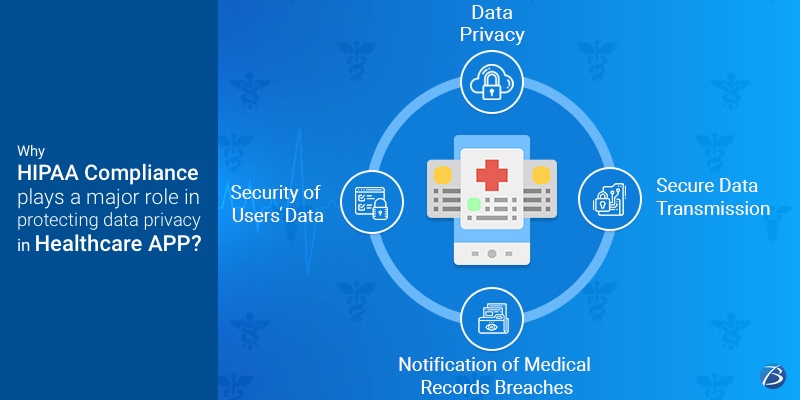
Data Privacy
The importance of capturing data has risen over the years to improve the overall healthcare operations, using advanced technologies like the Internet of Things (IoT), RFID technology Robotic Process Automation (RPA), Chatbots, etc. The personal information of patients, their contact details, and medical reports are recorded and saved digitally by several hospital bodies. As such, maintaining data privacy is important to ensure that only the relevant information is shared with the right set of people and at the proper time. This strategy helps providers to build trust amongst the patients.
HIPAA compliant apps abide by strict rules to ensure data security and privacy. These apps are hosted on HIPAA-compliant servers to ensure that all the HIPAA standards are fulfilled correctly. They have to display a link in the privacy policy of the mobile app, while the users download the app. The apps take consent from the patients/users before storing their information. Furthermore, the users are informed about how their data will be used.
Security of the healthcare data
Data breaches can lead to disastrous consequences for patients, hospitals as well as healthcare facilities. Fraudulent insurance claims, extortion, or identity thefts are likely, and once this data is hacked/lost, it can be devastating for both patients and medical providers. So, it is essential to secure patient data stored in electronic medical record systems, data concerning the hospital workforce, or other back-office data.
A HIPAA compliant mobile app solution ensures the safety and privacy of healthcare data. The medical app users can access the data only through a secure login procedure. Additionally, two-factor authentications are applied for more security and all data presented in the app can be only accessed using a secure PHI key. Besides, in case the mobile device is lost or stolen, personal user information cannot be accessed easily owing to the advanced security standards and encryption. Data stored on database servers are also encrypted to prevent easy access to healthcare data.
Secure transmission of data
In many large Healthcare Organizations with multiple branches, the medical data needs to be shared with several doctors or concerned authorities. If such hospitals use a mobile app for data transmission, it must be as per HIPAA rules and regulations. Moreover, hospital bodies should audit data from time to time for ensuring that the user data in the app isn’t accessed inappropriately or modified abruptly. Furthermore, in the case of remote monitoring of patients using wearable technology, like IoT or AI; only the required data will be transferred to ensure the security of data. For this reason, the communication networks of the apps possess integrity control mechanisms.
A HIPAA compliant software solution ensures that the amount of sensitive data stored in them has access limitations when the device is carried outside the hospital premises. Additionally, when users delete these apps, any related health data is deleted completely from their device. Remember that HIPAA laws apply only to the apps using PHI i.e. protected health information. Therefore, the data transferred from an app that does not deal with personally identifiable information need not be protected under HIPAA guidelines.
Notification of healthcare records breaches
Today, there is a high possibility of sensitive Healthcare data getting fraudulently accessed by hackers. However, if the Healthcare app is HIPAA compliant, it needs to notify affected individuals about the breach of data without unreasonable delay and this notification should not be sent later than 60 days. This policy is mandatory for all apps that are adhering to HIPAA Compliance to abide by data breach notification laws. As per these laws, eligible data breaches are obliged to alert the users or relevant parties.
Some of the data breaches may not cause serious repercussions to medical facilities. In case any disclosure of information, unauthorized access to it, or loss of personal information is bound to cause serious damage, then such breaches are known as eligible data breaches. They can cause financial losses or even damage the reputation of the medical organization. So, the mobile app they employ should be HIPAA compliant and should send prompt notifications to users.
Are You Interested in Building a Top-Class Website or Mobile App?
Key Takeaways:
Today, data is the biggest asset for any industry vertical, and healthcare bodies are no exception to it. Today, most hospitals implement diverse innovative digital technologies to deliver improved services to their patients. However, the medical data handled by apps are vulnerable to security and privacy threats. In order to protect this data, these digital healthcare apps must follow the HIPAA guidelines. As per HIPAA compliance, the covered entities need to administer physical, technical as well as administrative safeguards for PHI in place for ensuring privacy, integrity, confidentiality, and security of healthcare data. Therefore, while hiring a Healthcare app Development Company for tailoring an outstanding app for your medical facility, you must necessarily follow the standard HIPAA regulations.