Estimating Prices of Offshore Software Services: A Guide for US Companies!

Estimating Prices of Offshore Software Services: A Guide for US Companies!
Offshore Software services
US entrepreneurs and companies have emerged as global leaders in technology over the past two decades. But surprisingly, most of US-based firms face a severe challenge due to the shortage of local software developers. At times, they cannot match with the package expectations of the local developers and this costs the companies a big-time, leading to business losses.
This is where the concept of hiring an offshore software development workforce comes into the picture. Over a few years, outsourcing has successfully resolved the critical issue of shortage of developers for US firms to a great extent. Today, these firms are availing top-notch software services from any corner of the world.
But another challenge that these companies face is that the costs of offshore software developers and the services aren’t uniform globally. Every country has different rules, practices, and cost considerations. So this blog is meant to help US businesses in this scenario. Here we have jotted down in detail the components that affect offshore development costs, region-wise hourly rates, various outsourcing models, etc. for estimating costs of offshore development services. So, let’s get started.

Fundamental Components Affecting Offshore Software Development Costs

Offshore Development Services
Size of the Software Project
Project size directly affects the development costs. The higher the number of screens, features, and other factors, the higher will be the team required and so is the cost. For instance, a small software app will have between 10-25 screens and a larger app will have 40+ screens. So, the efforts and overall costs will hike accordingly.
Technical Considerations of the Project
Technical aspects like software architecture, UI/UX designs, tools and methodology selected, third-party integrations, etc. influence the cost of the project. Ultimately, it depends on the quality of the software product you are looking for.
Time to Market
Whether you want to bring your product early to the market or want to give it more time, both will affect the development costs. Also, deadlines affect the software project in myriad ways. For example, if you have an excellent idea but the timeframe to complete the project is shorter, chances are, it will affect the R&D, planning, and overall development. In such a case, you will have to hire an extended team of experienced developers to get things done efficiently and quickly, incurring higher costs.
Skills and Expertise of the Offshore Team
The knowledge, experience, and skills of your offshore development team are directly proportional to the project costs. If your project is simple, you can hire developers with comparatively less experience and skills. But if your project is complex, you need a qualified team of senior developers and this adds to the project costs.
Additional Costs
The offshore companies may charge extra for maintenance and support, some licenses like HIPAA in healthcare apps, infrastructural costs, etc. They may even charge in case the clients want some modifications. So, such factors should be clarified beforehand to avoid any ambiguity.

Region-wise Hourly Rates of Offshore Software Development Services Worldwide

North American Regions and Western European Countries: These countries charge the highest rates as compared to most of the other regions worldwide. Have a look.
  • New York: $58.44
  • California: $58.96
  • Washington: $55.01
  • Texas: $46.11
  • UK: $71
  • France: $82
  • Netherlands: $60
  • Germany: $56
  • Sweden: $67
Eastern European Countries: The average hourly rates in these countries range from $20 – $50. These countries include:
  • Belarus
  • Poland
  • Slovakia
  • Ukraine
  • Bulgaria
  • Romania
  • Estonia
  • Czech Republic
  • Hungary
African Countries: The average hourly rates of countries in Africa range from $20 – $40; which include:
  • Tunisia
  • South Africa
  • Belarus
  • Kenya
  • Nigeria
  • Polan Egypt
  • Morocco
Countries in Latin America: The average hourly rates in Latin American countries range from $30 – $50. They include the following:
  • Brazil
  • Argentina
  • Chile
  • Costa Rica
  • Columbia
  • Panama
  • Mexico
  • Peru
Asian Countries: Asian countries have average hourly rates that range from $18 – $40. India ranks in 1st position as an offshore destination in the Asia region. The countries that provide outsourcing services include the following:
  • India
  • Indonesia
  • Malaysia
  • Vietnam
  • Thailand
  • Pakistan
  • Nepal
  • China
  • Bangladesh
  • Philippines

A Glimpse at Diverse Outsourcing Pricing Models

  1. Manager Team Model or Dedicated Development Team Model
  2. In this model, the offshore software development services provide an entire team of expert software development professionals and this team operates independently. It is managed by a Lead or Project Manager from the offshore company and is responsible for reporting to the client firm. This type of model ensures effective communication between both parties, assures high-quality results, saves time for the internal team, and eliminates the risks to a great extent. This model is the best choice when you want a highly experienced team with good technical expertise and want to lead the software development process and decision-making of the project.
  3. Extended Development Team Model or Staff Augmentation Model
  4. This business model includes the addition of offshore software developers to the existing in-house team of the clients as and when required for the project. This boosts the overall efficiency of the in-house team while being in total control of the project. This type of model helps in improving development capacity and project output. It is a scalable and flexible model and leads to a substantial reduction in costs of development, operations, and HR as well. This model is beneficial when the internal team lacks some kind of skills or expertise or when there is an urgent requirement for additional technical staff.
  5. Outsourced Product Development Model or Project-Based Model
  6. This is a traditional model which frees the client company from the entire burden of the software project. Here, the offshore team takes complete control of the project and builds the software products as per the predetermined expectations of the clients. In this model, the client company has limited control over the project. They need to provide the initial details and specifications. The benefits of this model include- (1) lower time commitment from clients’ end, and (2) exact estimations of the project timelines and final outcomes. This model is the best option when the project scope is quite static and clients do not want to handle the burden of the project management. Besides, this model is good to go with when the project you are developing isn’t your core project.

Why India Has Emerged as a Global Favourite for Offshore Development Services?

For 15 years consecutively, India has remained the top-favorite destination of the US companies and other European countries too, for outsourcing software projects. Almost 50% of fortune 500 companies prefer India alone for their IT development services. Besides the software sector, India is a popular outsourcing destination for other services like BPO, LPO, KPO, engineering, R&D, etc. So, why India? Here are the potential reasons:
  • India is one of the largest English-speaking countries in the world, as per a BBC report, and hence, there is no or very little language barrier during project development. This improves communication, collaboration, and coordination of clients and offshore teams.
  • Budget-friendliness is another major reason behind the preference of India by the US and other western countries. As compared to the local developers, the average rates of developers in India are 30-35% lower.
  • Offshore software developers in India are known for delivering excellent quality products and services that meet the required global standards. India is home to the largest number of ISO 9000 certified IT firms and 75% of the world’s CMM Level 5 certified firms.
  • The availability of a massive talent pool is another driving force that attracts US companies to India. With a population of 1.3 billion, India boasts of highly educated, experienced, and certified software professionals.
  • To meet the business requirements of the clients, most of the Indian IT companies ensure flexibility in time zones, cultural differences, etc. making the offshoring process seamless.
  • Lastly, the favorable policies of the Indian Government are like a cherry on the cake. Their policies are designed for promoting ease of business in India. Also, there is a huge infrastructural support and numerous IT parks are often being developed across the country.

Final Thoughts

Partnering with offshore software development services cuts down several costs. It also helps protect your business from any probable issues that may occur during remote collaboration with the offshore partner. But before partnering with offshore software developers in India or any other country for that matter, it is always a good idea to calculate the approximate costs of project development beforehand. So, this blog is meant to make this calculation easier. Hope this helps.
That’s it for now!
Share your thoughts in the comments section and for any assistance on offshore development, reach out to us.

Redefining the Event Industry: Top Event App Trends to Watch Out for in 2021!


Redefining the Event Industry: Top Event App Trends to Watch Out for in 2021!
Event mobile app development
The event industry has witnessed immense advancement in the last few years. Besides, since the year 2020, since the outbreak of the Covid-19 Pandemic, all types of events, big or small, are being carried out virtually. New-age techniques are being utilized to host the events successfully. Owing to this, several innovative event app trends have emerged and are making the events more interactive, engaging, and dynamic.
So, what are these trends? How are these trends impacting the event industry? Why should the event app owners or the event development services keep pace with these trends? In this blog, we are going to look at these trends and related aspects. So, without much ado, let’s begin.

Top Event App Trends for 2021 that Event App Developers and Owners Should Consider!
Event App Trends
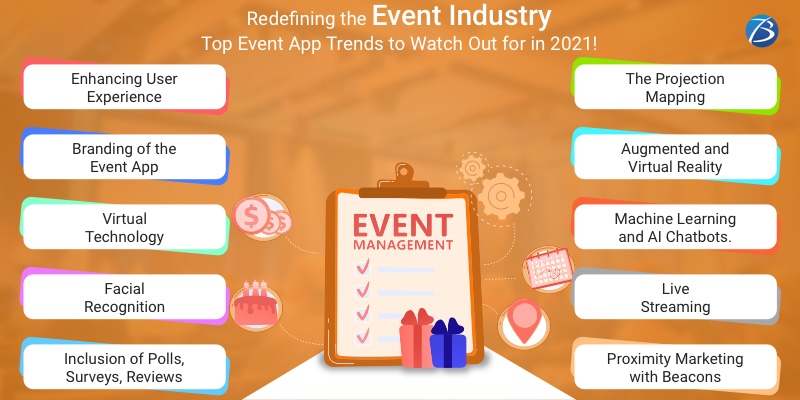
Enhancing User Experience
Optimizing the user experience is a MUST. This can be done by ensuring that the app content is highly relevant and engaging. For this, the app should possess content like the schedule of the events, contact information, directions of the events, speaker details/biographies, etc. Also, the user experience can be elevated by ensuring consistent styling throughout the app, using graphics or HD images in the app, etc.
Branding of the Event App
Your event app is the representation of your event business and hence, it should be branded accordingly. Pick the logo, fonts, styles, etc. wisely. Using color palettes that will be visually impactful is also quite essential for the app. Furthermore, all the app elements should be consistent with each other. Lastly, certain guidelines must be followed by every event application development company during its development to meet the standards of the app.
Virtual Technology
Virtual event applications are trending nowadays but, this feature is not yet much compatible with current platforms when it comes to matching with live engagement. There are a few other challenges too, like the untested solutions, no support, no integration, cost concerns, etc. But, these virtual apps are quite beneficial. They can help in expanding the customers, increasing the revenue, tracking vital data, promotional purposes, etc.
Facial Recognition
This is a new and innovative trend that comes with huge potential. It helps a big time in improving registration processes and app security. It streamlines the participation in events and reduces wait timings to some extent. Besides, for physical events, facial recognition in the event applications acts as a check-in tool. It’s a contactless and secure way for event attendees to check in the events.
Inclusion of Polls, Surveys, Reviews, etc.
These features are meant to improve user engagement. These can also be used for fun purposes during the events. It will engage the users and make them feel they are important and their views matter. You can gather real-time insights using the poll answers and live surveys and this data can be used for the enhancement of the app.
The Projection Mapping
Projection mapping technique is becoming quite popular amongst event planners nowadays. Projection mapping or Hologram is used for an in-depth understanding of content and then for higher user engagement. This trend enhances extra dimensions, optical illusions, and 3D movement, etc. Besides this, another technique called table projection mapping can be utilized in events for personalization, branding, story-telling, etc. Also, this technique helps to show pre-recorded presentations to the participants. Speakers from any corner of the world can deliver their presentations while not being physically present at the venue.
Augmented and Virtual Reality
Augmented Reality (AR) and Virtual Reality (VR) experiences have been impacting the event industry quite a lot in recent years. AR is used for grabbing the attention of attendees and motivating them to interact within the event. This technology has the ability to enhance the user experience, and result in increased media attention, more engagement, social media shares, etc. VR helps to create a computer-generated 3D world for the app users that makes the app much appealing.
Machine Learning and AI Chatbots.
These advanced technologies have influenced almost every existing industrial sector and the event industry is no exception. AI-powered programs collect the live event data and these programs are based on preferences, activity, behavioral data of the attendees, etc. This is real-time data and can be quickly altered or modified depending on the interest of attendees. AI chatbots can be used for interacting with attendees and answer their queries. Also, both these technologies can help the app owners to conduct multiple sessions, and deliver a powerful experience to the remote attendees.
Live Streaming
The live streaming feature is already being used on a large scale in countless apps. The live streaming events attract a huge number of people in real-time. These are more lively, authentic, and connecting and so, they get a much better response from the users. Using this feature, Q&A sessions can be extended during the live events, there can be group chats, the users can raise a hand, provide feedback, and similar engaging activities can be carried out.
Proximity Marketing with Beacons
While hosting an event, beacons can be placed around the event location for the creation of an interactive network for the online attendees using the event app. These beacons help in several important tasks like attendee tracking, online check-ins, proximity marketing, etc. This technology can also be useful in monitoring the floor plan flow in the events.
A Few More Trends for Optimizing the Adoption of Event Applications
  • Inform the attendees about the event app much earlier for ensuring widespread adoption of the event. This can be done using emails, social media, etc.
  • Use the app for registrations for early promotion of the app.
  • Let the promotion of the app be done by event speakers and other attendees as well. Encourage them to share the app with their contacts.
  • On the event day, introduce the app in various ways and ensure that the attendees use the app for some or the other reason like reviews, polls, or any games, etc.
Final Thoughts
Event professionals and also the event mobile app development companies all across the globe will remember the year 2021 as a transforming year for this industry. Several effective event app trends have emerged during this period benefitting the app owners and the related community. We have enlisted most of these trends in this blog. We hope they will be helpful to you.
Do comment below or drop us a mail and let us know your views about these trends. Also, share with us any other trends in this industry.