Step-by-step Guidance on How to Proceed from an App Idea to a Prototype!

Step-by-step Guidance on How to Proceed from an App Idea to a Prototype!
mobile app services
The journey from app ideation to prototyping – checking the relevance of the app idea before jump-starting the app development process – is one of the most crucial milestones for crafting an impeccable application. The reasons are:
  • App owners get a better perspective about the purpose of the proposed app and its target audience.
  • It helps in keeping the designer and the app owner on the same wavelength regarding the app design and ensures that the idea is implemented as intended.
  • It helps in identifying and resolving the potential usability problems.
  • It provides a competitive advantage while you pitch your app to potential investors.
However, to successfully prototype an app, you must be aware of the right steps. So, I have penned down the key steps involved in prototyping an application.

App Ideation to Prototyping: Key Steps
app development process

Pre-prototyping Stages

Prior to prototyping, check whether your app idea is financially promising and technically feasible.
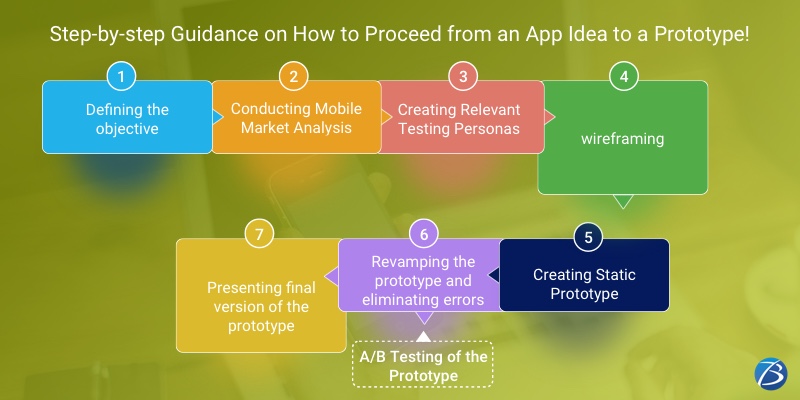
1. Defining the Objective
The crucial questions concerning app ideation that should be answered during this stage are:
What’s the app’s objective?
Does the app fulfill any specific consumer/business requirements?
So, the very first step is capturing the app idea and visually representing it on a piece of paper. Paper prototyping should be kept simple without using any colors, or art and should include only a rough list of the doodles or features of the UI of the envisioned app. This is a rough visualization of the app idea that will be recreated as well as refined into digital format during the later stages.
2. Mobile Market Analysis
For validating the effectiveness of your concept, one should conduct a mobile market analysis for understanding the following particulars:
  • The present demand for the proposed application
  • The upsides and downsides of existing apps that target the same set of audience
This stage determines whether the idea is effective, is capable of competing with similar apps existing in the market and whether the app launch timings are suitable for its success.
3. Creating Relevant testing Personas
The next step is to create relevant types of personas for subsequent testing processes. These personas represent the preferences, predicted behavior, values, etc. of the would-be app users.

Prototyping Stages

1. Wireframing
A wireframe is a simplified, low fidelity outline of the proposed end-product comprising of words, lines, boxes, and even descriptions. It is simply the structure of the app designed by first formulating the requirements. User flows (the sequence of actions needed by the end-user for reaching their destination) are created for every major feature of the app. Wireframes are created either on paper or using the graphics editor software. Check out the key steps.
  • Design positive workflows: Conduct a rough mock-up for each screen, using tools like Sketch, Figma, Adobe, Balsamiq, or Illustrator. Thereafter, organize the screens into flows by adding arrows and comments for example – Click the button ‘A’ for opening screen ‘B’.
  • Add error screens: When the end-users fail to achieve their objective, error screens inform them about the occurrence of an error or the failure of an action.
2. Static Prototype: Creation and Testing
Now, develop a static prototype based on the outcome of wireframing. This stage can be executed alongside wireframing as well. Its prime intention is to establish and display the transitions amongst app pages.
The next step is conducting the A/B testing of this prototype. It involves creating interactive prototypes and sharing them with software industry veterans, volunteering individuals, and various personas that represent the app’s target audience. User testing helps in receiving feedback on the app’s crucial usability aspects such as:
  • Is there any element hampering the app’s functionality?
  • Are the UI element texts easily understandable?
  • Are the users able to conveniently navigate through the interface layout?
  • Can the end-users effectively use the UI to execute intended actions?
Prototyping helps the investors get a real view and feel of the product. It allows the testers to get an idea about the app’s usability, and the developers to be well-versed with the intended UX prior to finalizing the design.
3. Revamping the Prototype
This stage involves resolving the flaws detected and revamping the app based on the testers’ feedback. This ensures that the app’s functioning is intuitive and convenient, and the app becomes more attractive to potential end-users in the future. Once this stage is completed, the prototype comes back to the testing stage and this cycle goes on till satisfactory outcomes are achieved.
4. Finalizing the Design
Once all parties approve of the prototype, the app’s UI design is finalized. This includes finalizing the app idea, the shape of buttons, etc., and achieving a consensus on the use of colors. After the design creation process is completed, testing is conducted for checking the validity of the selected UI solutions and the appearance of the visual elements.
5. Product Demo
Now, it’s time to combine screens into a prototype; either a clickable one or one with arrows; for demonstrating it to the clients or potential investors. Remember to be transparent with them about whether the prototype is the actual functioning product or not. The key points to highlight in the demo meeting are:
  • Clarity about the proposed application
  • The reason why it’s a profitable investment option
  • A pitch that displays the business model, problem, and solution
  • The app’s prototype to make them walk through the future app.
After the demo, the customers would wish to make certain changes. These requested changes should be executed at the earliest and arrange for another demo. Once, the clients are satisfied, the finalized user flows are handed over to the developers for preparing the cost estimate.

Bottom Line

Prototyping is undoubtedly a crucial aspect of the project planning stage and app creators shouldn’t ignore its importance.
Having trouble transforming your app idea into a fully functional app? Contact Biz4Solutions, a highly experienced offshore app development company. It is a leading firm offering mobile app development services that will be your technology partner all through your app development project.

Closed-Loop Mobile Payments: All You Need to Know!

Closed-Loop Mobile Payments: All You Need to Know!
Closed loop payment system
Executing payments via digital wallets/ Mobile payments solutions have become the order of the day owing to the emerging digital technologies and an increasing dependency on smartphones.
According to a research report published by the online portal, Mordor Intelligence, “The market value of mobile payment systems was 1449.56 Billion USD in the year 2020. The mobile wallet market is expected to grow at a CAGR of 24.5% during the next few years and the market value is predicted to reach 5399.6 Billion USD by the year 2026”.
Digital wallets have transformed the manner of making payments altogether. The two major categories under this type of payment methodology are open loop and closed loop mobile payments. The open-loop payment system involves using a single digital wallet via smartphones for making payments at several locations. Closed-loop mobile payments, on the other hand, requires prepaying a certain amount of money to one specific merchant or business brand just like using loyalty/gift cards at an apparel store or an eatery.
Out of these two mobile payment categories, the closed-loop approach is more preferable by merchants as well as consumers. In fact, the closed-loop payment model has revolutionized mobile payment one step further and elevated it to the next level! Let’s gather some quick insights on closed-loop mobile payments and the business benefits of adopting this approach.

What is Closed-Loop Mobile Payment?

A closed-loop payment refers to the payment transaction wherein a customer uploads money into a spending account linked to a payment device, just like the functioning of a gift card. This kind of payment happens between a spending account and a particular business brand. The mobile equivalent of this payment system is termed closed loop mobile payment. A closed-loop payment system uses mobile apps for managing gift cards and accounts via smartphone devices. Closed-loop mobile payment solutions allow users to check their balance within the system, make purchases using a mobile app instead of a physical card, and top up their account balance effortlessly. Customers can make payments using mobile devices/tablets to a specific retailer against an established account balance. Some of these solutions even provide the option of automatic balance top-up.
Any branded mobile payment or loyalty solution falls under this category. The TimmyMe app by Tim Hortons and the Starbucks smartphone app are popular examples of the closed-loop mobile payment model.
What is meant by a Closed-Loop Card?
A closed-loop card, also known as a single-purpose card, is an electronic payment card which the cardholder can use for executing purchases from a specific brand. Such cards usually bear the logo of the company where it can be used instead of bearing the logo of a primary payment processor such as American Express, MasterCard, Visa, etc.

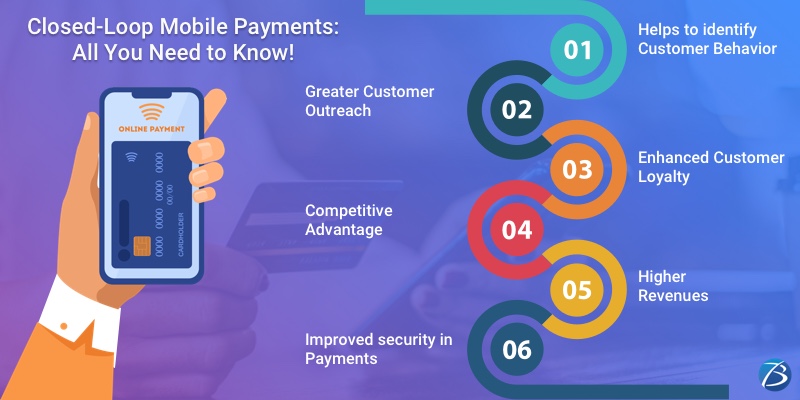
Benefits of Closed-Loop Mobile Payments

Closed-loop mobile payments
Identifying Customer Behavior for Creating Effective Marketing Campaigns
This mobile payment processing model helps entrepreneurs to capture big data based on millions of customer transactions and then, analyze this data for gaining deeper insights into the buying habits of consumers. Once, the businesses get a thorough understanding of their target market and identify the purchasing habits of their customers, they can create customized promotions/offers and deliver the same to customers’ mobile devices.
Greater Customer Outreach
Mobile technology simplifies sending out purchase reminders to customers via notifications. Moreover, businesses can even set up geo-targeted notifications which get triggered whenever potential consumers are close to their store.
Enhanced Customer Loyalty
The ability to send customized promotional offers and loyalty incentives to customers via smartphone devices not only helps in retaining consumers but also enhances their loyalty quotient.
Competitive Advantage
Using the closed-loop mobile payment model, customers enjoy several benefits like smartphone friendliness, automatic balance top-up, the option of pre-ordering for avoiding line-ups, being able to consolidate several gift cards, and many more. This makes your brand the obvious choice for customers.
The exclusive nature of a closed-loop mobile payment system enables business brands to monopolize customers’ smartphone devices concerning services and products within their niche.
The aforementioned advantages help businesses gain a competitive edge over peers.
Higher Profits
When users add money to fund their mobile wallet apps or e-gift cards, it implies that they have technically spent money within your store. Furthermore, if customers fail to use up their remaining balance, you gain extra profit.

Why should Business Brands Adopt the Closed-Loop Mobile Payment Approach?

It’s high time businesses should adopt the closed-loop mobile payment strategy. Take a look at the reasons!
  • Billions of individuals across the globe own smartphones. As such, your targeted audience is more likely to possess a smartphone device than your firm’s gift/loyalty card. Besides, modern tech-savvy consumers are on the lookout for ways and means that will allow them to link their payment wallets with mobile devices. And, the closed-loop approach perfectly befits this requirement.
  • Consumers express interest in this system due to the bar code scanning abilities of modern mobile devices.
  • Such systems promise improved security. This is because they are not tied into carrier networks, users’ credit cards, or bank accounts, thereby adding an extra security layer between the merchant and the bank account.
  • Closed-loop mobile payments are less complicated and easy to execute.
  • This approach proves profitable for vendors as it involves lower purchase fees in comparison to direct credit card transactions.

Concluding Thoughts:

A closed-loop mobile payment system proves profitable for the merchant as well as their consumers. Therefore, if you possess the necessary resources, commence the mobile app development process by partnering with reliable developers and a merchant service provider for architecting an impeccable closed-loop payment system.
Are you on the lookout for a dependable software firm for building a closed-loop mobile payment system for your business? Contact Biz4Solutions, a renowned Offshore Software Development Company in India, with 10+ years of experience in serving global clientele!