
Wondering whether to Outsource Business Operations? Watch out for these signs!


Running a business enterprise is rewarding but overwhelming at the same time. This is the reason several business owners choose to outsource app development and other administrative functions.
Take a look at these interesting 2021 stats concerning outsourcing published by the online portal capitalcounselor.com.
- The U.S. outsources approximately, 300,000 jobs every year
- 70% of entrepreneurs outsource for reducing costs.
Outsourcing business operations have become a current trend and it has been observed that the offshore software development model is the most preferred option. However, the most intriguing question that baffles entrepreneurs is; “When is the right time to start outsourcing?” Well, this post answers it all.
Check out the obvious signs that indicate your business needs to adopt the outsourcing strategy.
Obvious Signs that indicate your Business needs Outsourcing
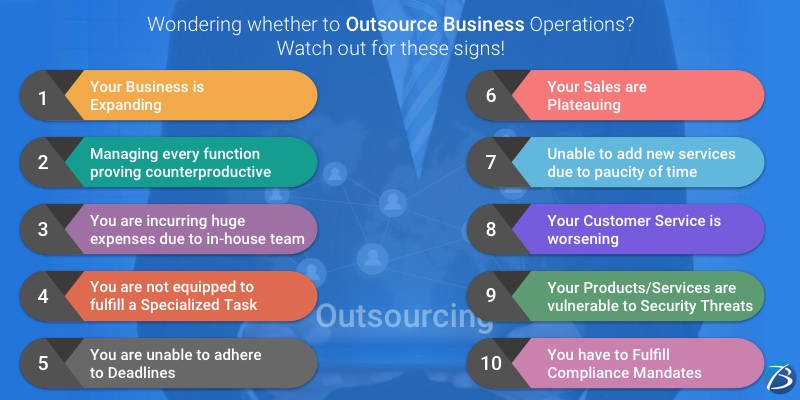
Your Business is Expanding
When your market grows, your sales shoot up as well. This results in a rising demand curve and more work to be accomplished within a short period. But, catering to the larger volume of orders and delivering them on time, becomes a challenge if you are inadequately staffed. So, it’s high time you seek assistance from an outsourcing firm so that you are able to efficiently meet the rising demand while adhering to strict deadlines. Moreover, when you have a team of experts executing your voluminous tasks, you can invest more time and effort in promotional marketing and advertising your business.
Managing every function proving counterproductive
Several start-up business owners prefer managing every small operations starting from administrative and organizational tasks to customer service, all by themselves. And, since such companies possess a limited number of in-house employees, they end up spending a huge chunk of their time handling repetitive, time-consuming, and monotonous back-office tasks like HR administration, accounting, etc. These essential yet non-priority tasks, keep them from paying attention to core competencies and also suppress innovation. Nevertheless, such counterproductive chores can be easily delegated to outsourcing companies, while enterprises can focus on core business objectives that will facilitate growth and expedite revenue generation.
You are incurring huge expenses due to in-house team
Entrepreneurs hiring and maintaining an in-house team need to incur huge expenses and encounter loads of hassles like as below:
- In-house workforce needs to be paid monthly remuneration and provided with other benefits like insurance, paid leaves, etc.
- E-Commerce businesses without a physical store find it challenging to spend on office spaces and purchasing work equipment.
- Small-scale businesses are likely to commit costly mistakes such as hiring incompetent/inexperienced employees or buying technologies and equipment that do not deliver a high ROI.
- Large-scale firms end up spending a considerable amount of time and money in recruitment, training staff, and managing administrative/HR responsibilities and other back-office operations.
All these aforesaid challenges can be addressed by sharing your workload with an experienced outsourcing vendor. This is because you only need to pay the vendor for the specific services needed by your business, while all other expenses and hassle-prone activities are taken care of by the outsourcing partner. Moreover, outsourcing companies routinely train their employees so that their skills remain relevant and their services are up-to-date with the latest industry trends. So, the strategy to outsource tasks/projects undoubtedly saves time, effort, and expenses; regardless of the size and nature of your enterprise. Hence, consider outsourcing, if you need to reduce costs and speed up the time-to-market.
You are not equipped to fulfill a Specialized Task
During situations when your company is lacking in specialized skill sets needed for a particular project; there are three possible solutions. You can either train your employees to acquire that skill, or hire full-time professional/s well versed in that skill, or outsource your project to third-party vendors who can provide the specialized services you need.
Training in-house staff may sound productive, but at the same time, turns out to be time-consuming, and yet there’s no assurance that the work quality will be good enough to meet clients’ expectations. The second option – hiring staff – would be worth the investment, only if you are certain that your business will require that specialized skill on a long-term basis.
Outsourcing, on the other hand, sounds like a profitable option in terms of quality as well as delivery speed. Therefore, outsourcing is the most viable option when you have to execute short-term or unexpected tasks requiring specialized skills.
You are unable to adhere to Deadlines
How many of you have encountered situations as given below?
- Your projects are running behind schedule and fail to get delivered on time.
- Timely execution of tasks like accounting, regular website updations, etc. becomes difficult and cramming everything during the final moments becomes the norm.
- You’re stressed that you hardly find adequate time in a day to realistically complete the necessary tasks.
The aforementioned scenarios are detrimental to your company’s goodwill. Furthermore, the pressure to meet deadlines is often nerve-racking and adversely affects the quality of your output. And, hiring an additional workforce may take you several weeks, which is not feasible if you have tight deadlines to meet. However, adopting the outsourcing strategy can be a huge relief as you can obtain adept professionals to whom you can assign responsibilities with immediate effect.
Your Sales are Plateauing
If your sales are plateauing and the root cause happens to be insufficient workforce and improper time management; outsourcing minor tasks or production functions will resolve your issue. This is because most outsourcing agencies specialize in specific industry verticals and domains, and so deliver premium-quality output.
It’s not possible to add New Services without Discontinuing the Existing Ones
There are times when you intend to offer a new service as per the latest trends that would prove advantageous to your clients. But, to your dismay, this plan wouldn’t work out due to the lack of enough time or workforce and you are on the verge of losing clients. And, if you add those services, you will have to make the tough decision to discontinue some existing services for accommodating the additional workload. Nevertheless, outsourcing can be the savior of such situations.
Your Customer Service is worsening
Customer service is a vital aspect that decides the success of a business enterprise. Whether it’s just sending periodic updates via emails to clients or more detailed interaction, it shouldn’t be ignored at any cost. This is because if you are too tied up with other responsibilities and unable to provide adequate attention to customers, they are likely to tail off to your competitors. Furthermore, your capacity to onboard new clients will sharply decline as well. The modern age customer behavior is such that if they are kept on hold for more than thirty seconds, or your instant messaging service is slow; they’ll desert your brand.
Outsourcing, on the other hand, will enable you to provide your customers with an enjoyable UX, and hence will help you in customer retention as well as attracting new ones.
Your Products/Services are vulnerable to Security Threats
Several modern-day businesses are vulnerable to cybersecurity threats such as ransomware, zero-day attacks, etc. Such attacks can cause monumental damage to the affected firms. To protect themselves from such a predicament, companies need to continually update their security systems. In many instances, firms are not adequately equipped to prevent and handle cyber-attacks. Well, in such cases outsourcing software operations to a prominent outsourcing agency are the most viable solution. The reason is specialized IT companies leverage the latest technologies like AI that will allow your security system to create protection layers autonomously. Besides, these agencies are well versed in the methodologies of adhering to security protocols. Thus, outsourcing can be the ideal solution for minimizing security threats.
You have to Fulfill Compliance Mandates
Businesses across certain domains like healthcare need to comply with national as well as international regulatory compliances concerning the protection and security of electronic data. And, the organizations that fail to comply with such mandates end up paying huge fines and tainting their reputation altogether.
Adhering to regulatory compliance like HIPAA Compliance involves certain complex requirements such as the ability to audit your security system and software infrastructure, generate accurate reports of the audits conducted, and many more. The simplest way to satisfy these essential requirements is to hire a proficient IT firm that possesses the necessary resources for securing your network, adhering to the cybersecurity measures as mandated, conducting audits promptly, and generating relevant reports.
Are You Interested in Building a Top-Class Website or Mobile App?
Concluding Thoughts:
Isn’t it wise to trade your weakness for rewards by reaping the benefits of outsourcing app development services? So, whenever you find any of these alarm bells ringing, it’s high time you should consider outsourcing. The myriad benefits of this strategy ensure high ROI for your business.
Are you on the lookout for a reliable outsourcing agency? Contact Biz4Solutions, a prominent Offshore Software Development company serving global clients for the last 10 years!


