Some noteworthy practices for Node.js to make it more Secure

Some noteworthy practices for Node.js to make it more Secure
Node.JS App Development
Node.js works on Chrome’s V8 JavaScript. It is a lightweight and scalable network-driven app framework built on an asynchronous event-driven JavaScript runtime. The development of Node.js applications can be readily scaled in both horizontal and vertical orientations.
Both client-side and server-side apps are built with Node.js. It has an open-source JavaScript runtime environment/model that allows single modules to be cached. As a result, Node. Popularity JS’s is predicted to skyrocket in 2022.
This blog will review some of the most significant programming performance recommended node.js security best practices and top node.js security risks. With these best practices in place, the app can automatically reduce JavaScript runtime problems and transform into a high-performance, robust node.js application, and process.
Because Node.js is based on JavaScript, the standard JavaScript practices apply in addition to the coding principles discussed in this article. These best practices apply to the Node.js developer community, or web app development company used, from specialists to newbies building “hello world” scripts! So let’s get a deeper insight into this topic.

Why Node.js projects have security flaws?

Open-source apps are exposed to any security or licensing flaws in open source components. The problem is that security testing techniques like dynamic and static code analysis are ineffective at detecting issues in open-source software.
To find open source components in Node.js, look through the package manager index files that identify the dependencies. The open-source community routinely reuses open source projects to accelerate development, minimize time to market, and add functionality. As a result, both commercial and open-source developers can add functions, code snippets, and methods to files.

Top Node.js security concerns in 2022

  • Injection of code
  • Any attack in which the attacker injects code into the device and compels the application function to execute it is known as code injection. To acquire insight into your codebase, the attacker examines the improperly handled and untrusted data.
    Inadequate input and output data integrity is a common cause of this security issue. SQL injection is a common code injection threat that most people run into while developing software.
  • A CSRF attack
  • CSRF (Cross-Site Request Forgery) is a prevalent Node.js security flaw that should not be overlooked. The CSRF attack forces authenticated users to send a request to a web application they have previously been granted access.
    CSRF attackers’ primary goal is to change the application’s state through social engineering tactics such as sending out a message or an email to the users.
  • Cookie names by default
  • When using Node.js, the issue comes when the developer uses the default cookie names rather than changing them to meet the needs. Because attackers are familiar with the default cookie name, they are more likely to attack and access user data under the rich ecosystem easily.
  • X powered by header
  • The X-Powered-By header is a widely used non HTTP response header utilized as a default option by many scripting languages. You could either enable or disable this header using server and configuration methodologies. This header indicates the app development technology utilized, allowing attackers to exploit numerous security vulnerabilities connected with that technology.
  • Brute-force attacks
  • Any Node.js security checklist will identify brute force as one of the most common attacks or dangers. To gain access to sensitive information, the attackers generate random passwords and try to use them on login endpoints of web applications. Making millions of combinations until you find the correct password for the online application is what brute force is all about.
  • DDoS Attacks
  • The full form of (DDoS) is Distributed Denial of Service attack that seeks to disrupt a server’s or network’s normal traffic by flooding the production environment with internet traffic. That may contain malicious JavaScript code. DDoS attacks have been reported using Node.js versions 4.0.0 and 4.1.1 because they allow attackers to exploit a weakness in the HTTP handling.
  • An XSS (Cross-Site Scripting) attack
  • It allows attackers to inject client-side Scripting using altered JavaScript code into the web app.
    An attacker can employ XSS to send malicious content to a user. The user’s browsers have no method of determining the codebase’s trustworthiness. As a result, it is run by default, giving attackers access to any cookies, session tokens, or other private information.

Top JavaScript security best practices with Solutions

Authentication using two factors

To obtain access to most node.js development environments, you’ll need a password. Passwords like letmein or donkeykong, on the other hand, are simple to guess, making the system open to hackers. You might have a user who uses a password manager to log in from a public computer. The password you or your company spent hours preparing is now available to the public.
Solution: Use Two-Factor Authorization to protect all of your credentials. Even if an attacker gets your user’s login credentials, they won’t be able to access your system until they have access to another device, such as a smartphone.

Limit Cross-site scripting attacks by validating user input

Cross-Site Scripting allows hackers to inject susceptible client-side scripts into website pages seen by different users. Client-side script flaws can lead to data leaks.
If the user types something into the search box and isn’t found in the database, it will be presented to them in the same format.
Solution: You can validate the input from the user. You can use output encoding methods or tools with in-built encoding frameworks to avoid cross-site attacks in Node.js.

Escape JS, HTML, and CSS Output

Code can take the form of an HTML paragraph with a visual representation of the data and JS instructions to run. The browser may read and execute JS code that was not supposed to be visible while rendering the HTML.
Solution: The approach is to tell the browser that any untrusted data piece should be treated as content only and that it should never be interpreted. This strategy is called escaping, and escape functionalities are available in several NPM packages and templating engines.

Make use of Security Linters

Vulnerabilities can be scanned automatically. Additionally, you can detect fundamental security issues while writing the code.
Solution: Linters such as eslint-plugin-security can be utilized. If you employ insecure programming methods, this type of security linter will alert you.

Cookie Session Name by Default

Session cookies allow websites to identify users. A cookie is created for every action you take on the website. Shopping carts on ecommerce sites are the most obvious form of this capability.
The session cookie saves information about the items you’ve selected on the e-commerce site. As a result, these items will be in your shopping cart when you’re ready to check out.
Solution: Attackers can easily detect default cookies and use them to cause harm to your app. Use one of the middleware cookie sessions modules to overcome the problem, such as express-session.

Each request should have access control

This is typically tied to how an app’s user permissions to specific URLs have been examined. As a result, you may employ access exposure to have restricted areas of the application, such as the admin dashboard, which typical users without the necessary role can access.
Solution: The only method to eliminate this vulnerability is to test app modules that require certain user rights manually. To avoid access rights being altered on the client-side. Authorization tokens or cookies, middlewares, and access control rules should be built on the server-side.

Error messages should be hidden from clients

If you don’t manage failures properly in a Node.JS application, sensitive application facts, including third-party modules in use, server file locations, and other internal functions of the programme, can be exploited.
Solution: Make sure you don’t offer the client the entire Error object if you use this strategy. This will keep confidential application information out of the public eye.

Working with children’s processes should be done with caution

Shell injection is one of the most common vulnerabilities for an unsecured Node.js application. An attacker uses a shell injection attack to acquire control of the server’s operating system and tell it to run arbitrary commands, compromising the application and all of its data.
Solution: Use a child process. exec file that only runs one function with a set of parameters and does not extend shell parameters.

Deserialization using Encryption

Serialization changes an object into a data format that can be restored to its original state later. At the same time, deserialization is converting an item back to its original state. If deserialization is done insecurely, harmful objects can be deserialized and executed via API calls or remote code execution.
Solution: We utilize a method known as cross-site request forgery to defend against such assaults (CSRF). Getting a CSRF credential from our server and inserting it in a hidden form field is all it takes. When the incoming token does not match the one that was previously sent, the CSRF middleware bans requests.

Scan Apps for Vulnerabilities regularly

The Node.js ecosystem requires the installation of a number of libraries and modules. Many of these can be used in your tasks daily. As a result of this, there is a security risk.
Solution: You must perform automated vulnerability scanning regularly to fix this. This makes it easier to find dependencies that have similar faults.
Also have a look at the best software development tools for the startups.

Conclusion

Security flaws and threats have cost businesses thousands of dollars over the years. While data breaches can cost a lot of money, sensitive data leaks and stolen information can’t be measured in dollars. We may not be able to block every attack that an attacker may launch against our apps. We can guarantee that our irresponsibility does not result in significant damage.
This blog aims to illustrate the best practices to follow while designing an app and address how to secure node.js applications security at every stage of the development lifecycle. This document is part of the Groovy Web checklist, a node.js development company expert team follows.


The Significant Advantages of Cloud Computing in Healthcare!

The Significant Advantages of Cloud Computing in Healthcare!
Healthcare app development
Cloud computing in Healthcare is growing at a rapid rate. It refers to a third-party provider offering a ready-made cloud storage infrastructure consisting of remote servers, databases, and repositories to healthcare organizations or individual practitioners. Cloud services are used to store, manage, and process healthcare data. The healthcare entities availing of Cloud services usually pay as per the services consumed. With a growing trend for EMR integration to store patient data, Cloud computing services have become indispensable for customers.
Consequently, the demand curve for Cloud computing services is on the rise. Take a look at these amazing stats as reported by the online portal prnewswire.com:
The estimated market value for Cloud computing in healthcare for the year 2022 was 40.1 billion USD. The market value is expected to grow at a CAGR of 18.7% and reach 76.8 billion USD by the year 2026.
This post outlines the key offerings of Cloud computing services and their noteworthy benefits to Healthcare Service Providers.

What are the different kinds of Cloud Computing Models in Healthcare?

The core models of Cloud computing in Healthcare revolve around distribution and deployment.

The Cloud distribution models available are:

IaaS (Infrastructure as a Service) – Customers are provided with an IT infrastructure as well as an OS that is used for deploying their apps.
SaaS (Software as a Service) – The customer deploys their app or software solution using the IT infrastructure offered by the provider.
PaaS (Platform as a Service) – The customer gets an entire ready-made platform that includes OS, IT infrastructure, software apps, and all other components needed.

The Cloud Deployment models available are:

Public Cloud (all stakeholders can access), Community Cloud (can be accessed by a group of medical entities), Private Cloud (can be accessed by a single healthcare organization and other facilities belonging to the same chain), and Hybrid Cloud (a combination of the existing deployment models).

Cloud Computing in Healthcare: Noteworthy Benefits

Healthcare IT Services

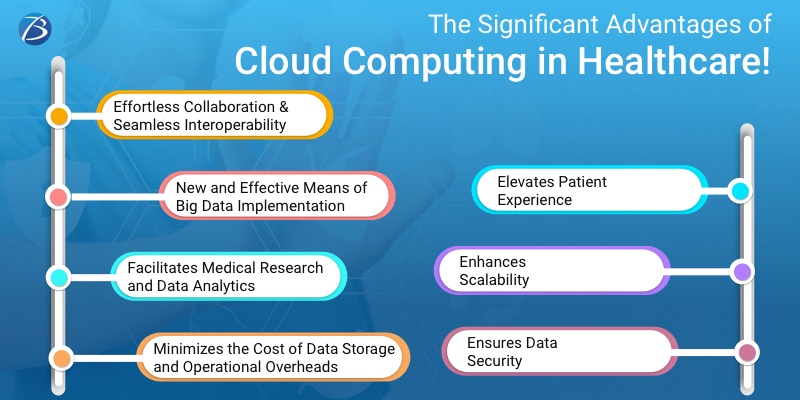
Effortless Collaboration & Seamless Interoperability

Earlier patients’ healthcare records were documented and maintained in files. There were separate files for every practitioner or specialist consulted, and each hospital or imaging lab visited. This complicated matters for patients as well as doctors. Patients had to carry every file for each doctor visit and physicians found it difficult to collaborate whenever they had to review a patient’s previous treatment history.
Cloud computing resolved this challenge by storing medical data on a secure platform with hosting solutions as well as virtual machines to enable quick access. Healthcare firms can either use Azure’s Blob storage or the AWS S3 service for storing and retrieving medical records. Patients’ medical records collated from different sources are consolidated in a centralized storage system powered by Cloud. These records can be collaboratively accessed and shared in real-time via web portals; by authorized stakeholders including doctors, nurses, and caregivers from any location. Cloud also offers additional perks like remote conferencing, providing prompt updates on patient conditions and healthcare developments.
Cloud computing saves time and efforts of both patients and doctors. Once patients’ medical records and lab reports are saved in EMR (Electronic Medical Records), they do not need to manage or carry files for doctor visits. Moreover, it becomes easier for specialists to review cases as the results of all previous doctor interactions are available in one single place. Improved visibility into patients’ medical history helps specialists to effectively co-operate with one another whenever there’s a need for consultation or recommendation. Furthermore, cloud storage allows physicians to analyze patient treatment data for future reference as well as research.
Storing patients’ medical data in the Cloud facilitates interoperability between various departments of a hospital and different sub-domains of the healthcare sector such as insurance firms, pharmaceutical companies, and imaging centers regardless of their geographical location. Cloud computing improves the overall efficiency of medical care and clinical decision-making and minimizes costly mistakes.

New and Effective Means of Big Data Implementation

These days most healthcare bodies employ healthcare app development services to digitalize their operations. This leads to the generation of loads of Big data that is accumulated via patient EMRs. This data holds a huge potential to elevate healthcare outcomes. Cloud-powered solutions for data storage have opened up new possibilities for effective implementation and utilization of Big data that was inaccessible during yesteryears. This is because the volume of data collected is humongous and could not be managed by one single server.
Cloud’s contribution to big data utilization is enormous. Big data, if effectively implemented, proves beneficial in detecting subtle correlations in patients’ ailments. This enables doctors to identify the correct cause of the disease and get insights into the most suitable treatment options for a specific set of symptoms. Big data also helps in predicting the occurrence of epidemics much before the epidemic manifests its obvious signs; this way the healthcare industry can detect public health threats well in advance and save lives.

Facilitates Medical Research and Data Analytics

Cloud computing allows researchers and medical professionals to reap the advantages of a high computing capability in storing and manipulating structured as well as unstructured data; and that too, at much lower expenses. With Cloud, huge volumes of relevant patient data collected from various sources can be securely stored and quickly processed using AI algorithms and Big data analytics tools for obtaining actionable insights. Therefore, it becomes easy for researchers to store data collected from various fields and condense this data to get a clearer and more advanced visibility of the research subjects. Advanced data analytics enables healthcare service providers to provide highly customized patient care, suggest personalized treatment plans, and make faster clinical decisions.

Minimizes the Cost of Data Storage, and Operational Overheads

Healthcare facilities that handle mobile apps, electronic medical records, patient portals, big data analytics, etc. can select from two options for the storage and management of data – an on-site data storage mechanism or services from a Cloud Provider. Medical companies opting for on-premise data storage need to spend heavily on setting up the required software infrastructure and investing in top-quality hardware drives for data storage so that data is securely stored and accessible whenever needed. And, since a huge amount of data is generated, all in-house software solutions are not capable of handling it. As such, medical bodies often have to invest in additional physical servers when the data load increases, ending up incurring extra expenses.
But, Healthcare firms availing of services from reliable Cloud providers get a good bargain – secure, efficient, and scalable services at much lower costs. Cloud providers manage all data storage prerequisites on behalf of the healthcare firm. Therefore, by hosting their ERP in the Cloud, healthcare providers can avoid infrastructure costs and the need for maintaining complex protocols, and they can pay for only those services that they avail of. Cloud computing also offers better support for operational functions like HR and administrative processes. Hence, cloud services are a cost-efficient option for medical providers who can outsource operational burdens and concentrate on their core service – patient care.

Elevates Patient Experience

Cloud computing improves patients’ engagement, communication, and awareness about their medical conditions. Patients can remotely access their healthcare data in real-time including treatment details, test outcomes, and doctors’ notes, they also receive instant notifications on updates. Cloud-based solutions ensure that no patient is overprescribed or advised unnecessary lab testing. Furthermore, Cloud computing supports telehealth solutions, the most popular and convenient healthcare service category amongst patients.
Cloud computing centralizes data storage so that patients can control and participate in decision-making processes. Moreover, Cloud simplifies data recovery; it offers automated data backups, and the data is maintained in a manner that there isn’t any single touchpoint of the stored data.

Enhances Scalability

Self-hosted storage solutions come with limited data capabilities and so, healthcare organizations using such solutions are unable to expand their bandwidth as per the scaling need and often need to employ extra servers during increased caseloads.
Contrarily, cloud models offer the flexibility to upscale or downscale the data storage capacity as per the demand based on the patient inflow. This way, medical providers can promptly respond to and handle surged loads arising due to unforeseen situations like increased patient activity during a pandemic. And, if medical services opt for the pay-as-you-go approach, this strategy proves cost-effective as well. Cloud providers also handle tasks like data security, patching, and upgrades on behalf of their clients.

Ensures Data Security

The more digital data, the more is it vulnerable to security breaches and cyber-attacks. And, it has been observed that healthcare data and sensitive patient information are soft targets for carrying out malicious practices. Here, Cloud computing plays a crucial role in securing data.
Cloud being a storehouse of sensitive data, providers adopt additional security measures and comply with mandated standards like HIPAA (Healthcare Insurance Portability and Accountability Act), GDPR (Europe’s General Data Protection Regulation), and HITRUST to protect their servers from cyber security violations. Cloud services also provide facilities like automated data backup, risk management plans, disaster recovery options, and continuous security monitoring. Hence, even in cases of data breaches or unauthorized access healthcare firm can recover their data effortlessly.

Final Thoughts:

Cloud Computing is the most viable option for Healthcare Service Providers to securely collect, store, manage, and maintain the PHI (personal health information) of patients. Cloud solutions come with endless offerings for consumers including customized patient care, data analytics, Big data utilization, and most importantly reduces operational costs. Cloud solutions enhance the overall efficiency of healthcare services and provide them a competitive edge over peers. So, it’s high time healthcare entities should seek technical assistance from dependable Cloud computing services.