
Why Every Hospital Should Have A New-Age Healthcare Management System
Technological innovations have smartened the processes involved in diverse industry verticals and the healthcare sector is no exception. A modern-day medical facility is expected to possess smart tools like a health management system to streamline workflow; medical software for doctors to ensure error-free diagnoses and treatment; and patient management system software to provide prompt services and deliver a rich patient-experience. The key requirements of a smart medical facility are as follows:
- A self-automated patient scheduling procedure.
- Online assistance and e-prescriptions for patients.
- Storing and maintaining health data and medical reports of patients digitally.
- Incorporating HIPAA compliance in your healthcare management system, mHealth app and other healthcare solutions to secure sensitive medical data from potential threats.
Smart healthcare solutions are the need of the hour as they not only add to the convenience quotient of practitioners and patients but also prove advantageous for the medical facility. Modernized healthcare management systems help medical organizations to deliver the highest standards of patient care and effectively manage patients and staff. This blog pens down the reasons why healthcare providers should consider adopting a smart healthcare management system.
Before we dive deeper, let’s take a look at what a smart healthcare system is.
Smart Health Management System
Healthcare management software refers to an all-inclusive solution that caters to diverse management requirements of patients, physicians, and providers unanimously. The commonest applications include Electronic Medical Record software (EMR), Electronic Health Record software (EHR) and Practice Management Software (PMS). These software solutions enable effective communication between doctors and patients, generation of e-prescriptions, maintenance of billing records, maintaining patient data digitally, online appointment-scheduling, management of doctor-schedules, and many more.
Key Advantages of Health Management System
EHRs and EMRs: Digitalization of Healthcare Records
Traditional record-keeping involving a huge amount of paperwork is being replaced by digital healthcare records. Electronic Medical Records (EMRs) and Electronic Health Records (EHRs) are employed for this purpose. These software systems ensure the proactive collection and maintenance of medical data. Patient data such as prescriptions, health reports, medical history, etc. are stored in a centralized system and can be accessed whenever needed. The usage of digital record maintenance assures data accuracy. Additionally, these systems are made HIPAA compliant to ensure the safety of sensitive data and to avoid the data violation protocol. Click here
why hipaa compliance plays a major role in protecting data privacy in healthcare apps
to know more about HIPAA Compliance.Online Appointment Scheduling
The HMS is multitasking. It functions as a patient scheduling system by enabling the patients to book online appointments based on the slots provided by practitioners. Besides booking appointments, the patients can also reschedule or cancel appointments. Doctor appointment app solutions help the doctors to view weekly calendars displaying the doctors’ appointment-schedule and hence can book appointments themselves in case of referrals.
Strengthening the Doctor-Patient Bond
Effective doctor-patient communication is crucial for collecting more specific details from patients, establishing trust amongst the patients and providing them the much-needed psychological support to make them feel cared for. Hospital Management Systems open up multiple options for online doctor-patient interaction like calling, messaging, personal chatting, etc. These communication channels help in strengthening the doctor-patient bond and lead to more productive outcomes.
Digital Calendar for Doctors
Appointment scheduling, rescheduling and cancellation is an integral aspect of every healthcare facility. However, managing doctor appointment schedules is a challenging task and chances of errors are likely. But the advent of management system software has eased things considerably. This system has physician schedule management that displays the appointments in the form of a digital calendar. As such, doctors can effortlessly view their own schedule as well as those of the other doctors. This simplifies the tasks of adding, re-scheduling, and cancelling of appointments. Moreover, this software sends them reminders about appointments well in advance. Therefore, digital calendars are productive tools that save time and effort.
Improved Decision-Making
The use of a Practice Management Software (PMS) boosts the accuracy and effectiveness of operational decision-making in a medical facility. The reasons are:
- Tracking of important medical data
- Reduced documentation errors
- Improved data security
- Employment of automated functions such as scheduling appointments in available slots, remote patient monitoring, sending reminders, etc.
Are You Interested in Building a Top-Class Website or Mobile App?
Final Verdict
Thus, the employment of a smart Healthcare Management System assists the medical facility to handle mundane operational processes effortlessly. Reaping the benefits of digital systems for hospital management and automation tools for executing healthcare operations; enables service providers to grow exponentially and reach new heights of success. So, every health facility, whether big or small must adopt hospital and patient management systems to expand their patient base and hence gain a competitive edge over peers.
I hope this blog was helpful. Did you face any challenges while managing your hospital functions? Do share your experiences in the comments section below and let us know if you have any queries.
Top 7 Retail Technology Trends For 2022
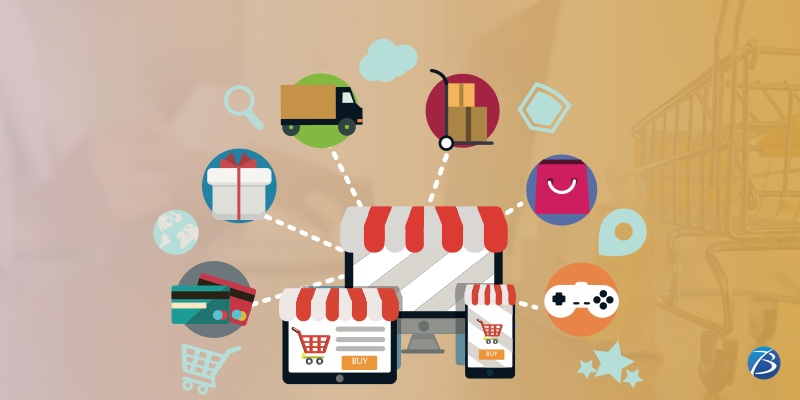
The retail industry has transformed over the decade with the growing penetration of the internet across the globe. The retailers have been progressively involved in capturing the large population that stays online with remote devices. Online presence has become important for the business over the past few years. The COVID-19 pandemic further propelled the demand for online shopping and e-retail. The pandemic also compelled retailers to automate their inventory management and supply chain. Going ahead in 2022, several other factors are meant to influence the retail trends:
- Generation Z: People born after 1995 have become a part of the workforce. They are going to strongly influence the retail trends
- Digital world: Retailers are going online to capture the maximum customers
- Convenience: Contactless and hassle-free shopping is going to be a driving point
These trends in turn are going to influence the retail technology trends. Mobile application plays an important part in developing an e-retail ecosystem. Many companies provide mobile app development services to provide a competitive UI for e-retail. So, hiring mobile app developers is the need of the hour as one has to keep a watch on other retail technologies going to trend in the coming years.
Major Retail Technology Trends
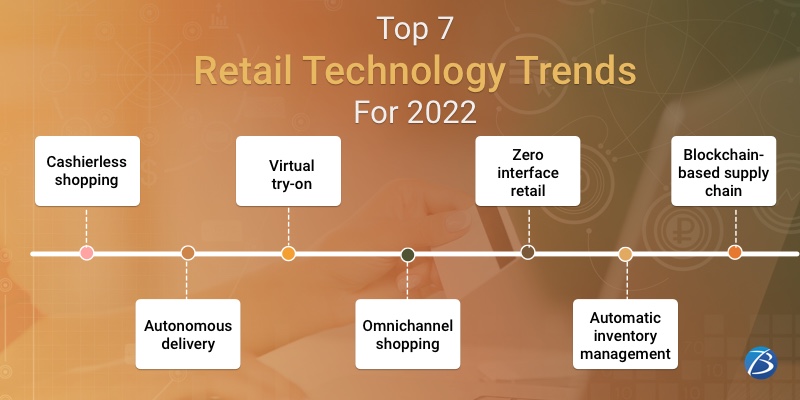
- Cashierless shopping
- Autonomous delivery
- Virtual try-on
- Omnichannel shopping
- Zero interface retail
- Automatic inventory management
- Reduced warehouse cost with minimal inventory stored in the warehouse, incurring less maintenance cost
- Stock availability whenever required by a customer, enhancing customer satisfaction and fetching customer loyalty
- Less dependency on discounts to clear the old stock
- Greater revenue with higher sales, and reduced old/dead stock
- Blockchain-based supply chain
This retail technology is already implemented in many Amazon stores. The concept is meant to put an end to the waiting lines. Consumers can walk into the stores after signing in on the mobile application. All the items picked up in the shop are automatically billed and the money is deducted through the application while exiting the shop. Today, this implementation is only in small stores. In the future, it can be into larger stores and supermarkets. This technology is being associated with a positive change wherein the former cashiers at retail stores can take up meaningful and rewarding jobs that do not involve sitting and swiping vegetables.
The most talked-about retail technology, autonomous delivery, may become a reality in the coming years. Many companies have started trials for drone deliveries with successful results. Machine learning and Artificial intelligence play a huge part in redefining the delivery infrastructure in the retail sector. The management of the air traffic caused by delivery drones and bots needs to be managed. With many retail players awaiting the successful rollout of autonomous delivery solutions, many technology startups are expected to come into the picture, inviting more retail companies to opt for autonomous delivery.
Augmented reality as one of the retail technology is going to take customer experience to a new height. Virtual try-on has become a reality. Social distancing and restricted movement are expected to boost its adoption in retail sector. The virtual try-on option allows the customers to make informed decisions. It can end in higher sales and lower return rates, a great benefit for the retailers. Virtual try-on also provides a means of market assessment for the garment retailers to maintain a balance between supply and demand by optimized manufacturing of products in demand.
Virtual try-on can be creatively used to suggest the best size and suitable color for the customers, cutting down their time spent in cloth trials. The ultimate result is expected to be better revenue and customer satisfaction.
Omnichannel shopping is an interface between a brick-and-mortar store and an online store. Customers create omnichannel customer profiles which are universal to both brick and mortar stores and online stores. The selected items are placed in cloud-based smart shopping baskets that are valid for the physical and digital brand stores. The customers get the choice to select products from any medium and add them to the basket. Similarly, the items can be purchased from any medium. The flexibility of purchasing products makes the buying journey hassle-free. Omnichannel shopping gives retailers a better understanding of the customers, helping in marketing their products.
It is way more personalized human-machine interaction, adopted to enhance the user experience. With technologies such as Artificial Intelligence (AI) and Natural Language Processing (NLP), the conversational interface can be the new UI for retail brands. Voice searches are already being used in different applications. Using voice as the operative base for retail brands is a good strategy. Moving ahead in 2022, voice can be used to create entirely new and unique user journeys.
Inventory management composes to be a huge part of every retail outlet. Retailers are able to reduce their manual efforts and costs in managing inventory. Data-driven analysis of the inventory helps in its management. There are several benefits that data-driven and automated inventory management can bring.
Artificial Intelligence (AI) and other technologies can be used to tag the inventory in categories and subcategories and track the performance of each category against different KPIs. Predictive analytics can be used to ensure products availability on different channels based on the demand to optimize sales.
Blockchain enhances transparency and security across all operations and transactions. It can be used to record the entire journey of the product till it reaches the end customer. Once created, this record cannot be edited. This error-less tracking allows Blockchain to address the challenges of supply chain traceability. In the coming years, Blockchain can become an integral part of supply chain management systems owing to its positive impact on transparency, auditing, and traceability.
Are You Interested in Building a Top-Class Website or Mobile App?
The retail industry is evolving with an increase in the use of technology. The retailers must pay heed to these retail technologies to stay ahead in the game. Every retail technology may not be applicable to every retail business and the business owners need to chalk out the requirements before acquiring these tools. Mobile application is going to stay as an important tool for e-retail. An application with good UI and responsiveness has higher chances of retaining consumers than a normal mobile application and website. Biz4solution can help retailers in developing robust mobile applications. Our experts will devise the best UI as per your niche. We will help your business go global with world-class applications. Contact us today to own a mobile application to offer a personalized experience to your customers.