Why is it advisable for Start-ups to pick Ionic for App Development?

Why is it advisable for Start-ups to pick Ionic for App Development?

ionic app development company
Success is not very easy for the start-ups who are planning to go for mobile app development as these entrepreneurs need to look into multiple aspects like envisaging an app with unique selling points, targeting the right set of audiences at the correct time, developing the app quickly while keeping the expenses low, and the list goes on. Therefore, it’s important to pick frameworks and technologies that will ease out app development and allow the app owners to focus on core business operations.
The Ionic SDK is an ideal option that helps start-ups to save time, effort, and costs, and sail through developmental challenges with ease. Besides, this framework is suitable for architecting apps for diverse industrial domains. This post explores the distinct offerings of Ionic that make it a popular pick amongst newbie entrepreneurs developing an app.

Reasons why Ionic App Development benefits Start-ups
hire ionic app developers
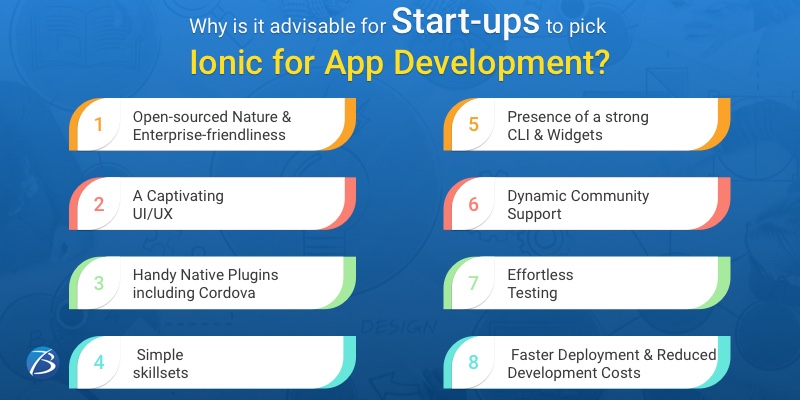
Open-sourced Nature & Enterprise-friendliness
Open-source frameworks are an ideal pick for start-ups owing to budgetary constraints and the core of the Ionic SDK is open-sourced, free, and possesses MIT authorization. As such, Ionic provides several cost-effective app development options. This framework is robust steady, reliable, and supports agile software developmental methodologies. While most of the open-source frameworks are likely to face developmental issues like sudden architectural breakdowns, Ionic is well equipped to tackle such challenges.
The framework is well-maintained and periodically updated by the Ionic team. The Ionic team also promises enterprise-friendly offerings.
A Captivating UI/UX
The UI/UX is a driving factor for an app’s success regardless of whether the app is used for marketing products/services or improving in-house employee productivity. Ionic perfectly meets this requirement as it offers loads of high-end UI elements along with multi-lingual capabilities that lead to the creation of an app with a pleasant and easy-to-use interface. Ionic app developers enjoy access to a wide range of components like themes, paradigms, etc. that help them to create visually attractive apps with a rich UX. Also, the JavaScript and CSS feature offered by Ionic allow developers to customize the app with different kinds of color schemes, menus, cards, and buttons of the app imparting a native-like look to the app.
Handy Native Plugins including Cordova
Plugins are small pieces of code written in JS format that is appended to an application and enable one to carry out tasks like in a native app. This way, plugins enhance the performance of a mobile app. Ionic app developers can access a host of native plugins and APIs to create a native-like UX. Developers can utilize as many as 120 native device features including AUTH, HealthKit, Bluetooth, and Fingerprint.
One of the most crucial plugins available in the Ionic eco-system is the Cordova plugin that allows access to OS features like camera, logs, pro-location, etc.
No need for Specialized Developers
Ionic app development uses popular technologies and programming languages such as HTML, JavaScript, and CSS. Moreover, the base of the Ionic framework is built with the outstanding technology AngularJS and Apache Cordova. So, Ionic app developers can leverage web technologies for building an app and then convert the app into an advanced and fully-functional mobile application. Owing to the use of well-known technologies there isn’t any need for developers to be trained in specific skills or SDKs. Thus, the app owner can save on hiring specialized developers and the app can be developed by regular developers with generic skillsets. That’s why most start-ups hire Ionic app developers for executing their project.
Presence of a strong CLI & Widgets
Ionic offers a built-in CLI (Command-Line-Interface). The CLI is a text-based interface that allows users to activate the “prompt” command to interact with an Ionic app through various commands.
The Ionic framework supports widget creation. Widgets help users to embed the frequently used apps to the home screens of their mobile handsets and the app can be directly triggered from the home screens.
Dynamic Community Support
Start-ups using Ionic enjoy the support of a huge dynamic community. The community lends a helping hand whenever Ionic app developers are struck or have any queries. And, as Angular and Cordova form Ionic’s base, the communities of these two technologies are also quite helpful to Ionic development teams.
A Future-proof App Development Process
Several business enterprises need to act promptly to fulfil their customers’ demands and requirements. But, making any modification, even a minor change, involves extra efforts and added expenses. Hence, companies must choose technologies and frameworks that future-proof the development process. In such scenarios, enterprises that have opted for Ionic app development are able to quickly respond to the modifications demanded by the market, users, or regulatory bodies.
For instance, an enterprise is required to update its branding style or logo. If the enterprise maintains different codebases for three different platforms – an iOS app coded in Swift, an Android app coded in Kotlin, and a web app coded using JS framework – all three codebases need to be updated separately in their respective languages. This is going to be not only time-consuming but also costly. Contrarily, if the company uses Ionic, there’s only one codebase for all three platforms; changes need to be executed on this codebase for updating all the three apps in one go.
Effortless Testing
Ionic offers effortless testing options. Ionic app developers utilize Cordova commands to perform Android app testing on the PC and simulators at the same time. For iOS apps, testing is conducted either on the Safari web browser or a mobile browser. The app can also be directly tested as a native or hybrid app, to gather clearer insights on the app’s functioning. These testing capabilities ensure the creation of a high performant and bug-free app.
Faster Deployment & Reduced Development Costs
Unlike most other frameworks, Ionic doesn’t require specialized developers to create separate codebases for native apps that target the Android and iOS operating systems. Ionic developers need to build a cross-platform app with a single codebase and then customize that codebase to function on Android and iOS. Furthermore, as Ionic involves web technologies and requires widely-practiced skills; it’s quite easy to find the necessary expertise.
On account of fewer codebases, smaller development teams, the availability of robust components & powerful plugins, lesser bugs, and effortless development; Ionic app development is speedy as well as cost-efficient.

Final Words:

Ionic app development is the one-stop solution for modern-day start-ups planning to develop a highly performant app in the least possible time and at a minimal cost. Outsourcing your development project to an experienced Ionic app development company would be a super-convenient option for entrepreneurs as it will reduce their burden to a considerable extent and allow them enough time to oversee core business functions.
Biz4Solutions, a prominent Offshore app development company in India having an industry experience of more than eleven years in Ionic app development would be a wise pick in such cases. We will remain your technology partner right from app ideation to deployment and even offer maintenance & support services post-launch.

Microservices vs Monolithic Architecture: Which Approach is Suitable for a Start Up?

Microservices vs Monolithic Architecture: Which Approach is Suitable for a Start Up?
mobile app development company
Monolithic Architecture is a traditional approach in which the entire app is integrated into a single unified model. The prime objective is to interconnect all features making them co-dependent on each other. This model may sound simple, but creates roadblocks in handling bigger and more complex projects.
Microservices architecture, on the other hand, splits an app into smaller services that are interconnected and interact with each other with the help of APIs. Every microservice is independent, loosely coupled, and possesses a distinct hexagonal architecture comprising of business logic and different adapters. Here, each service is a separate codebase, has its own database, and can be deployed independently. This approach has gained momentum these days as modern-day businesses expect more agility in their operations. Some renowned brands using the microservices approach are Uber, Twitter, AWS, Netflix, and Spotify.
This post explores Monolithic and Microservices architecture in detail, outlines their differences and provides suggestions based on specific project requirements. A quick read will help you to pick the best-suited approach for your upcoming software development project.

Monolithic Architecture: Strengths & Weaknesses

Strengths
Monolithic apps perform speedily at the initial stages as they use local calls in place of API calls throughout the entire network. But, this speed reduces with the expansion of the app. A monolithic app, being a single solution, rather than a set of separate apps, is easily manageable, involve much lower development cost, and encounter very few cross-cutting issues initially.
Weaknesses
When the codebase of a monolithic app becomes huge, the IDE slows down, adversely affecting the developers’ productivity. Moreover, it’s challenging to scale the app, and modifying the programming language or framework that hampers the app’s functioning. Also, it’s pretty expensive to migrate to different technology in situations where monolithic architecture is used.

Microservices Architecture: Strengths & Weaknesses

Strengths
Microservice architectures are well organized – each microservice is responsible for carrying out a particular task, without being concerned about the tasks carried out by the other components. And, since such services are decoupled, they can be effortlessly reconfigured and recomposed to fulfill the needs of various microservice applications. For instance, microservices can serve public API as well as web clients.
Each microservice can be written employing a different technology; for instance, one microservice can be handled by Java developers while the other can involve DotNet developers. Thus, you have the flexibility to choose a particular technology for catering to specific business requirements without having to lock other services with that technology. This helps in optimizing the performance of crucial functions.
Microservices allows you to auto-scale an application as per the load on the app, promises speedier deployment, and eases out rolling updates as there aren’t any dependencies between the services. With this type of architecture, you can execute parallel development by setting up boundaries between various parts of the system; these boundaries are difficult to violate resulting in fewer errors.
Weaknesses
Microservices apps consume more memory; involve higher development costs initially; come with complex requirements regarding the operation, testing, deployment, and management; and need a greater level of developmental proficiency and expertise.

Microservices vs Monolithic Architecture: Comparison

microservices application
Here are some major differences between Microservices and Monolithic architecture based on these crucial parameters.
Architecture
In Monolithic architecture, the app’s UI, database, business logic, front-end, and back-end are integrated into a single codebase; whereas in microservices architecture, all the aforesaid app elements are subdivided and operated independently of each other. Likewise, the processes of testing and deployment are executed under one line in monolithic apps, while in microservices apps, these processes are scattered across different adapters and databases.
Monolithic architecture is deployed in a traditional format and caters to standard web servers. For deploying microservices, on the other hand, a plethora of approaches are supported – One service-One host approach (each service is deployed to one virtual host machine); One Service-One Container approach (microservices are isolated by docker containers, but resources like frameworks, libraries, and operating servers are shared); and Serverless deployment (third-party cloud services host and manage the servers on which the program runs).
Development
Developing a monolithic application is easy if the app is new, but as the app gets bigger developmental challenges crop up. This is because the huge indivisible database needs the joint effort of the development team.
Microservices, on the other hand, offer loose coupling and several options to choose from while picking the tech stack; but the app developers must possess a more profiled knowledge. However, this structure allows developers to work independently on each component.
Testing
Testing is pretty simple in a monolithic app as a single script is used for testing the whole system while testing a microservices application becomes complex as every part of the app needs to be tested separately.
Deployment
Microservices architecture enables continual development and deployment as every service gets individually implemented. With monolithic architecture, deployment becomes slower.
App Updation
The process of updating a microservices application happens uninterruptedly and doesn’t slow down the entire system. Contrarily, updating a monolithic app is voluminous and burdensome and for every update, the entire app has to be redeployed.
Scalability
The bigger the monolithic app the more challenging it becomes to scale the app – for handling new changes the entire system has to be redeployed. In microservices apps, each part is scaled independently without downtime and so, involves fewer hassles while carrying out modifications.
Security and Reliability
Monolithic architecture involves a single source code; communication happens within a single unit, resulting in secure data processing and a simple monitoring procedure. Microservices architecture, contrarily, involves inter processing between multiple API connections increasing security threats, and hence, greater security monitoring is needed. However, in monolithic apps, one bug can hamper the whole system, while in microservices apps, one bug affects only that specific service and the bug can be topically fixed. Therefore, even when one service fails other services are not affected.

When should you pick Monolithic Approach?

You intend to develop a Simple App with faster Time-to-market
Monolithic architecture is an ideal choice for building a simple app that doesn’t require reinventing the wheel and the app is unlikely to scale rapidly. Moreover, developing the prototype of a simple app will take place at a fast pace leading to quicker time-to-market.
Smaller-sized Team and No prior Experience with Microservices
Start-ups with smaller-sized teams will benefit from the monolithic approach as experience and expertise in one tech stack will suffice and your team will not have to handle any developmental complexities. Furthermore, if your team doesn’t have any prior experience of working with microservices, picking this approach will be a risky business. In such a scenario, it’s better to start with a monolithic approach and migrate to microservices later on as and when needed.
Your app idea is Novel, Unproven, or the Proof of a Concept
If you have a novel app idea or planning to create a product that is unproven, your application is likely to evolve with time. Here, a monolithic approach will help in iterating the product speedily. Similarly, if your intended app is all set to prove a particular concept, you need to learn more within a short time and monolithic architecture will prove beneficial.

When should you pick Microservices Approach?

Your app is Complex and needs unprecedented Scaling
If you wish to develop a complicated software solution that involves a rich feature set, a substantial amount of personalization, extensive use of interactivity, a huge amount of business logic, or needs to be run by various modules; microservices architecture is your ideal pick. Start-ups who plan to build a highly innovative and revolutionary app that targets a humongous audience base and comes with heavy scaling requirements are recommended to adopt the microservices approach.
Need for Isolated Service Delivery
Microservices work better if you need to deliver independent services speedily. However, for this, you need a sufficient amount of resources as well.
A part of your Platform needs High Efficiency
For instance, your business is intensively processing petabytes of log volume. In such a scenario, you’ll have to create a service with a super-efficient programming language like C++ whereas the users’ dashboard can be created in Ruby on Rails.
Effortless Team Extension
If you commence your start-up with microservices architecture, your team will get accustomed to the idea of developing small services right from the very beginning and the teams will be segregated by service boundaries. So, later on, you can effortlessly scale up your team as per the need.

When is it advisable to migrate to Microservices Architecture?

It’s time to migrate to microservices architecture when your monolithic app grows big enough to create maintainability issues, when your business functions and their boundaries are crystal clear enough to be converted into individual services, and when your app needs scaling to deal with a humongous user load.
Example: The popular app Netflix started as a monolithic application. With time, the app experienced a surge in the demand leading to issues concerning performance and reliability. As such, the owners migrated their app to the cloud-based microservices architecture. Consequently, the app got segregated into hundreds of microservices and this approach enabled boundless expansion and scaling.

Summing Up:

Monolithic architecture as well as microservices architecture comes with its own set of strengths and challenges. So, when deciding on the most suitable pick for your start-up, you need to first define the requirements of your software development project. If you plan to develop a lightweight app and have budgetary constraints, it’s advisable to go with the monolithic approach. But, if your project is huge with complex requirements or you need to work with futuristic models like Big data, and you can spend on hiring several cross-functional teams, microservices is the most viable option.
If you want to adopt microservices or monolithic architecture, but lack the necessary in-house infrastructure, partner with the distinguished mobile app development company, Biz4Solutions. We would remain your trusted partner throughout the product lifecycle – from app ideation to development to maintenance post-deployment. We have helped several clients from diverse domains across the globe since the last 10+ years to achieve their business objectives.