Blockchain: A Cost-Effective Solution for Aviation Industry

Blockchain: A Cost-Effective Solution for Aviation Industry

blockchain app development
Aviation industry is one of the fastest-growing transportation sectors. With the economies going digital, every sector including aviation needs to ramp-up its technological footprint. Blockchain is digitalizing aviation industry in a big way and opening doors to new opportunities. It provides high-level security and transparency that has a multifaceted impact on the aviation sector. Blockchain app development companies are enabling the aviation industry to make easy transition to a Blockchain-based ecosystem.
According to Allied market research, the global aviation blockchain market was estimated to value about $0.42 Billion in the year 2020. It is expected to reach a valuation of $1.15 Billion by the end of 2030. These statistics only indicate, that many more aviation companies will adopt Blockchain as their core technology, creating a wide space of growth for Blockchain app developers and companies.

What Does Blockchain Offer

Blockchain is the emerging language of global exchange which is more authentic, organized, secure and transparent. Blockchain offers:
Decentralized System
The process of storing the data is fixed and organized. The decentralized computer system records every transaction, encrypts it and stores it in a digital ledger which is a shared system.
Consensus-Based Mechanism
Changes cannot be enforced by any single member. Every change and update is bound to be approved by every member for it to become part of the already established mechanism.
Failure-Proof Architecture
A major benefit of the decentralized system is that an error at one point does not influence the other nodes in the system. Every transaction is recorded and stored as data blocks in the hierarchy of their time stamp. This chain of blocks keeps increasing with every transaction, offering a very high level data integrity. While every transaction is connected with the other, it is also separate and unique in itself.
Security
There is a version system in the ledger where the same version is reflected to every member. This means that no one can alter anything without the consensus. Moreover, every data is encrypted by the system. Put together, Blockchain can be one of the safest technologies for any kind of transactions.

Challenges Faced by the Aviation Industry

The aviation industry is a very complex sector that involves the tracking of numerous assets, and transactions. Safety of every traced entity has always been a challenge. Every challenge ends up costing the airlines in terms of money. Let us look into some of the challenges:
Lack of real-time flight transparency
The real-time tracking of manned and unmanned flights is a major challenge ahead of the aviation sector as it can result in major hazards. A lot of manpower is invested in maintaining this information every minute, costing millions of dollars to the airports.
Overbooking
Airlines generally overbook the flight assuming unavailability of few of the passengers, resulting in a major disappointment for the passengers.
Poor insurance and refund policies
In cases where the passengers are denied service owing to over-boarding or flight delays, they have to undergo a time-consuming process for refunds. This results in poor customer experience.
Luggage misplacement
Misplaced luggage is a frequent episode that costs money and woes to the air fliers. The long-pending requirement of a mechanism to tag and trace the assets including luggage can be very beneficial.
Lack of systematic record-keeping
Record keeping is a major task that currently involves different aspects including technologies, systems and manpower, consuming hundreds of dollars.
These are some of the everyday challenges and there are many more that demand an effective technology for aviation management.

Blockchain as a Solution

Blockchain can be implemented in a number of areas in the aviation sector to efficiently tackle small and big challenges.
blockchain app developers
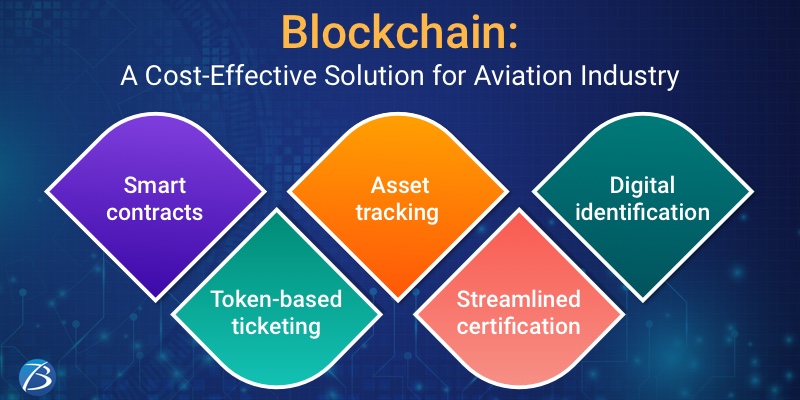
Smart contracts
Smart contracts can manage the transactions between all the involved entities including airlines and travel agents, unifying different processes such as monitoring, reconciliation, and settlement. The streamlined process enhances the accuracy, and speed of every transaction. Involving multiple vendors and partners for different activities costs any airline, some thousands of dollars.
Token-based ticketing
Smart token systems can revolutionize ticketing systems with tokens for passengers and assets. Tracking of assets and passengers can tackle issues such as overbooking, and unorganized intermediaries. Frequent flyers can benefit from loyalty points and compensation vouchers, a great step towards customer satisfaction. Optimized use of transaction money helps both parties in saving money.
Asset tracking
Asset tracking using the digital ledger can put an end to the problems related to luggage tracking and misplacement. All the valuable assets can be tagged to get their status and location. Blockchain is the tamper-proof and robust solution to record every event and transaction.
Streamlined certification
Certifications to validate every equipment, individual and process involved in the operations and management of the airlines can aid in providing necessary regulatory authentications. Streamlined and regulation-based processes ensure partnership with legit and responsible groups/individual to create a value chain.
Digital identification
Digital identification of assets contributes in the scalability of the airlines, providing it with the infrastructure to go global and collaborate with valued profitable partners.

Blockchain as profitable solution

Blockchain is the disruptive technology that offers multiple benefits including immutability, traceability, and transparency. Secure and decentralized storage and exchange of data without involving any third-party significantly enhances the efficiency of the airlines. A fully digitized system cuts down the cost of hiring multiple third-parties for operations and management, resulting in saving millions of dollars. Blockchain apps add infinite benefits for the management and governance of airlines.
Blockchain comes with multiple use cases for aviation industry with the potential to place any airlines on international platforms to collaborate with cross-border third-parties. Biz4solutions can be an ideal software development partner to develop scalable, responsive and user-friendly Blockchain applications to boost the efficiency and revenue of any airlines.


Top 8 Tools for Debugging React Native Applications!

Top 8 Tools for Debugging React Native Applications!
React native app development company
Debugging an application is the most essential part of the complete React Native development process before the application is pushed to the production phase. This is true for other technologies as well. Debugging involves thorough checking of the code and helps in the early detection of error conditions. Fixing these errors or bugs during the React Native app development process, instead of fixing them in the production stages can be highly economical for every company offering React Native app development services.
So, how does the debugging take place in React Native? Well, thanks to the availability of a wide range of React Native debugging tools that help the developers debug their code efficiently in a short time.
This post is a brief guide for you, where we will be exploring the most popular debugging tools used for React Native applications globally. So let’s quickly get started.

Most Efficient Debugging Tools for React Native Developers

React native app development
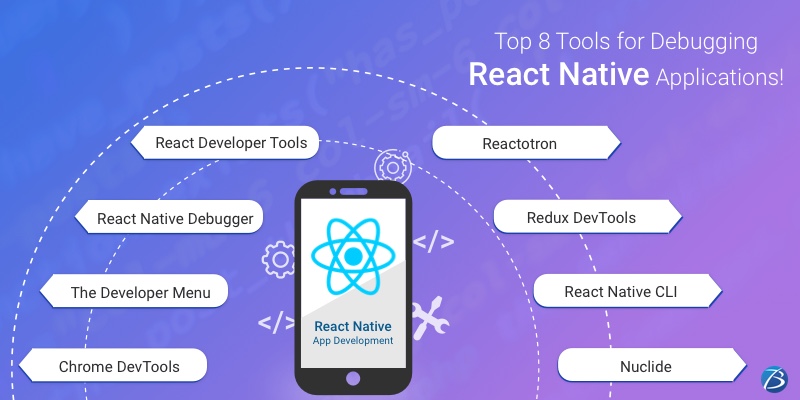
React Chrome Developer Tools
‘Chrome DevTools’ is usually the first name that comes to the mind of a React Native developer for debugging the code of an app. Being powered by JavaScript, this tool enables the debugging of both web appsas well as mobile apps. The React Native framework supports this tool through its remote debugging abilities by default.
So how does this tool work?
When your React Native app is running on an Android Emulator and you have to access the in-app developer menu, press ‘Cmd+M’ on Mac or ‘Ctrl+M’ on Windows. When the app runs on a real device, simply shake the device. Now, a menu will appear and you need to click on “Debug JS Remotely” to open the Google Chrome debugger. Thereafter, press ‘Command+Option+I’ on Mac or ‘Ctrl+Shift+I’ on Windows to open Developer Tools. You can now use console statements and debug the app. You may view your code by clicking on the Developer Tools Sources tab and open-sourcing the files. From here, you can add breakpoints and easily debug the app using the ‘Chrome DevTools’.
The Developer Menu
The developer menu comes with a plethora of options for the developers to carry out various functions, as given below:
  • Reloading option for reloading the app
  • Enabling Hot Reloading for watching the changes accumulated in a changed file
  • Debugging js remotely for opening a channel to a JS Debugger
  • Enabling Live Reloading for allowing the app to automatically reload when the save button is clicked
  • Toggle Inspector for toggling an inspector interface. It enables the developers to inspect a UI element present on the screen along with its properties. This interface has some other tabs too, which include a tab for performance and for networking that show us the HTTP calls
React Native Debugger
This React Native tool is a stand-alone desktop application that works on Linux, Mac, and Windows and is one of the most recommended debugging tools. It can be integrated with the other two tools- React’s Developer Tools and Redux DevTools, thus giving you the best of both tools. This combination doesn’t require any setup and can be installed quickly with ease. With this combination, react native developers can get some of the best features as below:
  • Profiler: Identify performance issues by getting a flamegraph with components
  • Elements: for examining the styles of the elements, editing them, and instantly viewing the results in the simulator
  • Console: for examining different errors and warning messages
  • Network: for checking and recording network requests
  • Sources: for debugging JS, setting breakpoints, and walking through the code.
  • Memory: for detecting any memory leaks
React Developer Tools
This tool is considered one of the best tools for debugging React Native due to the following reasons.
  • This tool allows the debugging of React components.
  • Its new version allows debugging styles in React Native and also works simultaneously in the developer menu with the inspector. In this version, the developers can debug and employ the style properties and without even reloading the app can instantly view the modifications implemented in the app.
So how do you get started with this tool?
You need to use the desktop app for debugging React Native with this tool. It can be installed locally as well as globally in the project by using the below command- “yarn add react-devtools” or npm- “npm install react-devtools –save”
Now you can start the application by running the command- “yarn react-devtools” which will launch your application.
Reactotron
This open-source desktop app was designed in 2016 by Infinite Red. This tool enables the inspecting of the apps quite effortlessly. It is available for various operating systems like Linux, Mac, and Windows. It offers amazing features like:
  • state tab
  • React Native tab
  • timeline tab for tracking app events and Redux actions
  • connections for running several devices simultaneously and quickly switching debugging
Redux DevTools
Redux DevTools is also a standalone tool and a state container for JS applications. It is meant for both- React Native and React JS. It is used for common state management and allows easy inspection between actions and their reflections on the data store. Redux DevTools allows using redux debug components directly into the applications. This tool comes with several useful features such as Chart, Slider, Inspector showing real-time actions, Dispatcher, State tab, Action tab, Diff tab, Log Monitor, Test tab, Export/import, etc. You can start using this tool by installing the Redux Devtools Extension to the firefox or chrome browser.
React Native CLI
This React native tool is majorly used for developing React Native apps and is also used as a debugging tool at times. React Native CLI helps to access some relevant information about the dependencies and libraries used in the app. This information can be then used for debugging some bugs that take place due to a mismatch of different versions of tools being used for your app development.
Nuclide
Nuclide is an open-source tool and enjoys the support of a strong community. It can be added as a plug-in on top of Atom- a renowned IDE built by Facebook. It offers some outstanding features like auto-complete, jump-to-definition, inline errors, etc. Also, it provides services like Hack development, Remote, and JavaScript development, working sets, built-in debugging, task runner, mercurial support, etc.
So, our blog comes to an end with this.

Final Verdict:

Apart from the tools mentioned above, there are several other React Native debugging tools like Flow, Expo, Ignite, Visual Studio Code, etc. that can be considered by the React Native development services for their projects. It depends on what tool seems right for your project requirement, what your budget and time considerations are, and what your developers are convenient with. You may even go with a combination of some of these tools. And last but not the least, hiring skilled and experienced React Native developers or React native app development company also impacts the debugging process.
We hope this read was insightful!
Do share your knowledge and experiences about other React Native Developer Tools in the comments section.
Here is a detailed list of the top-notch React Native developer tools widely used for serving various purposes like development, debugging, testing, etc. in the React Native development process.
Also, here are some of the UI component libraries used in React Native for building world-class apps.