
Top Benefits and Key Features of a Proficient Inventory Management System!

Just imagine!
A businessman is trying to run his business without knowing how much the stock in the inventory is, or the workers do not know the where-about of the product when there is a sale or an urgent requirement from any client. Or even worse, the products are being stolen by someone and there isn’t any record of it. What do you think will be the results in the long term? Losing the customers to a competitor? Ruining the relationship with clients? Incurring huge monetary losses? Or maybe all of these! Well, all these inherent issues can be resolved by businesses if they embrace an inventory management system.
The significance of such a system is monumental as it helps the businesses to track the inventory levels, track sales, orders, and distributions smartly thereby reducing the business losses. IoT is one of the key technologies being used widely in such systems – IoT in scanning the inventory using RFID, IoT in transportation and Logistics, etc. So, in this blog, to get a fair idea, we have outlined the advantages and key features of a technology-smart inventory management system.
Why the Need for an Inventory Management System?
- High transparency and visibility of product levels
- Preventing stock-outs and overstocks
- Minimization of capital investment
- Enhancement in business operations and workflows
- Accurate inventory tracking
- Getting rid of paper-based and spreadsheet tracking
- Appropriate planning of inventory balance
- Better warehouse management and utilization of warehouse space
- Time-saving due to automatic inventory and order management
- Cost-cutting by reducing manual labor intervention
- Increased efficiency of payment/billing details
- Improved relationships with vendors and clients
- Improved employee efficiency
- Enhanced inventory turnover and thus, better revenues
Top-notch Features of a Smart Inventory Management System!
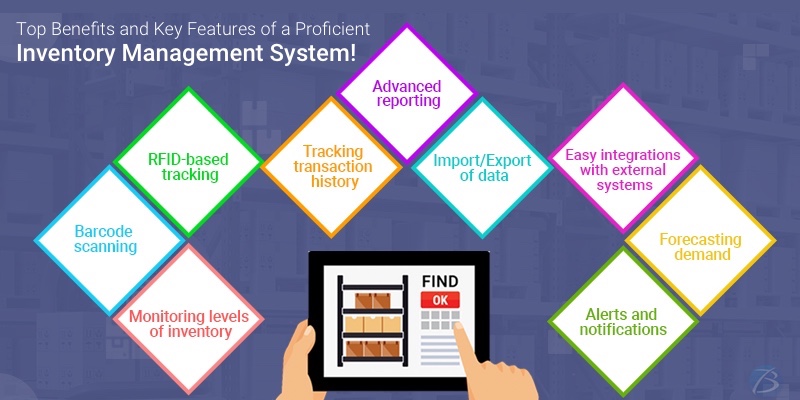
Check out the essential features of an ideal inventory management software.
-
Real-time Visibility of Inventory: A smart inventory management system must ensure that all the items in the inventory are under real-time visibility. Every item entering or leaving the warehouse must be tracked and this data should be stored digitally.
-
Monitoring levels of Inventory: An effective system must allow proper management of orders, raise alarms when inventory drops below a threshold limit or exceeds it. This feature allows decision-makers to take necessary actions like ordering fresh inventory, avoiding excessive stocking, etc.
-
Barcode Scanning: A barcode is a machine-readable code used for stock management and control. Barcode scanning is a must-have feature for easy identification of products, labeling, and sorting into categories.
-
RFID-based Tracking: RFID-based inventory tracking and control allows real-time and automated tracking of the inventory. Hundreds of tags can be read simultaneously making the process much faster and cost-effective. RFID technology is also capable of sending alarms and alerts in case of emergencies.
-
Advanced Reporting: An inventory management system should provide accurate insights on factors like stock management, sales, purchase, suppliers, customers, payments, etc. Reports of transactions, inventory totals, order details, etc. are mandatory for ensuring efficient workflows, and for augmenting efficacy. This feature helps to monitor the progress in the sales and understand which product is in high demand and which isn’t.
-
Tracking Transaction History: This is an absolutely essential feature. All the inventory-related details right from the receipt to shipment of the inventory must be tracked and stored. Details like the number of products, receipt dates, expiration dates, shipping dates, etc. must be saved and should be easily accessible by the concerned personnel whenever required.
-
Management of Multiple Warehouses: A single system should allow the management of multiple warehouses that may be located at different locations. This feature is especially relevant to companies that operate across multiple locations.
-
Grouping of Inventory: Grouping of the material according to its specification, size, components, etc. into predefined categories is another important feature. It enhances the inventory organization.
-
Easily Configurable: A good inventory system should be able to be configurable with different business entities easily and be successfully employed without much customization.
-
Easy Integrations with External Systems: System should be able to integrate with third-party ERP systems or a Warehouse Management System or Shipping companies with ease. A company may also want to integrate other systems for data analytics, corporate accounting, planning, etc. in the inventory management system which should be easily possible.
-
Forecasting Demand: This feature allows extracting the past data to identify the demand in the future; which in turn helps to make pro-active business decisions, build good relationships with customers, and boosts sales.
-
Security Features and Backups: It isn’t a good idea to invest in an inventory system without knowing about its security measures. To ensure high data security, there should be security features that allow only authorized people or give partial rights to access the data. This would prevent the system from any data misuse or data leakages. Also, there should be daily backups available. So, in case you lose the data to a third-party hack, or any other threat, you will be able to start the operations again without much trouble.
-
Receiving alerts: This feature allows the alerts and notifications about the receiving, picking, shipping, of the inventory, or when inventory is running low or there is overstocking of inventory.
-
PDF Printing: The inventory management system must be able to create or print PDF documents related to invoices, packing slips, shipping labels, quality control documents, etc. and such related documents.
-
Import/Export of Data: This is another advantageous feature of this system. It should be able to import data with ease to reduce data entry work and streamline mass changes. The System should be able to export data like shipment lists, inventory item lists, master data of vendors, customers, etc.
Are You Interested in Building a Top-Class Website or Mobile App?
Final Words:
When a business relies on traditional ways of inventory management, there are chances that data could be inconsistent or inaccurate. These ways are prone to human errors which could cause huge monetary losses at times and adversely affect business growth. Also, there could be security issues in them. A smart inventory management system embedded with the above features has ample advantages over traditional systems. It has impacted several businesses across the globe.
Would you like to develop such a system for streamlining your business? Contact Biz4Solutions, a prominent offshore software development company in India and U.S.A., for crafting a smart inventory management system customized as per your needs.
I hope this blog was helpful. Please feel free to comment below to let us know your thoughts on this.
For any queries, mail us at sales.enquiry@biz4solutions.com


