Social Networking App Development: Features and Technology Stack for a New-age App!

Do you know?
“The number of social media users is projected to cross 3.43 billion in 2023, which will be nearly half of the total population of the world then.“
These numbers provided by Statista, a reputed online statistics portal, are astonishing! They showcase that this industry is growing by leaps and bound. Not only individuals but even professionals and business enterprises use these platforms for their growth. As a result, a plethora of social networking app development services has emerged across the globe. These apps have evolved over time with innumerable trendy features and tools. So one needs to keep abreast with the latest trends for each platform to build a top-of-the-line social media app.
This blog instills a detailed overview, features, and technology stack for architecting social media or social network apps. Let us delve into them.
Major Types of Social Media Apps
- Photo/media-sharing platforms like Instagram, Snapchat, YouTube, etc.
- Social network apps like Facebook, Twitter, etc.
- Chatting apps like WhatsApp.
- Blogging and publishing sites like Medium
- Internet discussion forums like Reddit, Quora, etc.
- Business networking sites like LinkedIn.
- Consumer review platforms like TripAdvisor.
- Anonymous social networks like Anonyfish, Minds.com, etc
These apps have a general set of features embedded in them which are a must-have for any social media app. Let us have a glance at them:
Fundamental Features of Social Media Apps
Captivating user interface: The UI should form a great impression on users enabling easy navigation through the app. It should have a powerful and interactive visual design.
Easy registration and login: Considering the short attention span of today’s users, the registration and login processes must be as easy as possible.
Easier search functionality: Users should easily be able to search for anything by user names, tags, location, etc. As they start searching, the results should be filtered out and shown in a drop-down style at the earliest.
Private chatting and calling functionalities: A convenient chat feature for sending messages, photos, or other media and a calling feature to connect seamlessly are vital for these apps.
Message status: The users should be able to know if their message was read by the other users; they should also be able to hide their status if needed.
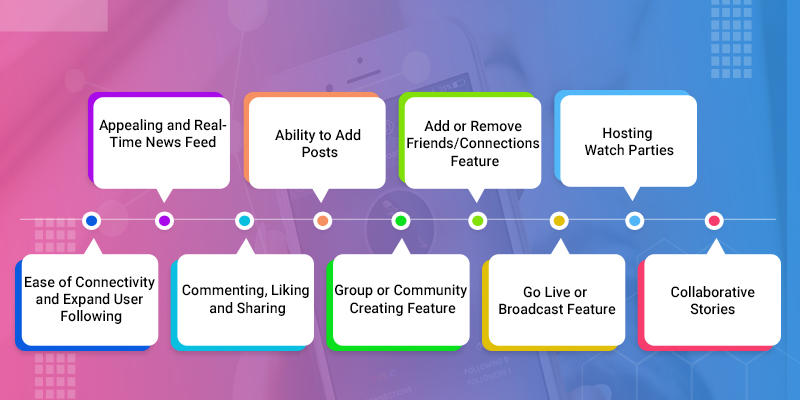
Ease of connectivity and expand user following: These apps must allow the users to easily access millions of people with ease and thus, build a following at a fast rate.
Creating and editing user profile: A thoughtful user profile that helps users to attract their target audience is essential for a social app. Users must be able to edit or customize it as well.
Push notifications: For keeping the users notified of recent activities and also about promotional activities, this feature is a must-have in the apps.
Appealing and real-time news feed: Relevant, real-time, and engaging news feed helps the users to stay tuned with information from friends and other communities. This potential feature compels the users to keep scrolling continuously.
Commenting, liking, and sharing: These features also ensure more engagement of the users.
Ability to add posts: Users should be able to express their thoughts on the platform. They should be able to share or upload files in the form of text, image, audio, video, etc. formats.
Group or community creating feature: Users, whether individuals or business entities, having common goals, interests, and values should be able to form groups or communities.
Add or remove friends/connections feature: Users must have the freedom to add, remove, or block their connections and also report if needed. This feature is extremely important in a world where unknown people connect so fast.
Emojis, GIFs, and stickers: These functionalities are necessary for ensuring that the apps give a more interactive and intuitive feel to the users.
Ability to integrate with other social media platforms: This feature helps the app owners to increase their user-base and drive adoption, thereby increasing its popularity.
Top-level security and privacy of information: Higher security and privacy features must be employed in the social apps to ensure secure interactions, prevent sensitive information of users, gain their confidence and thus, maintain the good reputation of the social network app.
A few more Advanced Features
- Go live or broadcast feature
- Hosting Watch Parties
- Ability to highlight best stories
- Ability to edit, crop or rotate images
- Collaborative stories i.e. short-lived stories for one-day or limited time-span
- Person-to-person (P-2-P) payment
Now as we are done with the features part, let us move to the technology stack requirements of these apps. There are two major parts- frontend and backend. Apart from this, we will also discuss the admin panel and database.
Social networking app development: Aspects to look for in Technology Stack
Frontend
Frontend development depends on several factors like frontend features to be inculcated, the framework to be chosen for faster development, best performance, and the flexibility of the app.
For developing a web frontend, AngularJs and Bootstrap are considered reliable. Some can also use ReactJs. After deciding these platforms, one can combine them with HTML and CSS for styling capabilities and develop outstanding social apps.
For developing native apps, native languages like the below can be preferred:
- Android- Java or Kotlin
- iOS- Objective C or Swift
For developing hybrid apps, one can use frameworks like Ionic, React Native, Flutter, Cordova/PhoneGap, etc.
Backend
Backend is a crucial part of development for determining what logic will be used and how. Node.js is being widely used for backend development of dynamic social apps that focus on real-time events that need quick data processing with minimal latency. Apart from Node.js, PHP and Ruby are also being used for backend development.
Admin Panel
The Admin panel can dramatically impact the budgets. Admin panel can be either developed in-house or with the help of other development companies, depending on your requirements and goals. Since it is a time and money intensive process, several companies don’t build their Admin panels from scratch and work with a third-party service. However, with third-party services, there are limitations as customization is not possible.
Database
Social apps need a huge amount of data to be accessed, stored, and processed. There are multiple databases available for the diverse needs of the apps. One can select any database: MySQL, PostgreSQL, SQLite or NoSQL database- for instance, MongoDB. However, we recommend using PostgreSQL or MySQL. For cloud services, Amazon Web Services are highly recommended as storage for all the data.
Are You Interested in Building a Top-Class Website or Mobile App?
Wrap-up:
The best social network apps on the internet attract millions of users daily. This fact has inspired several business enthusiasts, investors, and entrepreneurs to break into this arena. We hope this blog has guided you in your social app development journey with the features and the technology stack to be used.
Please feel free to comment below to let us know your thoughts on this.
You may drop us a mail at sales.enquiry@biz4solutions.com for any doubts!