How IoT Makes the Transportation Industry Smarter

How IoT Makes the Transportation Industry Smarter
IoT app development
If the safety of your vehicles, employees, and passengers is a concern, if you are facing issues in the business process improvement, if the rising cost of operation is threatening your profitability, then the internet of things i.e. IoT in your transportation business could be the right solution as it is transforming the way this industry operates.
Internet of things continues to dominate the future of several businesses and the transportation industry is no exception. As per IoT analytics, Inc. (the online portal that engages in researching about IoT market insights), the IoT market is booming despite the adverse impact of the Covid19 pandemic on most related sectors. The total number of connected IoT devices will reach approximately 27 billion by the year 2025. These are pretty big numbers and the future seems bright.
IoT in the transportation industry uses a network of centrally connected devices with sensors, GPS, electronic monitors, RFID systems, etc. to ensure real-time visibility. These devices are connected to vehicles or off-road locations like owners or/and customer’s warehouses, offices, or stores. Thus, the internet of things enhances operational efficiency.
It is interesting to know how the internet of things is contributing to smarter transportation systems and ultimately a smarter world. The top benefits and use cases are as follows.

Benefits and Use Cases in the Transportation and Logistics Industry
IoT in Transportation
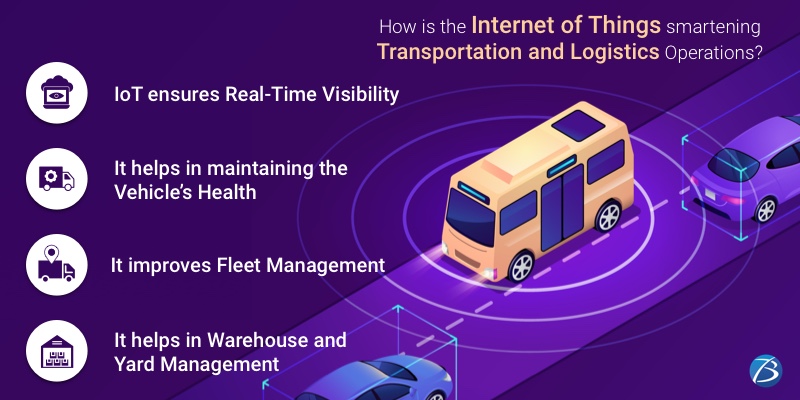
IoT ensures Real-Time Visibility
Transparency is a game-changer in the transportation and logistics industry. Internet of things makes operations transparent by providing real-time visibility. Issues like truck weight management, delays in traveling, energy and resource management, performance monitoring, location tracking, and safety management can be handled well.
The significance of real-time visibility is especially felt in the trucking and freight shipping business. If your freight bills are rising or you feel your truck drivers aren’t loyal to you, then internet of things can help to keep a track of the freight. An ideal example of the implementation of IoT in transportation is a software solution named AppWeigh. It is a specially designed smart app that measures the load on trucks throughout their shipment and sends the information to the owners on their smartphones. If the load on a truck is reduced or increased beyond the limit, then the owners immediately get notified. They can ensure that their goods are transported legally and safely to the destination. AppWeigh uses technologies like beacon integration, Bluetooth-enabled sensors, geo-location tracking, etc.
It improves Fleet Management
Internet of things strengthens the operations in fleet management – maintenance of vehicles, their financing, tracking, diagnostics, management of fuel, management of drivers, and safety management. For instance, special sensors are placed on the trucks that track pressure on the tires, load on the truck, unsafe speeds, or driving patterns and send notify the fleet managers accordingly. It helps the managers to track shipments, manage the drivers, optimize shipping routes and cut costs related to staff inefficiencies.
IoT Fleet management apps provide real-time information about the location of the vehicle using geolocation tracking. After incorporating IoT in the transportation industry, fleet managers can go the extra mile to improve its overall functioning.
It helps Maintenance of Vehicles’ Health
Smart IoT systems developed by smart IoT developers can monitor the wear and tear of vehicles and analyze vehicle health. Barcode scanning, GPS tracking, mobile fuel logs, sensors, camera, etc. are used for this. These provide information about engine health, fuel consumption, and inefficiencies. Some sensors are used to track the temperature of the products, shock and vibration levels, etc. to ensure that the goods are in safe conditions.
Using this information, the business owners can reduce maintenance costs saving thousands of dollars. Any breakdown issues of the vehicles can be detected in advance using IoT the in transportation industry, preventing major damages.
It helps Warehouse and Yard Management
If warehouse and yard management aren’t managed properly, it directly affects the cost of the business. IoT systems use beacon integration, SMS and email notification, BLE connectivity, scanning and detecting sensors, etc. for warehouse and inventory management. They ensure that the right products are placed in the right quantity and the right place at the decided time. These systems reduce human activities and enable machine intervention. They help to automate the tasks which reduces errors caused due to overlooking or visibility-related issues by humans.
IoT in Transportation Minimizes Risks and Increases Profitability
  • With real-time information, one can be loyal to their clients by informing them about any delays, changes, cancellations, etc. beforehand. Eventually, this improves customer relationship management (CRM).
  • IoT in transportation helps to increase the connectivity of owners and managers with operators and drivers. Thus, they can instantly communicate about any issues ensuring pro-active repairs and maintenance.
  • It provides robust security services to passengers and employees along with vehicles, equipment, freight, and data as well.
  • Illegal practices by drivers or operators can be easily prevented with the help of the internet of things during transportation. It provides transparent information which helps predictive analytics which can lead to better planning of the resources.

Conclusion

It’s evident why IoT applications are a blessing to the transportation and logistics industry. With so many benefits, transportation is increasingly becoming more dependent on IoT-empowered solutions/systems. It promises extensive profits for logistics operators, business clients as well as end-users.
All you need to do is hire competent IoT app development services for building customized IoT solutions as per your requirements. In this regard, Biz4Solutions, a distinguished Iot app development company is worth a try. We help with crafting and incorporating intelligent transportation systems so that business owners can pull ahead of their competitors and grab higher business opportunities.
Prominent Back-end frameworks to consider in 2022!

Prominent Back-end frameworks to consider in 2022!
While the front-end constitutes the visual part of an app, the back-end is responsible for the app’s functioning. And, a back-end/ server-side framework is a library containing tools and modules that create the architecture of a website or an application. Unlike front-end development that involves creating/implementing the client-side of an app like UI/UX design, the layout of the app, etc.; back-end development takes care of the server-side requirements – the creation of back-end functionalities, the implementation of database systems, and communication between various web services.
Exemplary back-end frameworks ease out the developers’ tasks by providing them with ready-to-use app development solutions. But, picking the right one is an uphill task due to the availability of multiple outstanding frameworks. So, I have listed down the noteworthy back-end frameworks to consider in 2022 and their lucrative offerings. A quick read will help companies offering web/mobile app development services to pick the most suitable backend framework for their upcoming project.

Noteworthy Back-end frameworks of 2022

A research report published in January 2022, by YouTube’s analysis and data visualization project “Statistics & Data” enlists the top backend frameworks based on their popularity amongst users. The frameworks have been ranked as per the number of repository stars earned from users.
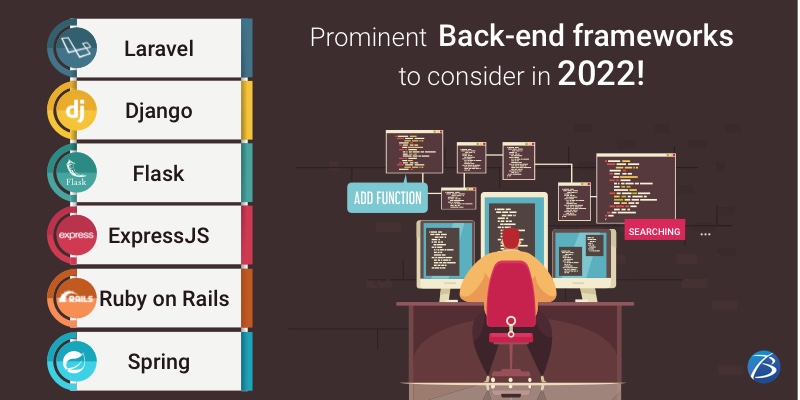
As per the report, Laravel tops the list with 67,902 repository stars followed by Django with 61.614 stars, Flask with 57.681 stars, ExpressJS with 55.520 stars, Ruby on Rails with 49,840 stars, and Spring with 45,609 stars.
Now, let’s explore these frameworks in detail!
mobile application development services
Laravel
This open-source PHP web framework is employed for building Symphony-based web applications. It comes with a modular packaging system having a dedicated dependency manager. Laravel possesses an MIT license and has hosted its source code on GitHub.
Offerings
  • MVC Architecture:
  • Laravel’s support for MVC architecture helps to:
    • Effectively separate the presentation layer and the business logic layer
    • Improve an app’s performance, security, and scalability
  • Effective Templates:
    • Light-weight built-in templates that are used for creating content and crafting simple as well as complex sectioned layouts/designs
    • Widgets having CSS well as JS code
  • Eloquent ORM:
  • On account of Laravel’s eloquent ORM (Object Relational Mapping) developers reap the benefits of:
    • Effortless implementation of PHP Active Record
    • Can help developers create database queries employing PHP syntax, without the need for creating an SQL code
  • Robust security:
  • Laravel promises high app security with the use of:
    • Hashed and salted password techniques
    • Bcrypt Hashing Algorithm for the generation of encrypted passwords
    • Ready-to-use SQL statements for ruling out events of injection attacks
Benefits
  • Simple Configuration:
  • Laravel comes with a simple configuration which eases out:
    • implementing authentication
    • controlling access resources
    • authorizing logic management
  • Plain-sailing API:
  • Laravel offers
    • A plain-sailing API that functions seamlessly with the SwiftMailer library
    • Drivers like Amazon SES, SparkPost, Mandrill, SMTP, and Mailgun
    • Amazing PHP drivers for sending mails
    • The usage of a local/cloud-based service to speed up the sending of application mails
    • Support for sending notifications through multiple delivery channels
  • Cache Backend Support:
  • Laravel provides support for popular cache back-ends including Memcached and Redis. Moreover, a file cache driver is employed for executing the process of cached object storage within a file system. Furthermore, Laravel users are empowered to configure several cache configurations.
  • Effective Solutions for Error Handling and Testing:
  • This backend framework
    • Has pre-configured exception and error management functions
    • Has Integration with Monolog logging library
    • Has support for several log handlers
    • Has support for PHPUnit testing as well as a ready-made phpunit.xml file for apps
    • Offers Helper methods for expressive app testing
    • Simplified user behavior simulation for functions such as the filling of forms, application requests, link clicks, etc.
Django
This high-end Python-based backend framework has been leveraged by biggies like Dropbox, YouTube, and Google Search.
Benefits
  • Reduces the amount of coding, leading to effortless backend web development and a faster development cycle
  • Creates data-driven and scalable websites with rich features.
  • Makes way for optimal pluggability, reduces coding time, and speeds up development
  • Facilitates clean and speedy development
  • Is one of the most viable options for projects with strict deadlines
  • Has hundreds of libraries and a large community
  • Manages the account and password without providing relevant information in cookie files from where it can be stolen, thereby tightening up app security
Flask
Flask is a Python-based backend framework used by brands like LinkedIn and Pinterest. It is a versatile framework that is suitable for developing small-scale as well as large-scale backend development projects. It is considered to be a micro web framework as it doesn’t need any tool or library for development. Besides, it does not have any components like form validation, database abstraction layer, etc. where the already present third-party libraries offer common functions. Nevertheless, this framework does support extensions for adding app features and other utilities, but these extensions have to be implemented in Flask itself. The extensions include certain framework-related tools, various open authentication technologies, form validation, object-relational mappers, etc.
Flask provides support for secure cookies, RESTful request dispatching, Jinja2 templating, and unit testing.
ExpressJS
Also called Express, Express.js is a Node.js web app development backend framework. It is open-source and licensed under MIT. This standard Node.js server framework is employed for creating web apps and APIs.
Offerings
  • Presence of Middleware in this backend framework facilitates the streamlined organization of different functions
  • Availability of template engines that help backend developers to build dynamic webpage content by creating HTML templates on the back-end
  • Higher programming speed due to the requirement of a few lines of code
  • A highly sophisticated routing mechanism that can manage dynamic URLs
  • Convenient and effortless debugging mechanism
Benefits
  • An easy learning curve for developers
  • High performance owing to the usage of JavaScript’s V8 engine
  • Utilization of full-stack JS features for front-end as well as back-end development that saves time and money
  • Ease of use owing to the support for the same language – JavaScript – for server-side as well as client-side web app development.
Ruby on Rails
Ruby on Rails is written in Ruby and licensed under MIT. This framework is fifteen years old and is employed for architecting eCommerce apps, stock exchange platforms, social networking websites, and informational portals. Several big brands like Airbnb, Hulu, GitHub, and Goodreads have reaped the benefits of RoR.
Offerings
  • Supports MVC (Model-View-Controller) architecture to separate the business logic from other parts of the app
  • Adheres to the principles of CoC (Configuration Convention) and DRY (No Repetition)
  • Produces clear, crisp, and consistent codes
  • High code reusability results in reduced time-to-market
Benefits
  • Its encoding process is easily understood and self-describing and hence, developers do not need additional documentation for starting a new project.
  • Its predictable nature facilitates the addition of new features as per the needs of the project.
  • It offers a top-quality development setup that is consistent and bug-free.
  • The framework is not only powerful and scalable but also highly affordable.
  • It lays focus on the conventional elements so that developers do not have to configure a custom developmental environment every time.
  • It boasts of a huge and dynamic community of developers that collaborates diligently for detecting as well as fixing vulnerabilities and extending help to RoR users.
Spring
Spring is an open-source Java-based backend framework designed by Pivotal Software, Inc. It was crafted for simplifying the tasks on microservices and can be utilized for standalone Java apps as well as traditional WAR apps.
Offerings
  • The presence of a simple workflow, flexible XML configurations, database transactions, reliable batch processing, and a wide variety of development tools
  • Helps developers to perform lazy initialization
  • Allows customization of banners
  • Availability of fluent builder API
  • The presence of a “liveness state” – notifies the app’s internal state and processes recovery in cases of app failure
Benefits
  • No boilerplate configuration is needed
  • SpringBoot starters for developers’ convenience
  • Embedded support for Tomcat, Undertow, and Jetty
  • Easier dependency management, easily customizable app properties, and effortlessly manageable profile-specific properties
  • Default settings for integration testing and unit testing

Final Thoughts:

I hope the aforesaid insights about the popular back-end frameworks and their exceptional offerings have provided you with the necessary guidance you were looking for and will assist you to select a suitable technology stack for your next project.
However, if you are a start-up or require technical assistance regarding app development, it’s advisable to hire professional help. Biz4Solutions, an experienced and proficient outsourcing software development company, would be a viable option in this regard. Reach out to us and we’ll help you to fulfil your business objective.
