Noteworthy Pros and Cons of the React Native Framework!

Noteworthy Pros and Cons of the React Native Framework!

React Native App Development
Why does every next-gen organization want to leverage mobility solutions today? That’s because the mobile apps have become the fast-track solution to influence the audiences. So, every company wants a dedicated mobile app.
But the real confusion arises when it comes to the choice of the right framework for mobile app development. As there are a vast number of competent frameworks available in the market, selecting the right framework becomes challenging.
What if there exists a promising framework that helps to design top-quality apps with fewer resources?
The Name of such a framework is React Native and is developed by Facebook and Instagram. React Native mobile app development is preferred by several big players in the market like Facebook, UberEats, Delivery.com, Skype, Bloomberg, Instagram, Vogue, Tesla, etc. to name a few. Javascript and JSX are used to create IOS and Android native apps. With the help of native layout components, React Native is able to create convincing UIs that are pretty much similar to native apps.
Reusability of components, sharable code repository and, “Learn once, write anything” objective, have already made React Native a winning choice for cross-platform app development. So, if you are going to build your next app with this framework or going to hire a React Native development company for your project, this blog will help you to make an informed decision. Here’s a list of some noteworthy pros and cons of the React Native framework.
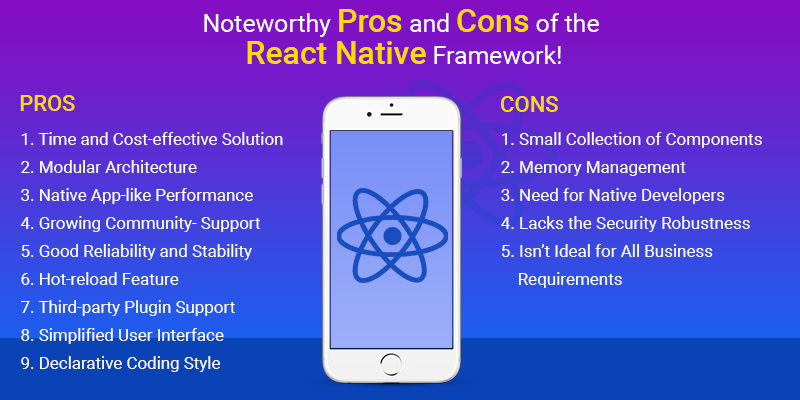
React native framework

Pros of using React Native for your Mobile App

Time and Cost-effective Solution

React Native app development allows the re-usability of the code i.e. the same code is being used for both Android and iOS platforms. As Javascript is used for development, it gives an opportunity for the developers to use the same codebase not only for mobile platforms but also for React web applications. This makes the job smoother, faster and easier for developers. Targeting multiple OS with one code reduces the coding time by 30-35% approximately. A single team can code for multiple platforms. As a result, team-size is reduced and the project becomes manageable.
React Native has ‘ready-to-apply’ components. So, instead of writing the code from scratch, the React Native app developers can use these components and save their efforts. All these factors boost the cost-effectiveness. The app can be launched in the market at the earliest, improving the time-to-market.

Modular architecture

This framework has a modular architecture. It allows the developers to segregate the functions of the code into the blocks called modules. These modules are interchangeable and free and they can be re-used for web and mobile APIs. Due to this, React Native mobile app development becomes flexible, and updating the apps becomes extremely easy.

Native App-like Performance

This framework uses native modules and native controls, which enhances the performance of the apps. The apps built using React Native render their user interface using the native APIs. Consequently, the performance of these apps is quite native-like.

Growing Community- Support

React Native is an open-source framework and anyone can contribute to its growth. This community of talented and experienced React Native app developers helps anyone and everyone who needs a piece of advice on an issue. It has active support from GitHub and Facebook. Facebook itself uses this framework and their team constantly works to introduce new features, functionalities, libraries as well. Also, companies like Microsoft, Callstack, Infinite Red, Software Mansion, etc. have made their contribution to React Native.

Good Reliability and Stability

Despite being a new framework comparatively, it is much stable and reliable. It has simplified data binding due to which child elements do not affect the parent data. So, if a developer changes any object, s/he would need to modify its state and then accordingly apply the updates, letting only allowed components to be upgraded.

‘Hot-reload’ feature

This is another precious feature of React Native. If a developer makes changes in the code or tweaks the UI, it immediately reflects in the apps, like a live preview even if the apps are running. The developer does not need to rebuild the app for every small change made in the code. It enables the implementation of feedbacks faster and reduces the wait time.

Third-party plugin support

Third-party plugins are usually not considered to be secure and so, the developers face challenges while using them. React Native, on the other hand, has many third-party libraries that are quite flexible and can be used swiftly. Also, there are pragmatic interfaces in React Native having customization options.

Simplified User Interface

React Native looks more like a JavaScript library and not a framework, where the user interfaces are simplified and platform-specific. So, the apps designed in React Native are more responsive and have a smoother feel.

Declarative coding style

The declarative coding style in React Native simplifies the coding process and coding paradigms which makes the development understandable. The code can be easily read and understand, simply by looking at it.

Cons of using React Native for App Development

Small Collection of Components

React Native is still in its infancy. Though it has ‘ready-made’ components to use, the collection is small. Some of the components may even not meet the expected standards, as they aren’t developed by official developers. This limits the developers to create simple basic apps. For developing an app with custom native-like features, one might have to maintain 3 codebases like react native, iOS, and Android.

Memory Management

React Native is based on JavaScript and not suited for the apps that are computation intensive. In terms of memory usage and management, float computations are handled inefficiently and the speed and performance are significantly degraded.

Need for Native Developers

To solve some of the issues in React Native, native modules are required. However, implementing them requires expertise in Java/ Swift/Objective-C and detailed knowledge of a specific platform. So, we can’t deny that occasionally, some help from native developers may be needed. This could be problematic especially to small enterprises or start-ups.

Lacks the Security Robustness

Being an open-source framework the security robustness of React Native may get affected. While creating data-sensitive apps like banking or financial apps, experts advise that this framework should not be used as it is based on JavaScript which is known for its instability.

Isn’t Ideal for All Business Requirements

React Native is known for saving time and money, however, it may not suit every business requirement. At times, when complex features are required to be used in the apps, React Native may not be the apt choice.

Key Takeaways:

React Native has been one of the most sought after frameworks for mobile app development. Though it has its downfalls like every other framework, its advantages surpass the downfalls. Also, the huge React community growing at a fast pace is highly likely to develop more efficient and advanced components and functionalities, making it ‘THE BEST’ framework in the future.
Was this blog helpful to you? We would like to know your thoughts on this. Please feel free to comment here or drop us a mail!

How to make your React App SEO-friendly?

How to make your React App SEO-friendly?
React native application development services
Today, architecting an impeccable and highly performant app/website isn’t enough to ensure success – you need to make sure that your content appears in the searches of your target audience as well. And, to meet this requirement, SEO is essential. Search engine optimization, commonly known as SEO, plays a crucial role in defining the success of an application or a website as it determines the amount of organic traffic received. SEO refers to the practice of regulating when, where, and how an app/website will be displayed in the search engine rankings.
SEO is more important for web apps as compared to a website. This is because web apps usually contain a lesser number of public pages and each of those pages need to be exposed to the fullest. Besides, web apps are likely to possess complex UIs on account of which search engine crawlers may trip and may exclude the app’s content from their indexes. And, SEO is hassle-prone, if a front-end technology like React is being used for web development. Thankfully, such challenges can be resolved with the use of productive strategies, judicious tweaks, and effective tools for SEO.
This post discusses one of the most sought-after queries of entrepreneurs – SEO strategies for a React app. React is one of the most popular picks for web app development and is known to fare poorly in terms of SEO. Therefore, this write-up guides you through the common SEO challenges encountered by a React app, the best practices for addressing those roadblocks, and the crucial tools that expedite a React app SEO.

Importance of SEO

How does a search engine function?
When a user types search keywords on the search box of a browser, the search engine decides the order in which the web pages are to be displayed. The search engine employs algorithms for examining the data stored for each webpage. Based on this data, the algorithms decide which of the web pages’ content is most relevant to the keywords typed by the user. The pages that are considered to be the most user-friendly by the ranking algorithms are displayed amongst the top ten. Here are the key steps!
  • Crawling: Crawlers such as Google bots look for new and updated web pages. This process is conducted by either following links from known sites or by crawling web host-managed web pages and sites.
  • Indexing: The new pages identified are examined by Google for understanding their contents displayed through texts, images, or videos. The content displayed via text – meaningful titles, meta descriptions, etc. – is understood best by Google.
  • Ranking: Then, Google provides the list of pages ranked as per the quality of content and the level of relevance to user searches – most to least relevant.
Role of SEO
It’s highly desirable for a web page to appear in the top ten of the search results to get viewed by users looking for similar content. The role of SEO is to convince the search engine algorithms that a specific webpage is the closest match for the content a user is looking for. Hence, web developers need to make the website/web app SEO-friendly by incorporating certain code modifications, tweaks, and add-ons. You must also pay attention to SEO prerequisites like powerful keywords, title description, heading tags on pages, alt tags on images, canonical tags, and OpenGraph information.

SEO Challenges encountered by React Applications

SPA Usage
The usage of React-based SPA (Single Page Apps) is preferred for web apps and websites as it reduces the loading time considerably. SPAs refresh the content when updating add-ons/changes; instead of the traditional practice of reloading the entire page. This approach improves the page’s performance and responsiveness, but poses SEO challenges as given below:
SPAs are likely to encounter indexing woes. A single-page app can provide the content only after the page has been entirely loaded and, if the loading is incomplete while a bot is crawling the page, an empty page will be viewed by the bot. As a result, a major portion of the webpage will not be indexed leading to a lower search ranking.
JavaScript usage: An SPA uses JavaScript for loading content dynamically into the various web page modules. There’s a high possibility that bots might miss running JavaScript pages.
Limited Crawling Budget
Crawling budget refers to the maximum amount of pages on a particular website that can be processed by search engine crawlers within a given time. The time devoted to each script is usually five seconds. But, the loading, parsing, and execution of the script of most JavaScript webpages take more than five seconds for loading. As a result, the Google bot runs out of its crawling budget for your site and has to leave it before the indexing is complete.
The Inability of creating built-in Sitemaps
Google bots need to assess sitemaps – files containing crucial information about a web page, video, etc. – for comprehending a web page for being able to crawl it correctly. But, React is incapable of creating sitemaps within the given framework.
Meta Tags
For obtaining higher search engine ranks, a webpage must have unique titles, and descriptions for every page; if not all pages will end up with the same Google listing. With React is unable to change the tags.
Less likely to crawl JavaScript pages
Earlier, Google used to crawl only HTML pages, but now Google claims to run JavaScript pages as well. But some bottlenecks persist and Google may or may not load JS pages. The likelihood of JS pages being crawled depends on several factors like the usage of obscure engines, the manner in which JavaScript is polyfilled or transpiled, and so on.

Strategies and Tools to Boost SEO for React Apps

React Native developers
React App SEO Strategies
Isomorphic React Apps
Developing an isomorphic JS technology-based website/web app in React is a viable solution to boost SEO. This technology auto-detects whether the client-side has disabled the JS page or not and if Javascript is turned off, Isomorphic JS renders the code on the server-side and then sends the webpage content to the client. This way, all the essential content and other prerequisites including metadata and HTML/CSS tags, are available to the crawling bots at the time of page loading.
When JS is enabled, the first page gets rendered on the server. This allows the browser to receive HTML, CSS, and JavaScript files. Thereafter, JS starts to run and the remaining content gets loaded dynamically.
Prerendering
Prerendering is one of the most prominent approaches that is implemented for improving the SEO-friendliness of single-page apps as well as multi-page web apps. This approach is leveraged whenever search engine bots or crawlers are unable to effectively render pages. Prerenders are distinct programs that restrict the number of requests made to the website. When a crawler sends a request, the prerenderer sends the webpage/website a cached static version of HTML. And, if those set of web pages sends the request, the page is loaded normally.
These programs are effortless to implement, support the most recent web novelties, and effectively execute various types of latest JS, transferring them into static HTML. However, such services come with a price, take too long to load in case of large files, and are less effective for pages that modify data at frequent intervals.
Server-side rendering
Client-side rendering is not an SEO-friendly option because bots either cannot detect any content or receive minimal content leading to improper indexing. But, if you employ server-side rendering, the browsers/bots receive the HTML files containing the entire content and hence the page is indexed properly; leading to higher search engine ranks.
For designing an SPA that is going to render on the server-side, React developers need to add an extra layer of Next.js while crafting the web app.
URL case and ‘Href’ Usage
When the URL of a web page contains the upper as well as the lower case, Google considers them as separate pages, leading to duplication of pages. So, it is advisable to create all URLs using the lower case only.
Google bots are unable to read “onclick” links, and so it is recommended to define web page links using a “href”. This makes it easier for bots to locate your page and visit it.
React App SEO Tools
React Helmet
This is a library that enables developers to set the HTML metadata in the header of a component. With this tool, one can easily update the meta tags on the client-side as well as the server-side.
React Helmet supports every valid head tag including meta, title, script, NoScript, style, link, and base; server-side rendering; and every attribute for title tags, body, and HTML. Moreover, it enables callback from tracking the DOM alterations. The nested components override the duplicate modifications in the head and these duplicate head modifications are preserved when they are specified under the same component.
This tool not only makes your web app SEO and social media-friendly, but also facilitates modifying the title, metadata, and language of the page. Combine server-side rendering with React Helmet for best results.
React Snap
This tool is responsible for pre-rendering a web app into static HTML and employs Headless Chrome for crawling all links that are available right from the root. Moreover, React Snap involves a zero-configuration approach – you need not worry about its functioning or configuration techniques. Furthermore, it employs a real browser behind the scenes to avoid any issues regarding unsupported HTML features such as Blobs, WebGL, etc., and is not dependent on React.
React Router v4
This is a component for creating routes between the various pages/components and makes it possible to develop a website having an SEO-friendly structure.

Concluding Words:

I hope my post has enlightened you on the necessary attributes of SEO and provided ample information on the best practices and tools that are used by veterans to accelerate SEO ranking.
For further assistance in developing an SEO-friendly React app, contact Biz4Solutions, a highly experienced mobile/web app development company providing top-notch React/React Native app development services to clients around the globe.