How the Hospitality Industry is Enhancing with IoT Technology?

How the Hospitality Industry is Enhancing with IoT Technology?
IoT in Hospitality Industry
What does the hospitality industry crave the most? Providing an ultimate guest experience!
Since the rise of hospitality industry, providing the best services and experience to the guests has been its topmost priority. This industry already possesses a huge potential for revenue generation and technology has made it much more profitable. Especially, the Internet of Things (IoT) is playing a significant role in automating the processes while reducing operational expenses. It is enhancing the customer experience by making the physical assets smarter. IoT has drastically changed the way this industry used to work.
Marriott International has launched an IoT hotel room which is an amazing example of how the future of hotels may look like. Marriott’s own Innovation Lab has teamed up with Legrand and Samsung for this project. The IoT hotel room is capable of performing several activities automatically to elevate the guest experience.
This blog will give you a glimpse of the applications and the benefits of IoT in hospitality industry. Let us first have a look at its applications.

IoT Solutions and Applications for Hospitality Industry
IoT Applications

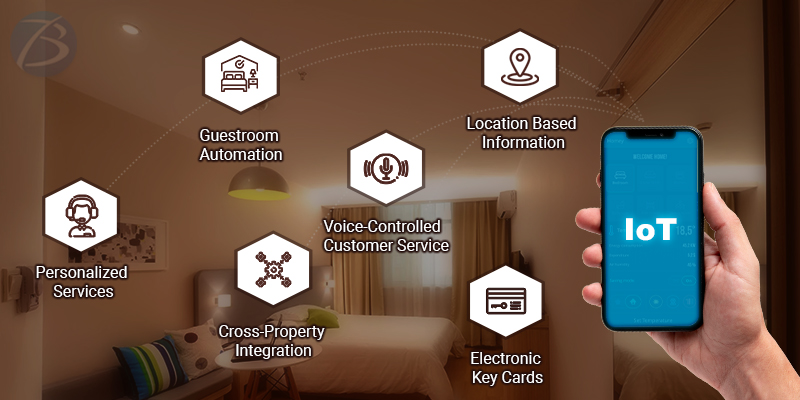
Guestroom Automation

IoT automation can help the hotels deliver services as per the guests’ likings. For instance, a hotel app on the guest’s Smartphone or tablet can connect to the controlling devices to control the lights, temperatures, etc. of the room. As the guests enter the room, the lights are turned on automatically using the sensors and turned off as the guests leave the room. Even the temperatures can be controlled automatically. The AC will switch on and off automatically and as per the guest’s presence. This also helps with energy savings.
In some hotels with a centralized AC system, the room temperature can be controlled depending on the outside temperatures or seasons for providing a better guest experience.

Electronic Key Cards

Instead of physical key cards, IoT applications make it possible to send the electronic key card directly to the mobile phones of guests. This will communicate with the door lock and unlock it, without the need for a separate key.

Personalized services

IoT systems help the guests control the temperature of the rooms as per their choice, switch on the television, manage the curtains electronically, etc. Thus, the guests get a super-personalized experience.

Voice-controlled Customer Service

Nowadays, voice-controlled customer service is becoming a new trend in hotel industry. This area is sure to expand in the coming years. The guests can request room service or book a spa session or a table for dinner using this service, without the need to call every time. For instance, Amazon Alexa is a voice-based interaction assistant which utilises IoT. It allows the guests to manage the in-room features.

Location-based Information

Connected devices, Bluetooth, Beacons, GPS technology, etc. are used for collecting and providing location-based information to the guests. The hoteliers can send a message to their guests while they near the premises. They can inform of the menu items for the day or advertise of the laundry, cleaning, gym services, etc. They may also update the guests about the nearby attractions, local transport links, etc.

Cross-property Integration

Interacting IoT systems can be used to gather data like guest preferences and details. This data can be saved in centralized systems as the guest profile or updated in the CRM to maintain transparency of information across properties. It can be shared across the chain of hotel groups to deliver the same enriching experience to the guests if they visit any of the hotels in the chain across the world.
Few of the other applications of IoT in hospitality industry are:
  • Surveillance and access control
  • Food preparation monitoring
  • Smart refrigeration
  • Front desk management, housekeeping
  • Guest data collection for management and more business in the future
  • Predictive repairs and maintenance
  • Energy savings through temperature control, air-conditioning, etc.
IoT is a smart and new-age investment for hotels and the hospitality industry. Let us also understand the advantages IoT offers to this industry.

Top Benefits of IoT in Hospitality Industry

Enhances the customer experience:

Customer experience is the winning factor in this industry. IoT ensures fast and personalized services which makes the customers happy and gains their trust. This results in improved customer loyalty and retains the customers while ensuring they visit again. These customers may also recommend the hotel to their friends and family which might give more business.

Optimizes the expenditure:

Embedding IoT applications is a lucrative investment. It helps the hospitality industry to provide quality services as well as save money at the same time. The hoteliers can keep a watch on their workload savings, energy usage, etc. and optimize their resources. For instance, when the guests leave their room, the lights get turned-off automatically, which results in cost-savings in the long run.

Predictive analytics:

IoT devices help to collect valuable data that can be smartly utilized for modifying the existing services or introducing more services. They can track real-time data about what their customers prefer and accordingly offer them the services pro-actively. It also informs the staff about the deterioration or unusual performance of the appliances in advance. It helps to avoid emergency repairs, improve the efficiency of staff and reduce customer complaints.

Synchronization with existing devices:

Incorporating IoT solutions for hospitality industry doesn’t require replacement of the existing devices or restructuring of the hotel bodies. With some modifications, IoT systems can be well-utilized to enhance the services and provide a rich guest experience.

Final Words

IoT solutions offer a personalized, secure and soothing experience to the guests. The guests don’t need to wait in long queues while checking-in and checking-out. They can control the devices without having to leave their place. Such facilities make the guests feel special and valued. IoT applications also lower the energy costs and save time for the staff in the hospitality industry. Many hotels and travel companies have already started incorporating the IoT solutions and they are definitely ahead of their competitors.
Was this blog a helpful read? Let us know your thoughts on this through your comments. If you want to know more about IoT in Hospitality industry, contact us!

Reasons to Choose React Native for building Social Media/Networking Apps!

Reasons to Choose React Native for building Social Media/Networking Apps!
react native development services
The React Native architecture proves highly advantageous for mobile app development! Before the coinage of the React Native framework, mobile app development encountered certain bottlenecks. One such roadblock was creating a unified codebase for mobile and web apps. Business brands that lacked adequate resources and funds to engage native development teams for crafting applications for Android as well as iOS; were left with one single option – employing web viewers such as Cordova or Ionic. And so, app creators had to settle down for mobile web apps or HTML 5 apps. Unfortunately, these web view apps were ported over version of the app’s website and failed to deliver a good UX – the user experience seemed fake and clunky.
The launch of React Native in 2015, by Facebook as an open-source project, came as a breather for app owners – React Native development resolved multiple stumbling blocks that were posing challenges in mobile app development.
Have you ever wondered why a major chunk of the social media applications like Facebook, Skype, Pinterest, etc. are built in React Native? Let’s explore the reasons!

Advantages of using React Native for Social Media App Development

react native developers
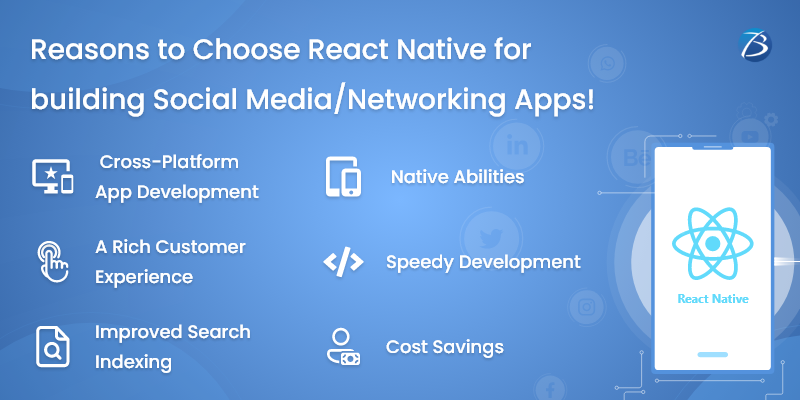
Cross-platform App Development
React Native allows businesses to build a software app solution that will function across the Android, iOS, and web; using the same programming language – JavaScript. For instance, before the advent of the React Native framework, developers had to use Java for Android-based apps and Objective-C or Swift for iOS-based apps.
Native Abilities
React Native simplifies the methodology of building social media/networking apps with newsfeeds and timelines. Using React Native, social media app creators need not create a hybrid app, mobile web app, or HTML5 app. React Native development leads to the creation of real mobile apps that are way different from applications developed in Java or Objective-C. This is because React Native employs the fundamental UI building blocks that are used in native Android and iOS apps; developers just need to combine these building blocks employing React and JavaScript. Hence, React Native apps look and feel like native apps and possess similar capabilities.
Furthermore, with React Native, one can leverage the mobile hardware components like cameras, accelerometer, Face ID, Touch ID, etc.
A Rich Customer Experience Guaranteed
Modern users are least likely to use an app if it takes a long time to load and so, a social media app must be performant to provide a great UX. React Native apps load faster as the framework employs UI elements that compile into one native application. These apps are competitive and guarantee a high UX to consumers.
Speedy Development
React helps you to develop scalable and reactive apps. And, React Native enables the front-end web developers to write the code for native cross-platform applications without the need to jump through hoops for learning a new language. Moreover, since React Native involves only JavaScript, one can use any of the JavaScript libraries starting from Loadash to the most obscure of packages for app development projects. These goodies further speed up the development process.
Moreover, the availability of several ready-to-use free tools and libraries allow React Native developers to speedily craft social media app features like social sharing. Furthermore, due to the presence of a huge, dynamic, and helpful dev community, changes can be executed quickly without any hassles.
Improved Search Indexing
A social media app must make its presence felt on popular search engines like Bing and Google. But search engine crawlers are unable to render JavaScript and return a blank page and as such, Google does not index the page altogether. The lack of search engine optimization adversely affects server-side rendering. However, React supports server-side rendering of JavaScript which results in a pre-rendered HTML page that is ready-for-display on the browser. And, the crawlers are able to crawl HTML without any glitches and the app appears on user searches.
Cost Savings
  • The framework empowers React Native developers to entirely optimize the user interface and make it uniform such that it functions perfectly with all devices. This results in the creation of an improved UI in a cost-effective way.
  • The code and components of the React Native environment are highly reusable and this helps in saving costs as well as development time. Approximately, 90-99% of the code can be shared between multiple operating systems without facing any technical issues or glitches.
  • The framework makes it possible to integrate loads of customer-centric features by means of native plugins or third-party modules. And, this integration is easy to implement and involves minimal costs.
  • While purely native apps need periodic updates separately for every device/OS; cross-platform apps are far more flexible as they avoid versioning. With React Native’s single coding approach, the overall maintenance including bug fixing becomes easy and hassle-free. Hence, React Native apps involve low maintenance costs.

How does React Native cater to Specific Requirements of Social Media App Development?

  • The components in the activity feed in React Native enable the creation of a dynamic news feed and also enhance the user engagement, retention, and conversion rate of social media apps.
  • React Native social media apps enable users to like a photo and react to it with an emoji. Also, single-page apps facilitate the actions of liking or reacting to a post/photo. And, all of us are aware of how beneficial React is for creating SPAs.
  • Photos can be easily and quickly uploaded.
  • With React Native, one can build real-time chat apps with two parts- server-side library and client-side library – that instantly connect users with friends and acquaintances.
  • A login functionality with several sign-in options can be created employing Firebase’s authentication
  • The usage of firestore database for integrating push notifications into the app. A social media app must necessarily have the feature of real-time notifications for receiving messages and collaborating with posts of friends.
  • Firebase’s real-time database helps users to change posts in real-time
  • D3.js can be used for creating the timeline that graphically represents posts in the map
  • The integration of the localization feature for providing multiple language support

Success Stories of some Popular Media Apps built in React Native

Facebook
The fundamental objective of this framework was to utilize the advantages of web development – quick iterations and engaging one single team for executing the entire project – while architecting mobile applications for the iOS and Android operating systems.
Facebook Ads Manager
This is the first full-fledged cross-platform app built in React Native by the Facebook team. The platform is leveraged by entrepreneurs as well as individuals for promoting their products and managing ads for the same.
How React Native development was helpful?
  • The app possesses a clean UI, effortless navigation, and an intuitive UX.
  • The framework appeared to be a perfect pick for handling several instances of complex business logic including the management of date/ad formats, time-zone differences, etc.
  • Both the Android as well as the iOS versions of the app was built deploying a single app development team.
Instagram
This popular social networking app switched to React Native in 2016. They implemented the Push Notifications view as the web view. A navigation infrastructure was not required because of the simple user interface. The React Native eco-system sped up the process of integrating features to Android and iOS apps and increased the developer velocity by approximately 85-99%.
Pinterest
Pinterest creators used React Native so that codebase can be shared across Android and iOS. It took only ten days to implement on the iOS platform. Thereafter, Android implementation was completed in just two days as developers were able to share 100% of the UI code for the Android platform as well. This way the firm saved over a week as compared to the usual implementation time.
Skype
In 2017, Skype’s owner Microsoft redesigned the platform using React Native for their mobile version as well as the desktop version.
Discord
This popular React Native app is used by millions of individuals for connecting with friends/family/communities via voice, text, and video communication. React Native development has made it possible to share 98% of the code across the Android and iOS platforms. The team was able to effortlessly able to make their comprehensive iOS app run on the Android platform in just two days.

Conclusion:

Above examples indicate that the React Native framework can create innovative, highly performant social/networking apps that are rich in trending features.
Would you too like to harness the potential of React Native for tailoring feature-rich social media/networking apps? Reach out to Biz4Solutions, a distinguished mobile app development agency offering high-end React Native development services to global clientele for 11+ years. Tell us your social media app requirements and objectives; our proficient team will help you to fulfill your goal.