Disrupting Mobile App Development Trends that are set to Dominate 2022!
The technology and methodology of mobile app development are constantly changing to meet the demands of a dynamic and competitive market. Every year, new and fresh app development trends are replacing the existing ones to maximize profitability as well as customer satisfaction.
So, what are the mobile app development trends that will dominate 2022? Well, this post explores the most recent and upcoming trends concerning mobile app creation. A quick read will provide mobile app creators with comprehensive insights on the best technology trends for mobile app development in 2022.
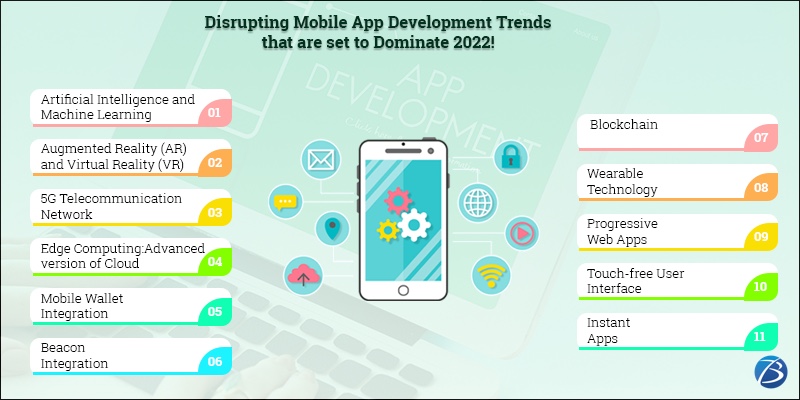
Key Mobile App Development Trends: 2022
Artificial Intelligence and Machine Learning
Employing Artificial Intelligence (AI) for the functioning of chatbots, and using a combination of AI and ML to form Siri are the latest trends in mobile app development. Other noteworthy AI/ML implementations include facial recognition features in smartphones, ensuring improved security in mobile phones, etc.
But, in the year 2022, the use cases of AI and ML will not just be limited to Chatbots and Siri. New innovative trends of implementing AI and ML are expected that will prove profitable to enterprises and reduce their operational costs.
Upcoming AI/ML trends
- Automated ML
- AI-empowered chips
- Establishing interoperability amongst neural networks
- AI-enabled automated DevOps via AIOps
- Geo detection
- Improved gaming experience
- Image/speech/face recognition
- Predictive maintenance
- Authentication of apps to ensure cyber/IoT security
- Classification of text and images
- Recognition and classification of sediments
Augmented Reality (AR) and Virtual Reality (VR)
AR and VR have immensely impacted mobile app development trends and have elevated the gaming sector to the next level. Mobile apps powered by AR and VR are known for their distinct abilities such as people occlusion, light estimation, movement tracking, and environmental understanding. AR-enabled apps have proved beneficial to industrial domains like healthcare, retail, tourism, marketing, education, etc.
Examples of AR/VR Implementation
- AR/VR software solutions enable doctors to conduct live surgeries from any location across the globe.
- App users enjoy the option of interacting with VR in Facebook locations.
- Instagram has employed several AR filters within its app.
- Gadgets like HoloLens, Magic Leap, and Oculus, offer an immersive experience to users.
- AR/VR solutions can virtually transfer individuals to unseen areas of the universe like other planets, deep oceans, etc. for rediscovering realities.
Upcoming AR/VR mobile app trends
A host of new use cases are predicted in the coming years. Apple and Google have launched their AR demos – ARKit and Google ARcore. Check out the future trends!
- AR-powered navigators for reaching one’s destination
- Providing simulations for conducting virtual training
- Carrying out exploration activities using VR
- AR-empowered virtual user manual
- AR and VR powered visual learning process by employing images
- VR-based solutions for live concerts, festivals, and music events
5G Telecommunication Network
The 5G telecommunication network is fast replacing the 4G technology and it turns out to be way better than its predecessor.
5G Technology: offerings and add-ons
- It is almost 100 times speedier than 4G.
- The super-fast streaming capacity can be utilized by the gaming sector by promoting mobile versions of the most sought-after games like Clash Royale and Fortnite.
- It comes with low latency, better stability, and enhanced security.
- It enables more number of connections per square kilometer.
- 5G resolves the issue of buffering that existed in earlier networks.
- Videos will get replaced by images which means better user engagement.
- Higher resolution textures will enhance the visual clarity for users.
- Its wider bandwidth will allow better handling of VR/AR 3D objects, resulting in the creation of more realistic and advanced AR/VR applications.
- It will improve IoT services because of better connectivity.
5G Technology: Present/Future Implementations
- Cloud computing
- Cloud computing
- Wireless healthcare Services
Edge Computing: Advanced version of Cloud
Cloud has undergone an evolution giving rise to edge computing. Cloud computing has been a valuable asset of the software industry so far, but it comes with its own set of shortcomings. Owing to Cloud’s highly centralized nature, latency becomes a big deal for the technological advancements ushered in by 5G. However, edge computing resolves this challenge.
The role of Edge Computing is to move the Cloud nearer to the users. This is done by processing some computational requirements locally or on the nearest station which is the edge of the cloud. And, the cloud remains, but goes into the users’ device, such that the device becomes a part of the Cloud. This approach removes latency issues to a certain extent. Hence, the innovations brought about by 5G technology – wireless/autonomous cars, and the IoT eco-system will take cues from devices that are edge-powered. Besides, the increasing trend of B2B mobile apps will also promote edge computing in the years to come.
In the recent past, mobile edge computing has already been employed in location-based services to meet demanding requirements like improved data transmission and 5G implementation.
Mobile Wallet Integration
The practice of integrating mobile wallets into smartphones has gained momentum in recent years as they are effective tools for contactless payments and are also effortless and convenient to use. The users have to simply link their bank account details to a mobile wallet application for paying bills, transferring money to friends/family members, and purchasing items from eCommerce websites. Google Pay, PayPal, and Amazon Pay are some of the most popular mobile wallets used by global consumers.
The upcoming trends include adding future-friendly functionalities into mobile wallets – audio-based methodology, RFID payments, and NFC. As per veterans, mobile wallets are going to gradually replace traditional payment practices.
Beacon Technology
The Beacon technology has been successfully implemented in the retail sector so far. Beacons are used by retailers to comprehend customer behavior as they track down the real-time interaction of shoppers with mobile applications in stores, provide information about the number of store visits by a consumer, and so on. This way, retailers are able to identify the shopping patterns and preferences of a specific customer and thereafter, send them relevant ads based on this information. This strategy has turned out to be an effective tool in accelerating sales. Moreover, Beacons also help individuals navigate through huge stores or busy shopping centers.
In 2022, Beacon technology is expected to integrate with more smartphone functionalities.
Future trends: Beacon Technology
- AI-powered chips
- Mobile payments via Beacons
- Beacon-enabled gaming: treasure hunting, clue games, etc.
- Automated ML
Blockchain
We have already experienced the disruptive capabilities of Blockchain by applying it in the form of cryptocurrencies and smart contracts. Blockchain has a lot to deliver in the coming years.
Data exchange, gadget transactions, and document sharing happening within the Blockchain environment cannot be traced. Therefore, it can work wonders in protecting sensitive information/data and is the one-stop solution for preventing cybercrimes. Moreover, Blockchain can be used to build decentralized apps in which mediators won’t be needed for managing the humongous information; as suppliers would be directly connected with the users, leaving no room for infiltration of data. Such decentralized apps will prove handy across industrial domains such as healthcare, finance, gaming, media, and trading.
Future trends: Blockchain
- Maintaining security protocols in public elections
- Ensuring cyber security and eliminating piracy
- Robotics and transparent betting
- BaaS: Blockchain as a Service
- Bringing transparency in the fashion industry
- Tokenization of assets
- Gaming and crypto space
- Trading on the exchange of crypto-currencies
Wearable Technology
Wearable devices like smartwatches, smart bands, etc. have created ripples in the industrial sector by their unique ability to track and analyze health parameters like heart rate, body temperature, sleep patterns, blood oxygen/glucose levels, etc. The best part is users can control and communicate with wearables via smartphones. Wearable technology is expected to smarten in 2022 and touch new horizons.
Future trends: Wearables
- Smart jewelry and body sensors to track down bodily movement and wellness parameters
- Smart contact lenses have an in-built visual display and are equipped with virtual assistants
- Smart glasses empowered with mind-reading technology
- Virtual keyboards via contact lenses or nail polish
Progressive Web Apps
Progressive Web Apps, commonly known as PWAs – a hybrid combination of web pages and applications – are set to dominate the app development market in 2022. This is because PWAs successfully address most of the downsides of native apps. Take a look at their unique advantages over other kinds of apps!
- Takes lesser time to develop as they are websites having app features
- Loads faster
- Occupies lesser storage space
- Have lesser dependency on internet connections
- Can be saved on the home screen of users’ smartphones
- Are highly accessible and adaptable
- Can be automatically updated
Touch-free User Interface
Touch-free user interfaces in mobile apps are expected to replace the existing touch-based UI so that users have to put in minimal effort while operating mobile apps. Touchless interfaces include voice-based/gesture-based UI. Besides raising the convenience quotient of average smartphone users, such interfaces will be a huge sigh of relief to the elderly and differently-abled individuals.
Instant Apps
Instant apps are the next big thing in the coming years. The most distinctive trait of such apps is that the users can test these apps without the need for installing or downloading the app, at first. Hence, the users enjoy the flexibility to test a wide range of applications available in the Android/Apple app stores; before they select the one that suits their requirements. Some brands like New York Times have already started using instant apps and more brands are expected to follow this trend in 2022.
Are You Interested in Building a Top-Class Website or Mobile App?
Final words:
I hope this post has given you a thorough understanding of the novel development trends that are set to dominate the mobile app market in 2022.
If you are looking for an experienced and proficient technology partner, contact Biz4Solutions, a leading mobile app development company in India and USA. Our outsourcing services in India and USA are unparalleled and our prime focus is to fulfill the business goals of customers.