Online Grocery Stores promote a Greener Environment! How?

Online Grocery Stores promote a Greener Environment! How?

Online grocery app
Gone are the days when weekend trips to the grocery store were an integral part of a family’s schedule. The practice of social distancing ushered in by the pandemic has transformed the grocery shopping process of consumers altogether. People have finally realized the advantages and experienced the convenience of making online purchases using an online grocery app.
Online grocery stores have become the order of the day and this trend is here to stay. Take a look at some interesting stats concerning online grocery shopping and delivery as researched and predicted by the U.S-based online portal SaveMyCent.
  • 70% of the grocery shoppers in the U.S.A. will make online purchases by 2022
  • Merchants who are linked with logistics firms will be able to reduce their fleet expenses by 30% approximately
  • The grocery market share in the U.S. would witness an expansion by 35.6 billion dollars by the year 2023
  • The global online grocery store market is expected to grow by 24% by the end of 2024
  • eCommerce warehouses are predicted to be entirely automated by the end of the year 2029
Shopping for groceries via online grocery apps come with myriad benefits and is an environmental-friendly option as well. Let’s explore the reasons and take a look at its future prospects too!

Reasons why Online Grocery Store Promotes a Greener and Cleaner Environment
Grocery app developers
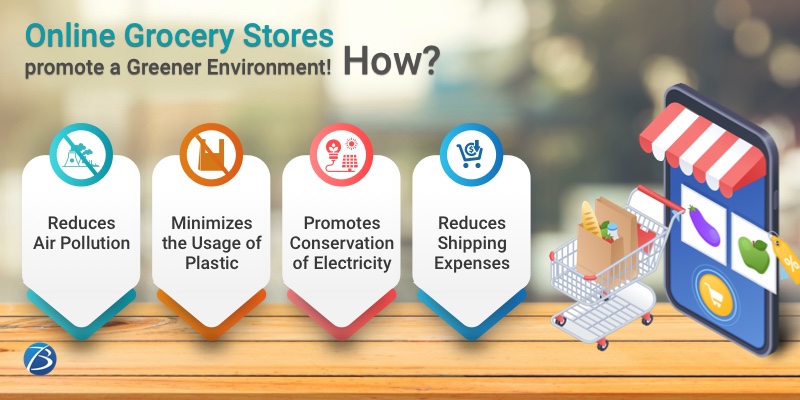
Reduces Air Pollution
Consumers rarely carpool or pick up friends while paying a visit to the grocery store; they prefer an individual trip instead. And, needless to say, every household requires frequent grocery shopping trips, as often as once or twice in a week resulting in humongous emissions. In this regard, online grocery shopping proves advantageous! Online grocery delivery involves delivering multiple customer orders on a single trip made by a truck/van/bus. This practice reduces greenhouse gas emissions and carbon footprints, thereby contributing to minimizing air pollution.
Minimizes the Usage of Plastic
These days eco-friendly packaging material is gradually replacing plastic shopping bags. Some online grocery delivery stores send the ordered goods in huge crates that can be emptied into the consumers’ home at the time of doorstep delivery. Some of the stores make use of reusable cloth tote bags that can be returned during the next delivery and some use recyclable/recyclable paper bags that decompose fast without adversely affecting the environment. These practices discourage the usage of cardboard boxes and plastic grocery bags that generate harmful waste and pollute the environment.
Promotes Conservation of Electricity
Proper and effective means of managing/conserving energy is a crucial step towards the sustainability of your business. However, physical stores consume a great deal of power through lighting up stores, maintaining expensive refrigerators, thermostats, and crafting elaborate displays. Nevertheless, eCommerce business models of online grocery delivery apps help entrepreneurs save on electrical energy and reduce electricity bills, thereby promoting a greener environment.
Reduces Shipping Expenses
When consumers opt for online grocery shopping and delivery via grocery apps, the goods are delivered to their doorstep directly from nearby farmers’ markets or warehouses. In this case, goods need not be transported from the warehouse or farm to be stored in sophisticated physical spaces/stores. This saves additional transportation expenses and reduces carbon footprints on account of vehicular emissions; while consumers receive fresher groceries.

The Future of Grocery Delivery Promises Lesser Carbon Footprints

Technological Innovations
Grocery app development is expected to get greener and more tech-friendly in the recent future. But, how? Well, delivering doorstep orders via drones is the next big thing in the realm of technological innovation. The utilization of drones for this purpose means lesser fuel consumption thereby lowering carbon emissions to a great extent. Besides, the usage of vehicles that run on solar power and electricity is also being proposed for reducing carbon emissions.
Environmentally Conscious Purchases
Modern-day consumers are becoming more conscious about the carbon footprints associated with the products they purchase. Hence, individuals search for natural products and prefer brands with minimal carbon impressions over the ones that possess heavier carbon impressions. Such purchases, termed environmentally conscious purchases, bring down the global pollution levels substantially.

Proposed Ways to Reduce GHG emissions from Grocery Delivery in The Coming Years

Avoiding Express Delivery
Express shipping/same-day delivery generates more carbon footprints than standard delivery practices. So, if consumers avoid express shipping options and opt for slower delivery options instead; delivery trucks can optimize their routes and avoid additional trips. Some grocery outlets offer discounts to customers who go for longer delivery windows.
Bulk Ordering/Grocery Pooling
Frequent grocery delivery trips can be avoided if consumers place bulk orders or practice “grocery pooling” – club up their orders with that of neighbours and receive the delivery at the same date and time.
The usage of alternative fuel for grocery delivery
Usage of hydrogen fuel for refrigerating trucks to keep the cargo cool or hydrogen-powered electricity for running delivery trucks are some of the alternative fuels for delivery purpose. As per the standards established by DOT and EPA, trucks need to reduce greenhouse emissions in the years to come and extra standards have also been suggested for the same.

Final Words:

Thus, online grocery shopping not only reduces carbon footprints but also proves beneficial for consumers and entrepreneurs. Planning to architect a future-friendly high-tech grocery ordering/delivery app that will steal the show? Contact Biz4Solutions, a proficient mobile app development agency offering top-notch Grocery Delivery services in India and USA. Our IT outsourcing services have helped numerous businesses around the globe to transform their dream into reality.


React Native App Development: Reasons to Adopt and Key Aspects to Consider!

React Native App Development: Reasons to Adopt and Key Aspects to Consider!
React native app development services in India
React Native, based on the Facebook-developed JavaScript library called React, facilitates the creation of purely native apps for Android and iOS platforms. It happens to be one of the most preferred and trusted frameworks for architecting app solutions for diverse industrial and commercial requirements. Renowned app owners like Facebook, Instagram, Bloomberg, Walmart, Townske, etc. owe their success to the React Native framework.
However, entrepreneurs need to gain insights into the unique selling points of this framework and consider certain aspects, before investing in React Native development. This post provides all the aforementioned information and a quick read will help aspiring app creators to make meaningful decisions.

React Native App Development: Top Benefits

React native app development
Lesser Resources/Smaller-sized Teams
React Native projects do not need a lot of resources or large teams. Entrepreneurs are able to build a React Native app with a small team comprising of a project manager, a technical lead, a business analyst, 1/2 UI/UX designers, one developer, and one QA specialist. This is indeed a huge business benefit.
App Performance
React Native development involves executing the entire project in short developmental cycles. React Native apps come with a quick loading speed due to the absence of heavy components that can adversely affect the speed. Furthermore, React Native’s hot reloading functionality accelerates the bundling process enabling developers to detect changes in the real-time application, even if that change is trivial. For these reasons, it speeds up app development to a great extent.
Third-party Integration Compatibility
Thanks to React Native’s high third-party integration capability, developers do not have to entirely depend on the web view for particular functions. For instance, for integrating Google Maps into your app, the React Native environment enables linking the plugin with a particular module. The map feature can be connected with certain functionalities of the mobile device such as rotate, zoom, etc. and the periphery can be maintained so that the app uses less device memory and loads quicker as well as effectively.
Flexibility across Multiple Platforms
React APIs are mostly cross-platform-oriented. Moreover, the file extensions offered by React Native support modules as well as platforms. And, these platforms are able to effortlessly determine the OS on which an app is running and also save this information for usage in more platform-oriented implementations. Since the file extension is platform-specific, developers can easily define specific files meant for executing particular functions.
Faster Deployment and Reduced Cost
React Native’s open-sourced nature makes several components readily available to app development teams. Furthermore, the same code is applicable for deploying the application on the iOS and Android platforms. Additionally, the usage of Redux, an innovative management tool, shortens the development time further. This results in a shorter app development cycle and reduced app development expenses without having to compromise on the originality, quality, and productivity of the application.
Dynamic Community
There exists a vibrant and dynamic community to help out React Native developers with doubts and queries. The offerings are manifold including handy information on React Native development, beneficial resources, and extended assistance.

React Native App Development: Key Considerations

Picking the Correct Navigation Library
Picking the right navigation library is important. The React Native ecosystem offers two kinds of navigation libraries – JavaScript Navigators and Native navigators. JavaScript Navigators can be set up easily while Native navigators deliver exceptional performance. You need to select the one that works best for your mobile app development project. In this regard, a quick discussion with experienced React Native app development Services will help you to choose the best-suited library.
Scalability: Scope
Today, it’s crucial to consider the scalability of the proposed application so that it perfectly fits into the differently-sized screens of smartphone devices. Besides, a modern-day app should have the required scalability for handling more real-time users as well as devices to accelerate profitability.
To scale react native applications to a larger codebase, adopt good tools like prettier and ESLint can help reduce syntax errors, include good libraries like React Router, react-hook-form, use GitHub for sharing and managing the components as building blocks that are independent and you can use Next.js instead of Create React App for starting the project.
React Native mobile app development offers plenty of room for scalability. – Facebook, a React Native empowered app is a good example. Nevertheless, for getting it right, it is important to understand the structure of the React Native app thoroughly. And, this can be achieved through extensive developmental efforts by skilled and experienced React Native developers.

Which Types of Apps are best suited for the React Native Framework?

Fully Functional Prototypes/MVPs
The strategy of hitting the market with a quick app prototype (MVP) at budget-friendly development costs, instead of investing in a full-fledged app at the beginning, is incorporated by most start-ups for getting their app idea validated and identifying the requirement of the target audience. This plan of action is one of the key prerequisites of agile development:
  • Developing a solution before competitors get time to act
  • Ensuring that a wide range of target audiences use the solution
  • Iterating speedily based on user feedback
React Native development is the ideal solution for this strategy as this framework involves low project expenses and speedy development cycles as compared to native tech stacks. And, unlike hybrid apps, React Native applications will deliver test users a truly native UX. In fact, most of the popular React Native apps have begun their journey as quick prototypes and were thereafter updated with necessary functionalities.
Example:
Airbnb possessed a website built using React. Thereafter, the rising popularity of mobile apps put them under pressure to craft a mobile app solution for staying competitive. So, in 2016 they developed an MVP using React Native and added new features in the form of updates. Once, they were well versed with the requirements of target users and the shape of the full-fledged mature product; they architected two native applications – one each for iOS and Android.
Basic Cross-platform applications
Native app development is advisable for developing highly complex software solutions that require several platform-specific features like audio/video processing, multi-threading, etc. But, if you intend to create a basic cross-platform app in a cost-effective way and your target market is evenly distributed across Android and iOS platforms; opting for React Native app development will be the ideal strategy. The reason is React Native apps involve low developmental costs and app owners can effortlessly make the interface function for both Android and iOS platforms using one single codebase.
Example:
The business brand Townske has leveraged React Native to build an application that shares city guides. The firm had only one developer, and so it was impossible to even think of developing separate apps for the iOS and Android platforms. React Native development enabled them to create a cross-platform app speedily, with their existing resources – the brand reused most part of the business logic of its existing React-based web app for building their mobile application. React Native’s key offerings – high code reusability, development speed, easy debugging, and helpful community – helped this brand to sail through all project-related challenges.

Final Words:

I hope, this post has clearly defined why React Native app development is a top pick amongst app creators and the kind of app creation projects that are best suited for this framework. If you are planning to craft a customized React Native app, contact Biz4Solutions, a prominent offshore mobile app development firm offering high-end React Native app development services in India and U.S.A. We possess extensive experience in partnering with global clients across diverse industrial domains.