Why should Startups Opt for Ionic App Development?

Why should Startups Opt for Ionic App Development?

Blockchain app development company
Every start-up entrepreneur desires to reach out to a wide range of audiences and aspires to grow exponentially. And, having a digital destination for a business is essential for fulfilling these aspirations. Nevertheless, the software development approach, frameworks, and technologies for building a digital platform should also be chosen wisely.
A majority of start-ups adopt a cross-platform software development approach to craft mobile/web apps for multiple platforms using a single codebase. This approach saves development time, effort as well as expenses.
And, amongst several cross-platform app developments frameworks, the Ionic framework has been one of the most preferred ones for start-up app development. Ionic, empowered by open web technology, has helped several start-ups to transform their vision into reality by offering unparalleled cross-platform app experiences. Untappd, Cryptochange, ChefSteps, Sworkit, Pacifia, Marketwatch, etc. are examples of the world’s fastest-growing start-ups who owe their success to Ionic app development.
This blog introduces you to the Ionic framework and outlines the reasons why it proves beneficial for cross-platform app development.

Ionic Framework: An Overview

Ionic is a framework meant for developing cross-platform apps employing web technology such as JavaScript, HTML, and CSS. The framework comes with a lightweight component library and a host of tools like auxiliary CLI, native access plugins, data handling, and binding, routing and navigation, template population, etc.
The type of apps that can be built using Ionic app development includes PWAs (Progressive Web Applications), Web Apps, Hybrid Mobile Apps, and Desktop Applications (employing Electron).

Reasons to opt for Ionic App Development
Offshore app development company in India
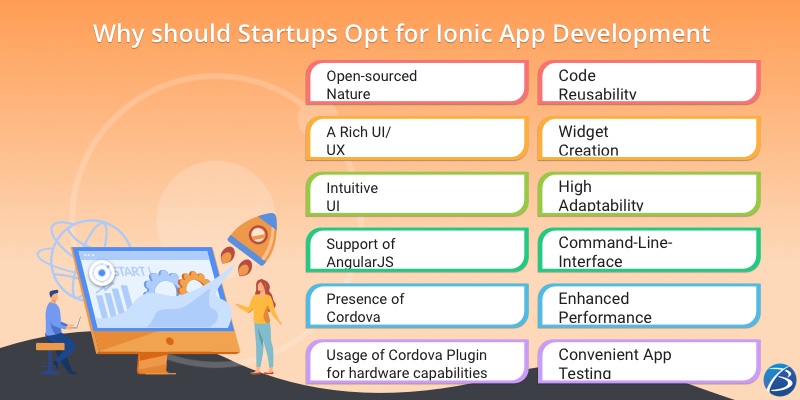
Open-sourced Nature
for them. And, Ionic, being an open-sourced framework, licensed under MIT, offers several cost-efficient options for app creation. Moreover, while other open-sourced frameworks may encounter unexpected architectural breakdowns during app development, Ionic handles these issues effectively and hence, is considered to be steady as well as dependable.
A Rich UI/UX
A rich UI/UX design is the key prerequisite of a top-grade mobile app and Ionic fares well in this aspect as well. This front-end framework comes with captivating designs and contains components like JavaScript, HTML, and CSS. As such, Ionic mobile app developers can reap the benefits of smooth animations containing beautiful designs and themes to build interactive and user-friendly apps.
Intuitive UI
Ionic’s ecosystem comes with a humongous repository of customizable themes that enable the creation of a highly usable app with a dynamic UI. The app components automatically adapt to the app development platform used.
The Support of AngularJS
AngularJS, one of the most versatile app development frameworks, forms the base of the Ionic framework. The presence of AngularJS imparts a robust structure to the developers for making the code more manageable, provides a host of features to app designers, and leads to the creation of an interactive app solution.
The Presence of Cordova
The Ionic framework uses Cordova, a mobile app development framework created by Adobe Systems. Apache Cordova enables Ionic to access and utilize a mobile device’s hardware like camera, contacts, geolocation, etc. For this purpose, Cordova plugins need to be used. This functionality helps Ionic mobile app developers to craft highly competitive apps.
Advanced Integration Abilities
Ionic allows integration with a vast range of add-ons, plugins, and modules for Cordova and AngularJS. The plugin repository of Angular consists of 2000+ modules and because of this advantage, Ionic apps can easily integrate with popular web services that implement complicated UI elements.
Moreover, the app integration abilities of the Ionic framework allow the sharing of information and processes amongst various enterprise applications. Because of this feature, enterprises can easily coordinate their business processes and link them with cloud applications.
Code Reusability
Ionic codes are highly reusable. The codes written by Ionic app developers for one platform can be effortlessly used across other platforms too, eliminating the need for creating different platform-specific codes.
Widget Creation
Ionic app development supports the creation of widgets. With the help of widgets, the frequently used applications can be embedded into the home screens of smartphones, such that the users can trigger the app from the home screen itself.
High Adaptability
Switching to the Ionic ecosystem is effortless as most developers are well versed with programming languages like CSS, HTML, and JavaScript. So, it is advisable to use Ionic while switching from native to the hybrid app as it eases out the whole process.
Command-Line-Interface
Ionic offers Command-Line-Interface, commonly known as CLI which is an in-built development server. This interface is text-based wherein users activate the command “prompt” for interacting with the Ionic app via different commands.
Enhanced Performance
Ionic’s CSS transitioning technology provides a considerable amount of leverage for the GPU. As such, the processing time can be effectively maximized resulting in the speedier functioning of the app.
Convenient App Testing
The Ionic framework simplifies the process of app testing by offering multiple convenient testing options. An Ionic web app can be tested on the desktop browser and in the case of Android and iOS apps, simulator testing is conducted by employing Cordova commands. iOS apps can also be tested using a Safari web browser or a mobile browser. An Ionic app development team can directly test the app as a hybrid/native app on a real platform for gaining more precise insights on its functioning. Besides, these testing methodologies facilitate remote debugging as well.

Final Verdict:

Thus, employing Ionic for developing cross-platform apps is a profitable option for start-ups. Ionic not only saves the time and resources of app owners but also comes with innumerable outstanding offerings.
If you are looking for hiring an Ionic app developer or an Ionic App Development team, contact Biz4Solutions. We are a distinguished Ionic App Development Company in India and U.S.A. with an excellent track record in mobile/web app development and a rich experience of partnering with global clients.

Blockchain’s Contribution in Implementing Employee Safety Protocol in Workspaces!

Blockchain’s Contribution in Implementing Employee Safety Protocol in Workspaces!
Blockchain app development company
Today, a huge chunk of employees across the globe have returned into a physical office environment and several others are scheduled to resume working-from-office after remotely working for a long time. But, the fear of getting infected with the Covid19 virus persists.
So, how could organizations maintain safety protocols at their workspaces? Well, the two most effective mechanisms that are being incorporated by enterprises to ensure employee safety are: contact tracing and maintaining digital health wallets for employees. However, there are security risks involved in both these processes and so employees may be reluctant to adopt these processes.
This post explores how Blockchain application development improves the effectiveness and enhances the safety quotient of the aforementioned processes.
Before we delve deeper, check out the unique attributes and functioning of Blockchain technology!

Blockchain Technology: Key Attributes

Offshore app development company in India
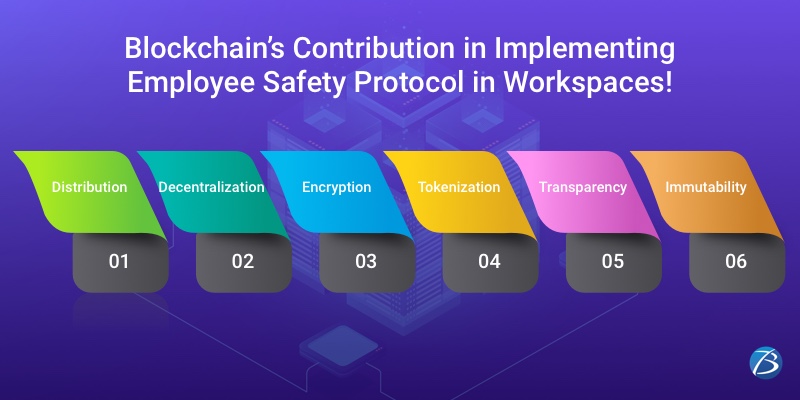
Distribution
The participants, who are a part of the blockchain, are connected through a distributed network. “Nodes” (computers) are present for operating this network. The nodes run programs for imposing the rules laid down by the business enterprise that owns the blockchain. The nodes also maintain a copy of the ledger and updates data independently, whenever a new transaction takes place.
Decentralization
Blockchain is a decentralized ledger, based on peer-to-peer technology, in which the information is distributed across the network instead of being stored by one single entity. As such, no entity can control a majority of the nodes or dictate terms. Thus, unlike the traditional approach, this approach eliminates the need for a centralized authority for controlling the network. Instead, multiple participants are authorized for managing the network – a “consensus mechanism” is employed for approving and checking transactions. Decentralization, increases reliability as the users no longer have to trust a third-party authority and also minimizes the risk of systematic failures considerably. Hence, Blockchain solutions are more transparent, secure, performant, and irreversible.
Encryption
This feature uses pseudonyms to record the participants’ details and thus ensures the security of all recorded data. The participants are entitled to control their personal details and share them only with authorized entities whenever needed.
Tokenization
With this functionality, items of value or physical or non-physical elements are converted into “tokens”. Blockchain identifies these “tokens” as “currency” within the system and these can be traded as well. Data and even a participant’s identity can be represented as the value that can be converted to tokens and then traded.
Transparency
This aspect of Blockchain imparts a layer of accountability that is a crucial prerequisite for several enterprises. All transactions can be searched for as well as traced in open Blockchain. And, to protect data privacy, granular access is provided to certain authorized users and at the same time, the data is protected from unauthorized access.
Immutability
This ground-breaking property of Blockchain rules out any third-party interference to the continuously growing chained data. Blocks are used for storing data introduced into Blockchain and these blocks are connected as well as secured by cryptography. Each block is given a unique identification number employing a cryptographic algorithm and is called the cryptographic hash function. During a transaction, blocks are time-stamped, sequentially added to the ledger, and cryptographically signed. Each block contains its own hash, transaction-related data, a timestamp, and the cryptographic hash of the previous data. As such, data once entered into the Blockchain network, cannot be tampered with.
Functioning of the Blockchain Network
When somebody joins the Blockchain network, an entire copy of the Blockchain is received and the nodes verify whether every aspect is in order. This new block is then sent to all participants of the network and the block is verified by each node for ensuring that no tampering has taken place. Once successfully verified, the block is added by each node into their Blockchain and the transaction is completed.
For ensuring the authenticity of this new block, the nodes use a particular consensus mechanism. All the nodes present within the network create a consensus by agreeing on which of the blocks are valid and which of them are invalid. Any block within the network that has been tampered with will be rejected by the other nodes of the network.
So for tampering with a Blockchain system successfully, one must manipulate every block contained within the chain and then gain control over more than half of the P2P network, which is not possible by any means.

Blockchain’s Role in maintaining Safety Protocols at the Workplace

Today, contact tracing and maintaining digital health wallets for employees has become an essential prerequisite to ensure safety protocols at workplaces. And, employing Blockchain app development for architecting such solutions is necessary. Let’s explore!
Contact Tracing
What is Contact Tracing?
Contact tracing is a mechanism that is implemented for limiting the spread of communicable diseases or disease-causing viruses. This process involves the following steps:
Step 1: Identifying the infected and their contacts
Individuals infected with a communicable disease are identified and asked about their routine activities and locations visited in the recent past. This is done to identify other individuals like family members, colleagues, friends, medical practitioners/staff, etc. who were within close vicinity of the patient.
Step 2: Tracking down the contacts
Once identified, a list of all persons who have come in close contact with the patient during the past couple of days is prepared. These contacts are then tracked down and notified about the situation. They are also provided guidance on the timely measures to be adopted and the practices to follow if they develop any symptoms of the communicable disease and are advised to stay in isolation if needed.
Step 3: Follow-ups with contacts
The health symptoms of these contacts are closely monitored by conducting regular/periodic follow-ups and tests to limit the spread of the disease.
The Traditional way of Contact Tracing: Limitations
Contact tracing was implemented in the past to control the spread of various communicable diseases. Also, for tackling Covid19 the traditional approach was implemented in some countries. But, the traditional approach comes with certain limitations. The lists of identified contacts who are likely to contract the infectious disease are maintained in paper files and the contacts are notified as well as advised via phone calls or emails. So, the entire process becomes not only time-consuming but also error-prone. To sum up, the paper-based system is unorganized, incomplete, less effective owing to data redundancy, alterable, insecure, and less accurate.
Digital Contact Tracing and its Challenges
In modern times, digital contact tracing, with the use of contact tracing apps via smartphones is trending. This method guarantees prompt as well as convenient contact tracking and is being implemented for tracing down Covid19 patients and their contacts in several regions. But, this approach too, comes with its share of downsides, the key challenges being issues concerning transparency and risks to the security and privacy of personal/medical data, if the apps are not bound by strict privacy rules like GDPR.
For example, the Covid19 patients need to upload their personal data to the centralized server so that the concerned authorities can download it and use it in contract-tracing maps. But, during this process, the users’ data becomes vulnerable to risks like trajectory attacks and reconstruction of information. For this reason, many users are reluctant to share personal health information and if the participation rates are low, the apps become virtually useless.
So, the employers whose employees need to share personal data using a contact tracing application must comply with the laws mandated by the State, Federation, and Region, depending on the kind of data that is being collected. Some regions in the U.S like California have enforced privacy laws for protecting the geolocation data of individuals by providing the option of opting out or deleting obligations. But such laws do not exist in other areas of the country.
How does Blockchain-enabled contact tracing solutions resolve all challenges?
Despite its challenges, there is no other better option than using digital contact tracing app solutions for contact tracing, and integrating Blockchain technology for building such applications is the one-stop solution. Blockchain-powered contact tracing apps can successfully resolve all challenges and also enhance the efficiency, accuracy, and speed of this system. In such solutions, a symmetric key cryptographic mechanism is employed to avoid misuse of data and guarantee the privacy of users’ data. And, digital contact tracing is decentralized, thereby keeping users’ data private and secured and ruling out any chances of trajectory attacks.

Blockchain-empowered Digital Health Wallets

Why are Digital Health Wallets needed?
While the contact tracing process is needed for isolating the Covid19-affected individuals, there also needs to be an effective means of verifying that all employees entering the workplace have tested negative. For fulfilling this requirement, employees need to share their test results and immunization records digitally with third parties like the employer, TSA agents, transportation personnel, etc.
Here again, data security is essential and hence, a digital health wallet based on Blockchain is needed so that the users’ sensitive/personal data is protected from the risks of getting exposed.
How does a Blockchain-infused digital wallet function?
Persons who wish to get tested for Covi19 need to share their Blockchain-powered digital ID with their healthcare service provider. Once the test is conducted, the medical provider will upload the test results and link them to the patients’ digital credentials with cryptographic evidence, so that its authenticity could be easily verified by any third party. Thereafter, the test result is directly issued into the health wallet of patients.
On reaching the workplace, an employee is required to scan his/her QR code with a smartphone/computer application for verification. This app would then extract the information contained within the credential and check the evidence prior to displaying the test result.
Advantages of Decentralization
Blockchain entirely decouples the users’ Covid19 status from their personal information, ruling out any possibility of data reconstruction. Moreover, the data can be moved off the chain into a private database so that the owner can directly control his/her data and delete obsolete data. Thus, the decentralized platform created by Blockchain ensures the privacy of users’ data. However, for making this model work effectively, the Covid19 test results and immunization records provided by medical bodies need to be wallet-ready.

Concluding Lines:

With Blockchain-empowered systems in place, coupled up with other common safety measures like social distancing amongst colleagues, daily screening of employees, etc. employers would be able to create a safer workplace.
If you are looking for experienced and adept Blockchain app developers/ Blockchain app Development Company for crafting impeccable Blockchain-powered solutions, reach out to Biz4Solutions. We are a prominent Offshore app development company in India having a proven track record of delivering outstanding Blockchain solutions.