Steps to Hiring the most Competent App Development Company for building a Healthcare App!

Steps to Hiring the most Competent App Development Company for building a Healthcare App!
Healthcare app development company in India
The significance of healthcare apps is intensifying as modern-era patients expect prompt digital services from their medical providers. Therefore, most healthcare organizations are under pressure to revamp their devices, systems, and software for providing better patient services and enhancing their operational workflow. Today medical apps dominate the healthcare market to a great extent and so healthcare providers must adopt effective software/app solutions for staying competitive.
However, architecting an impeccable, productive, and highly performant automated healthcare solution that perfectly complements the existing setup of a healthcare facility is no cakewalk. So, most medical service providers hire healthcare software development services to execute this challenging task.
Coming to hiring external agencies for building healthcare apps, healthcare providers get utterly confused due to the availability of multiple options. The commonest questions that baffle entrepreneurs are:
  • Whom should I hire? – Freelancers, Offshore agencies, or engage the in-house team (if any).
  • What are the factors to consider while hiring healthcare app development services?
  • How to ensure that I pick one of the top mobile app development agencies?
Well, this post answers them all and a quick read will guide you to selecting the best-suited services for your medical body. Let’s commence!

Why is offshoring app development the most lucrative option?

Most medical providers choose to outsource their software development projects to offshore agencies rather than involving their in-house workforce or opting for budget-friendly services from freelance developers. Here are the reasons.
  • Outsourcing saves a considerable amount of your time and lets you focus on core business functions.
  • Offshoring allows you to access a huge talent pool from any part of the globe.
  • Hiring offshore developers is far more cost-effective than maintaining an in-house team.
  • The hiring process is hassle-free.
  • Dedicated offshore developers are far more reliable than freelancers.
  • An offshore team ensures real-time communication all through the developmental stages and on-time project delivery which is less likely with freelancers.
  • Higher scalability is guaranteed.

Why is India the most preferred Offshore Location?

It has been observed that most businesses in the Western nations prefer to outsource their medical app development projects to a Healthcare app development company in India as this is considered to be the most profitable option. The reasons are as follows:
  • Superior work quality available at unmatched lower rates
  • Houses the world’s second-largest English-speaking population
  • IT industries are a major part of the Indian economy
  • Indian Government’s support to the IT sector through tax relaxation and other rules mentioned in the Information Technology Act 2000.

Factors to Consider before hiring App Development Services

Define your app development objectives
Decide what kind of healthcare apps you are going to build. Given below are the various types of healthcare software solutions.
Apps for Service Providers: Hospital Management Software, Healthcare Diagnoses Software, Medical Research Software, Digital Health Records Software, Medical Equipment Management Software, and Pharmacy Management Software.
Apps for End-users: Appointment Booking apps, Health Monitoring apps, Medical Records apps, medicine delivery apps, and Wellness apps.
Decide on the Feature Set
Decide on the desired features that you would like to integrate into the proposed medical app. Some of the standard features of a good healthcare app are telemedicine options, intuitive registration and auto-login, multifactor authentication, support for multiple languages, multimedia, etc., API compatibility, and a compelling UI/UX. Besides the basic features, you may add some extra functionality for gaining a competitive edge.

Checklists for Picking a Competent Mobile App Development Company in India
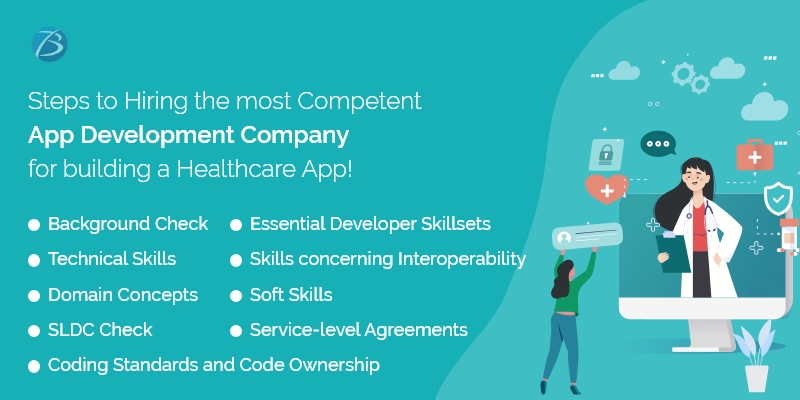
mobile apps development company in India</div>
<div class=
Background Check
Conduct an extensive background check in the following ways:
  • Check their past work experience and the type of projects handled in the past by going through their portfolio.
  • Examine the case studies, blogs, etc. to understand how their developers handled challenges faced during past projects.
  • Go through the reviews by previous clients
  • Validate the proficiency and level of expertise of the development agency.
  • Look for company reviews/ranking on prominent online authority portals like GoodFirms, Clutch, Wadline, VenturePact, etc., and the accolades earned.
Essential Developer Skillsets
Having a thorough knowledge of programming languages is not enough for healthcare app developers. This is because medical app development extends way beyond coding and requires some additional prerequisites like interoperability, integration, and compliance with standard laws/regulations. As such, developers must have the required expertise and certain dedicated skills. Check them out!
Technical Skills:
Developers must be well versed with third-party integrations, data security standards, and cutting-edge technologies like big data, AI, AR, ML, VR, AR, IoT, AI, etc. so that they can craft a versatile, secure, and future-friendly solution.
Skills concerning Interoperability:
Semantic vocabulary and knowledge about integration standards and integrating frameworks are needed to make the software solution interoperable with the systems, devices, and existing software of the healthcare facility.
Domain Concepts:
The app development agency must be aware of revenue cycle workflows and the regulatory compliances/standards/certifications for medical apps mandated by the governing authority of the region where the healthcare software is to be implemented. For example, all healthcare software solutions used by organizations in the U.S. need to adhere to HIPAA (Health Insurance Portability and Accountability Act) and the medical bodies in Canada need to follow PIPEDA (Personal Information Protection and Electronic Documents Act).
Soft Skills:
Soft skills like app usability, and effective planning and coordination during the development cycle as well as after app launch, are necessary to avoid any operational glitches.
SLDC Check
Get a clear idea about which SLDC or Software Development Lifecycle model, your would-be technology partner is going to deploy. The checklists include the following:
  • Clarity about whether an agile methodology (the most preferred approach) would be adopted
  • The niche – iOS OR Android – of the developers allocated for your project
  • The turnaround time expected for every stage of the SLDC
  • The team’s approach towards the commitment required for debugging and troubleshooting and their stand to minimize the chances of re-runs while coding.
  • Their readiness and policy to provide support post product deployment for executing interactive changes based on user feedback.
Service-level Agreements
There are certain service level agreements that you need to watch out for when hiring offshore agencies.
  • An NDA (Non-Disclosure Agreement) is necessary to protect the app’s idea and design.
  • An agreement between both parties concerning the payment deadlines, hourly/monthly rates, the token amount, and the form of payment (digital currency/wire transfers) is necessary.
  • Negotiation talks after the announcement of the first quote, should be an integral part of the initial discussion.
Coding Standards and Code Ownership
Ensure that your app development partner possesses mastery in coding for the healthcare domain niche you have opted for and employs the best available and aptest frameworks/technologies for your healthcare application development project. Moreover, make sure an agreement is sealed wherein it’s declared that you are the rightful owner of the mobile application, its design and source code, and other app elements.

Common Mistakes to Avoid

  • Not conducting adequate research to check the background of the agency you hire
  • Hiring low-cost resources or the cheapest vendor available for accomplishing your project
  • Considering the project cost as the key determiner for selecting healthcare app development services
  • Prioritizing costs over experience and expertise
  • Not paying attention to app store optimization
  • Being unprepared for the stages after the product launch

Final words:

If you follow the aforesaid best practices and avoid the common mistakes, you are sure to hit a great deal and find that perfect offshore app development firm that will provide you with a compelling healthcare app solution.
If you are looking for a competent technology partner, reach out to Biz4Solutions, a proficient mobile app development company in India with a rich experience of 10+ years in building ground-breaking healthcare software solutions for global clients. We tailor the software as per the specific requirements of clients.

The Significant Role of Event-driven Apps in Software Development!

The Significant Role of Event-driven Apps in Software Development!
event planning app development
The ever-evolving digital revolution is transforming the way applications used to function. Since the past couple of years, apps have become way more advanced and complex with the usage of several innovative technologies, frameworks, and data centers. Here are some of the modern-age trends:
  • Implementing microservices architecture
  • Apps are moved to Cloud
  • Apps communicate with each other via lightweight protocols such as REST APIs, RPC calls, etc. instead of the erstwhile practice of sharing the same computational space.
These state-of-art practices have reshaped the methods of software development altogether. One such innovative approach is the usage of an event-driven architecture for building futuristic apps.
In traditional three-tier apps, data (base) used to be the core of the system. With the advent of event-driven applications, this focus shifted to events as well as the manner in which the events are flowing across the system. This shift has completely transformed the way how apps are designed.
This post takes you on an enlightening journey into the world of event-driven app development. Let’s explore the myriad aspects of event-driven architecture, its specific use cases as well as business benefits.

Event-driven Approach and the Data-driven Approach: Comparison

An event-driven architecture focuses on events, unlike the traditional model, service-oriented architecture that is based on data at rest. The shift from a data-centric model to an event-centric model means moving from the practice of gathering data/data lakes and emphasizing on data in flight as well as tracking the data while it is moving from one place to another. The event-driven model still considers data to be important; the only difference is that events become the most crucial component.
The service-oriented model prioritizes data and ensures that no data is lost; whereas the major focus of the event-oriented model is to ensure that you respond to the events as soon as they occur. This is because events are driven by a law of diminishing returns – as the events get older, their value diminishes. Nevertheless, both the service-oriented and the event-driven architectures are used together in most modern-era applications.

Understanding Event-driven Architecture?

Event-driven architecture refers to a specific kind of software architectural model that is used for designing an app. It is quite different from the conventional request-driven model. The reason is that, in an event-driven model, the core structure of the software solution is formed by the capture, processing, communication, as well as persistence of events.
This model is a programming approach implemented during product development and not a language or technology. Event-driven programming segregates the event-processing logic from the remaining portion of the program’s code. Hence, event-driven apps can be built using any programming language – most of the visual and object-oriented languages like Java, Visual Basic, Visual C++, etc. support this model.

What is an event?

An event is an identifiable occurrence or a change in the state that has significance for the hardware or the software of the system.
An event can originate from external as well as internal inputs. For instance, its source can be user-generated like the keystroke/mouse click, system-generated such as the loading of a program, or an external input like sensor output. The role of an event-driven app is to detect the events as soon as they take place and thereafter, manage/process those events employing event-handling processes.
Events: Examples
Take a look at some examples/use cases of events to serve diverse business requirements:
  • Web server: The receipt of an HTML message
  • Text editor: The pressing of a key or the request for resetting a password
  • Fraud detection: The detection of illegal trade patterns
  • Commercial business processes: The acceptance or rejection of a loan application
  • Real-time warehouse management: A warehouse updating its inventory, the arrival/delivery of a package to the desired location, or a robot reaching the desired destination.
  • Management System: A new rostering schedule being ready for distribution to the concerned personnel.
  • Gaming (Car racing): A car hitting another one in a computer game
Actions triggered as a response to events
Once the event notification is sent, this occurrence/change in state is captured by the system and then the app responds to the event. The aforementioned events are likely to trigger one or more actions as a response such as logging the event for further monitoring. Some instances of such responses are:
  • Virtual conferences where the sale of tickets are closed after all the seats are booked
  • An email for resetting the password is sent to the customer
  • The account involved in a fraudulent transaction is locked and the security team has been notified about this event
  • An order for more items (that are running low in the inventory) is placed

How does the Event-driven architectural Model function?

Event-driven architectures are employed for the purpose of building, detecting, consuming, and reacting to events. Publishers, subscribers, sources, and sinks are some of its crucial components. This is how they work.
  • Sources are the places where data gets generated.
  • The publisher captures the data contained within the event and then stores it in a repository.
  • This data is then consumed by the subscriber who potentially responds to the event.
  • Sinks refer to the destinations to where the data is sent by the subscribers.
For example, a retailer gathers data on every purchase that is taking place in all his stores around the globe. This data is fed into an event-driven system or app that is keeping a watch on fraudulent transactions and then sent to a credit card processor or for the next set of actions. From manufacturers’ perspective, they are informed about the data coming from their equipment that inform facts including temperature and pressure. This information obtained from the data helps them in real-time event monitoring and triggering of actions such as failure predictions, scheduling maintenance, etc.

Event-driven Architecture: Models and their Functions

Pub/sub Model:

This model is a messaging infrastructure that is based on subscriptions to a stream of events. After the occurrence/publishing of an event, it is sent to the concerned subscribers who are supposed to be informed.

Streaming Model:

Using this model, the events are written to a log instead of event consumers subscribing to an event stream. This model enables the event consumers to not only read any portion of the event stream but also join the stream at any time.
Event streaming is categorized into three types.
Event stream processing:
This category makes use of a data streaming platform such as Apache Kafka for ingesting events and processes or for transforming the event stream. This type of streaming is used for detecting meaningful patterns in the event streams.
Simple Event processing:
Under this category, an event triggers an action in the event’s consumer almost immediately.
Complex Event processing:
With this category, an event consumer is needed for processing a series of events to detect patterns.

What kind of Apps/Software Systems is best suited for Event-driven Architecture?

Event-driven app development leads to the creation of digital enterprise app solutions that are more agile, contextual, scalable, and responsive.
  • As the events take place, they are captured from their sources like IoT devices, apps, networks, etc. For this reason, the event producers, as well as consumers, can share the response information and status in real-time.
  • Owing to its scalability, this architecture allows you to create as well as respond to several events in real-time. So, modern-era apps that need to make use of consumer data in real-time, adopt this approach.
  • This approach is an ideal pick for future-friendly apps with distributed architectures because event-driven architecture allows minimal coupling.
  • Event-driven architecture is loosely coupled as the producers have no knowledge about the event consumers who are listening for an event and the events are not aware of the consequences of their occurrence. Therefore, it is a perfect pick for loosely coupled software like microservices. Microservices are designed for performing specific tasks based on event occurrences.
  • The event-driven model turns out to be very versatile as it functions well with unpredictable and non-linear events.

Event-driven Architecture: Business Benefits

The benefits of event-driven development are as follows:
  • Enterprises can obtain a flexible software system that is capable of adapting to changes and indulging in real-time decision-making.
  • Owing to this approach, businesses can think of their operations and generate data as events instead of viewing them as a couple of metrics on a quarterly/weekly report.
  • This real-time situational awareness enables business owners to make use of the available data that reflects the ongoing state of affairs of their systems while manual/automated decision-making processes. And, access to context and data leads to more effective and productive business decisions.
  • The organizational apps and systems utilizing the event-driven approach are more scalable and responsive as compared to other apps using traditional approaches.

How are Event-driven Applications hosted?

The aptest platform for hosting event-driven apps is the serverless platform. The reasons are given below:
  • Event processing needs simple responses unlike typical transaction processing wherein complex processing is needed.
  • Events may originate from any location.
  • The frequency of the events ranges from zero to tens of thousands each second.
  • The serverless platform has the capability to scale as per the rate of generation of events and is less likely to fail in situations when some of the cloud resources are lost.

Final words:

The software development industry has started focussing on event-driven applications to make their systems/apps future-ready and gain a competitive edge over peers. So, it’s high time to engage event-driven app developers for smartening and accelerating your business processes.
If you are looking to create an app using event-driven architecture, contact Biz4Solutions, a prominent event app development company. We have extensive experience in this architecture and our event app development services are worth a try!
