All-inclusive Insights on Beacons: Types, Advantages, and Use Cases!

All-inclusive Insights on Beacons: Types, Advantages, and Use Cases!
Offshore Software Development Services in India
Beacons happen to be an integral component of IoT technology and are transforming the functioning of diverse industrial domains at a fast pace. The concept of Beacon was launched in 2013 by Apple and has progressed a long way since then. Take a look at these amazing stats concerning beacon technology.
A 2020 report by Statista states: “The market value of Beacons technology was 519.6 million USD in 2016 and is expected to grow at a CAGR of 59.8% such that the market value will shoot up to 56.6 Billion USD by 2026.”
This post takes you on an insightful journey into the world of Beacons! So, let’s explore comprehensive aspects of the Beacon technology – types of Beacons, benefits of Beacons, IoT applications using beacons, and many more.

What are Beacons?

A Beacon is a small wireless device that continually transmits a radio signal displaying its presence with its unique ID. This signal is captured by nearby smart devices, mostly smartphones that use BLE (Bluetooth Low Energy) technology. The smartphone device detects the signal sent by the beacon by reading its identification number (ID) and then calculates how far away the beacon is located. Based on this information, an action is triggered on a mobile app compatible with a beacon.
Beacons utilize proximity technology for detecting human presence within close vicinity and then trigger pre-set actions for delivering contextual, informational, and personalized experiences. As such, beacons are employed in IoT (Internet of Things) networks as well as outdoor/indoor positioning systems.

Types of Beacons

There exists a wide variety of beacons. Beacons vary as per their size, use cases, battery life, and degree of resistance to exogenous factors. Take a look at the different variants of beacons that emerged to accommodate diverse business requirements!
  • Standard beacons are devices sized like a Wi-Fi router or even smaller and are used for indoor tracking and proximity solutions.
  • Small-sized portable beacons that are as big as a large sticker or a credit card are utilized for proximity solutions and asset tracking.
  • USB beacons are portable, small in size, and can be promptly deployed. These are used for asset tracking and proximity solutions.
  • Sticker beacons happen to be the smallest beacons available and are used for asset tracking.
  • AI-empowered beacon is a machine learning-empowered device capable of detecting various gestures as well as movements.
  • Video beacons refer to the devices that are plugged within the back of a screen for delivering digital signage and providing contextual visual information. For instance, the users of a beacon-enabled app receive personalized offers when they appear near the display screen of an eatery.
  • Dedicated beacons are devices that are resistant to exogenous factors like water, dust, shattering, and antistatic/UV. These serve as proximity solutions in harsh eco-systems and are employed for indoor tracking.
  • Parent beacons are as big as Wi-Fi routers. They are used for tracking other beacons, gathering data, and then storing it in the cloud, etc.

The Basic Components of a Beacon and their Roles

A beacon consists of a battery-powered small ARM computer with a CPU and a Bluetooth Smart connectivity module. And, for running this module, firmware is installed within beacons. Its computing power is limited as the maximum Bluetooth Smart playout is only 257 bytes – inadequate for inserting media content. Therefore, it can be used to encrypt a beacon’s ID and process sensor data. There exists a small antenna within the CPU which is designed for broadcasting electromagnetic waves with a length and frequency of 2.4 GHz radio waves. On account of the RSSI (Received Signal Strength Indicator) estimate, this technology is useful for location and mapping services.
The eco-system of the beacon technology consists of an SDK, beacon devices, and back-end management tools. Also, noise-reduction algorithms are present to smoothen the signals and lead to fairer outcomes.

How does a Beacon function?

A beacon continuously broadcasts an identifier – a unique ID number. Once, a mobile device picks up the identifier and gets connected; the beacon accomplishes the function that it has been programmed to execute. When a user enters the zone where an IoT network containing beacons or a positioning system is established; they receive a code through a text message on their mobile devices. Such a message can be sent only via a mobile app in the form of a push notification.
Beacon IoT apps are installed within smartphone operating systems following any one of the beacon standards – iBeacon standard for Apple smartphone devices: iOS7 and higher versions; and Eddystone standard for Android mobile devices: Android4 onwards. Lastly, the smartphone user must give permission for enabling beacon-based notifications and using a particular positioning system.

Beacons: Use Cases
Beacon IoT Applications
Smart Shelves
Beacon-infused smart shelves assist retailers to comprehend consumer preferences, identify customer demands, and enable speedy and effortless tracking as well as stock control.
Such shelves are powered with an RFID (Radio Frequency Identification Reader) that can be embedded either into the shelf or placed over/below/behind the shelf. This reader is used for scanning the targeted commodities placed on the shelf and then notifying the backend system of those items.
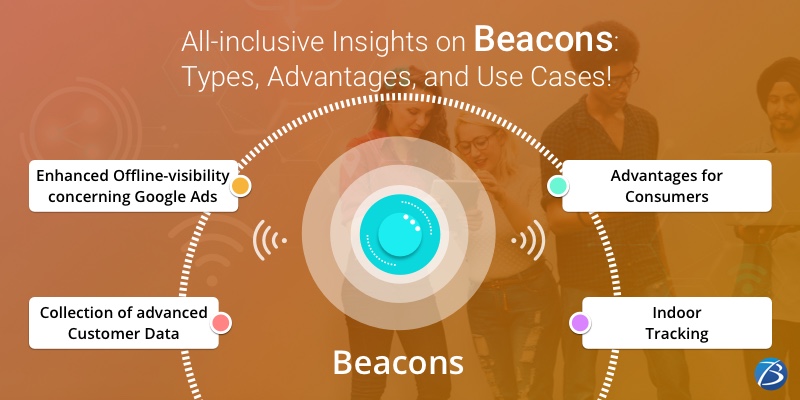
Indoor Tracking
Google maps, the most commonly used tracking and navigation tool possesses certain limitations: It’s incapable of tracking within concrete areas like buildings and fails to provide point-to-point navigation across short distances. All these shortcomings of Google maps are fulfilled by beacon-powered solutions used for indoor tracking in areas such as malls, exhibitions, hospital spaces, resorts, hotels, huge organizations, airports, etc.
Beacons are installed within the building which sends Bluetooth signals to the users’ smartphones such that the positioning data is directly displayed on the mobile screens. Here, the signal strength measurement is used for localization. Moreover, the device can transfer data to platforms where the collected data is intelligently processed. When the position is determined the accuracy of a client-based process is one to three meters and the range is up to three meters. It detects the present floor too.
Implementation in the Educational Sector
This technology facilitates the functioning of educational institutes such as colleges, universities, training institutes, etc. Beacon devices placed in each class can replace traditional notice boards used for broadcasting important information like administrative posts, time-tables, upcoming activities, etc. to the students via push notifications; conducting automatic attendance using timestamps; and many more.
Healthcare Sector Implementation
Coming to the healthcare sector, beacons embedded within mobile devices of the medical facility enable efficient equipment tracking. Moreover, a beacon can load the patients’ medical records/history into the doctor’s iPad immediately after the practitioner enters the patients’ room and remove those records after the doctor leaves the room. Beacons are also immensely useful in helping patients as well as visitors to navigate through large corridors of hospital spaces by providing them location guidance through maps.

Benefits of Beacons

Collection of advanced Customer Data
The positional accuracy of beacons allows retailers to collect reliable information about consumer in-store behavior. This data plays a crucial role in enhancing your in-store layout and product listings, improving your customer experience, designing effective marketing campaigns, and thereby accelerating in-store conversions.
Enhanced Offline-visibility concerning Google Ads
Business brands that connect their beacon signals to the Google Ads account gain handy insights about the offline activity of the searchers and track their in-store visits. Tracking the interaction points of the visitors who have clicked your digital ad campaigns provides one an idea of the effectiveness of your campaign and helps you to identify the areas of improvement so that they can tailor their marketing strategy accordingly. This is how beacon-empowered online marketing strategies are directly linked to offline attribution.
Advantages for Consumers
Beacons allow consumers a personalized interaction during their shopping experience thereby improving the UX to a great extent. Targeted/customized ads from their preferable brands provide customers the flexibility to choose wisely while offline as well as online purchasing and hence, helps in building familiarity, trust, and security.

Final Verdict

Tech giants like Google and Apple are promoting the Beacon technology in full swing and the outcome is obvious – businesses across various domains are leveraging its promising potential. Would you also like to reap the benefits of this amazing technology? Well, reach out to Biz4Solutions, a prominent offshore software development services in India and U.S.A, for our customized software solutions using this beacon technology.

Various Business Models of Mobile Event Apps and their Distinct Offerings!

Various Business Models of Mobile Event Apps and their Distinct Offerings!
event planning app development
Mobile event apps are becoming universally acclaimed as the most viable solution for the successful planning and execution of events. Here are the top reasons for its popularity.
  • A single enterprise branded event app solution serves the foundation for all events conducted by the brand without the need for separate apps for various events.
  • It improves the quality of meetings, strengthens communication, and engages the audience effectively.
  • Once the attendees download the app, they can utilize its social media tools and integrated networking for interaction as well as relationship building before, during, or after the event.
  • Branded mobile apps enable extending the lifespan of a specific event through content sharing and networking all year round.
  • Corporate mobile apps keep attendees updated with real-time targeted resources and information.
  • Branded event apps open up sponsorship opportunities and new revenue streams.
  • Events apps allow organizers to comprehend the reactions of participants during an event and the attendee expectation from future events.
Today, there exists a wide variety of event planning app types, and each type suits a specific niche of event planning and management like trade shows, conferences, corporate gatherings/meetings, entertainment/university events, and many more. Hence, organizers must choose the right kind of event app that complements their event requirements. This post provides comprehensive insights into event apps. A thorough reading will help you to decide which type of event app solution is best suited for your purpose.

What is a Mobile Event App?

A mobile event app refers to a software solution installed on a mobile device like a smartphone, smartwatch, or tablet. This software is employed to build a customized mobile event app for planning and conducting a physical event and serves without the need for complex coding. With the template-based application programs, event organizers can select the design and functionalities as per their choice and customize the content based on their requirements. Event apps belonging to the mobile category offer a no-code WYSIWYG/drag-and-drop interface that allows the development of event-specific applications without coding.
Such an app is a necessary tool for all the stakeholders like exhibitors, attendees, speakers, sponsors, team members, and sales representatives. A branded event app contains all the prerequisites needed by attendees like attendee information, exhibitor information, maps, schedules, speaker bios, etc.

The Must-have Offerings of a Perfect Event App

Essential Features:
  • General info and information/maps of the venue/facility
  • Event registration
  • Contact details and attendee list
  • Sessions, speakers, and an interactive floor plan
  • Exhibitor Catalog, surveys, and slide sharing
  • Newsfeed and Social Media Integration
Features: Communication and Customization
  • Personal agenda, messaging/inbox, and push notifications
  • Profile creation and check-in options and QR code scanner
  • Favorites, people around me, my notes, and activity feed
Features: Interaction and Engagement
  • Session rating, live polls, and voting
  • User accounts and roles
  • The option of asking a question
  • Matchmaking, sharing of photos, and gamification
  • Event analytics and tracking
  • Event marketing
Features: Monetization Strategies
  • Premium content and sponsored push notifications
  • Premium listings and banner ads
  • Capturing and generation of leads

Key Categories of Event Apps: Additional Features

Now, take a look at the additional features that need to be included for each of these events categories!
Apps for Corporate Meetings
These apps should be personalized based on the requirements of the company. For instance, apps for small-scale meetings should possess easy-going features with many screens that include functionalities like registration forms, schedule, address of the venue, location-related maps, etc. For large-scale meetings, additional features like subscription forms for gathering contacts or feedback form/chatbots for collecting opinions regarding a specific report are recommended.
Apps for Conference/Business Gatherings
Such apps cater to business events/occasions such as workshops, conferences, profile meetups, etc. The timeline for these events is usually a couple of hours or even a few consecutive days. Besides the key functionalities such as location maps and schedules, such apps need add-ons like a request for a particular report, the disposition of auditorium locations for helping the visitors to navigate, and so on.
Apps for Festivals, Exhibitions, Sports Championships, and Local Events
Apps belonging to this category needs features like booking a table, buying a ticket, etc. For Sports Championship apps you may add a calendar displaying match schedule and other crucial information, stats on different teams/clubs, broadcast of matches in real-time, and the option to view past matches that are present in the records. Coming to local events, like bar/restaurant/mall performances, a party, etc. the geo-location feature is a must-have apart from the aforesaid functionalities.

Prominent Event Apps: Comparison

Let’s compare the offering of some prominent event apps!
Eventmobi
Eventmobi offers an end-to-end platform for event management that includes all necessities required for building engaging event experiences for online as well as in-person events.
Offerings:
  • A storehouse of virtual event information including all-inclusive general info and even FAQs to provide effortless access to attendees
  • Support and training for the staff conducting an event – paid onsite support or complementary remote services.
  • A sample event for would-be event planners/organizers so that they can peruse/experience the platform on the Eventmobi website before investing in it.
Teem
This app is specifically designed for handling space management, reducing the friction in packed venues, and facilitating networking. It is a perfect pick for events like association or education-based events and conferences. The app enables attendees to speedily and effortlessly find out spaces within the venue where they are supposed to attend the meeting/conference.
Offerings:
  • A way-locator within a campus or a building to allow visitors to locate the spot quickly
  • The facility of space management and scheduling through the app so that participants can easily locate and book a meeting room for networking purposes.
  • The usage of space analytics displaying the spaces that have already been occupied and methods for optimizing this process.
SpotMe
This app leverages cloud technology to provide personalized experiences to each user. It caters to the needs of healthcare/pharmaceutical firms that organize activities pertaining to training, experience-sharing, etc.; business enterprises offering training/development programs via refresher training courses, seminars, etc.; and companies involved in trading operations.
Offerings:
  • Content in the form of an easily downloadable format and an animated UI/UX
  • Announced notifications, dynamic maps, and full-fledged event analysis
  • Support for multiple languages and WCAG 2.0
Eventbase
Eventbase is a smart app that caters to luxury brands and facilitates organizing various kinds of events comfortably and effortlessly. This app is designed for diverse types of events – occasions concerning a company’s internal/external activities such as partner meetings, important conferences, or small-scale events, varying trading events, festivals, premieres, sports events, entertainment events and many more.
Offerings:
  • A smart recommendation system activated via AI-powered technology that provides a unique and fulfilling experience to participants.
  • An award-winning UI/UX that is highly customizable
  • 3D-category maps and gamification options like Activity Stream
  • Round-the-clock access through chatbots enables organizers to keep in touch with the attendees throughout the event
Doubledutch
This app assists in conducting a firm’s internal activities such as generic meetings, corporate parties, promotion courses, etc.; external activities like enhancing brand image and strengthening partnerships through conferences, partnership meetups, professional exhibitions, etc.; or public gatherings like local conferences/exhibitions, academic events, educational training sessions, etc.
Offerings:
  • An advanced CMS system that enables organizers to manage mobile app content effortlessly
  • An intuitive UI that elevates the user experience to the next level
  • An iBeacon from Apple that utilizes location data to deliver highly personalized information to users

Concluding Lines:

Events apps are amazing solutions for content absorption, networking, and audience engagement as they are specifically designed for handling every aspect of event planning and execution. These apps not only improve the management efficiency of event organizers but also elevate the convenience quotient of attendees.
If you are on the lookout for a proficient event app development company, contact Biz4Solutions, a leading software firm providing Event App Development Services in India and U.S.A. for 10+years.
