Game-changing On-Demand App Ideas for 2021!

Game-changing On-Demand App Ideas for 2021!

On-demand app development Company
Modern-era consumers demand high-end products/services instantly! They are constantly on the lookout for easy-to-use, speedy, and convenient mobile app solutions. And, on-demand apps perfectly complement this customer requirement.
So, what are on-demand apps? Well, on-demand apps refer to mobile/web solutions using which customers can avail of real-time services or purchase products. These solutions are either a marketplace/platform that enables various businesses to publish their offerings or a dedicated app developed by a single business enterprise/brand for boosting their revenue generation.
Several businesses and aggregators have embarked to explore the potential of the on-demand economy, resulting in a highly competitive market. Therefore, your on-demand app idea needs to be novel and unique. This post enlists the popular on-demand app ideas and provides insights into some fresh new ideas that can be employed for your next on-demand app creation project.

Trending On-Demand App Ideas with Noteworthy Examples
On-demand app development services
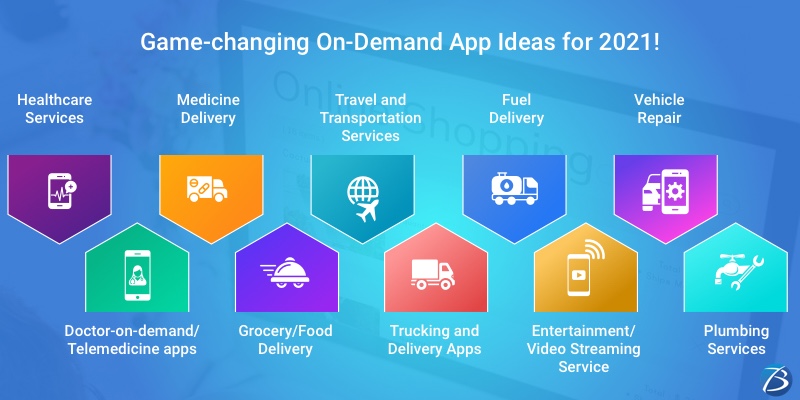
Healthcare Services
Ever since the outbreak of the Covid-19 pandemic, people are reluctant to visit hospitals or pharmacies to avoid crowded spaces and waiting in long queues. However, on-demand mobile apps have brought these services to their doorsteps and people have embraced this new concept wholeheartedly.
There are several categories of Healthcare on-demand apps each catering to a specific sub-domain of the healthcare sector. The services offered by healthcare apps include online doctor consultation, maintaining a fitness regime, obtaining information related to common diseases, hiring professional nurses, collection of laboratory test samples from residence, acquiring doorstep deliveries of medicines, etc.
Doctor-on-demand/Telemedicine apps
Such apps come with features such as online appointment scheduling, secured/encrypted messaging, video calling, ePrescriptions, EMR/EHR integration, and online payment gateways. These apps allow users to avail 24X7 online doctor-consultation services for obtaining basic diagnosis and guidance and most importantly, such services can be accessed using smartphones, from any location.
Noteworthy examples: PlushCare, TelaDoc, and Lemonaid.
Medicine Delivery
On-demand medicine delivery apps prove highly beneficial to patients who require purchasing or refilling of medicines and obtaining other medical products such as testing kits, asthma pumps, medicinal cannabis products, etc. Users upload their prescription and then the pharmacy owner checks the availability of the desired medicines and provides doorstep delivery.
Noteworthy examples: PharmEasy.
Grocery/Food Delivery
The consumers’ lifestyle, as well as shopping behaviour, underwent a drastic transformation over the past couple of years. Today, consumers prefer online ordering and home delivery of restaurant food, groceries, utilities, and most other products needed in their day-to-day lives.
Grocery delivery apps connect consumers with grocery vendors, local stores, and supermarkets. Such apps not only prove convenient to the users but also help businesses to accelerate sales and expand their customer base.
Noteworthy examples: Beelivery, Walmart Grocery, Peapod, FreshDirect, Instacart, and Big Basket.
With an online food delivery app, food-loving consumers enjoy the advantage of choosing from countless varieties of cuisines. Providers, too, can reach out to more customers.
Noteworthy examples: UberEats, Grubhub, Zomato, Postmates, and DoorDash.

Travel and Transportation Services

Vehicle Booking/Renting Apps
Apps that allow users to book cabs, bus tickets, car rentals, shared rides, e-scooters, and e-bicycles are in vogue these days. Many of these apps come with engaging features that include a GPS navigator for live tracking, a real-time traffic checking facility, etc. and some of them even do not charge any additional fee for rescheduling/cancellation of rides.
Noteworthy examples: Careem, Uber, Lyft, BlaBla Car, and Via.
Trucking and Delivery Apps
This On-Demand category offers services like all-in-one trucking, livestock transportation, dump truck functioning/delivery, airline transport, healthcare-sector transportation, marine shipping, etc.
Noteworthy examples: FreightBro, Uber Freight, GoShare, Convoy, BlackBuck, and Transfix (U.S.A.).
Fuel Delivery
Individuals traveling to other cities in their own vehicles often encounter the challenge of running out of fuel in the middle of their journey. And, things get more complicated if they are not aware of how far the nearest available gas station is from their current location. In such situations, an on-demand fuel delivery app would be a huge sigh of relief.
Such an app allows users to obtain fuel delivery regardless of their location. For accessing fuel delivery services, users need to execute the following steps:
  • Download the application
  • Register themselves in the app
  • Grant location-related permissions
  • Book fuel service
  • Enter the location whenever services are needed at a different location
Once, all the aforesaid prerequisites are fulfilled, a fuel truck will reach your current location and fill your vehicle with fuel while adhering to all safety standards.
Noteworthy examples: Cafu, Booster, and Filld.
Entertainment/Video Streaming Service
The whopping success of Netflix clearly indicates the current trend of ditching TV broadcasts and resorting to on-demand service apps for entertainment. On-demand video streaming apps enables one to watch movies, entertainment series, as well as live concerts/shows happening at any corner of the globe, irrespective of the time and location of viewers. Such apps charge a yearly/monthly subscription from viewers.
Noteworthy examples: Amazon Prime, Netflix, YouTube Red, and Hulu.
Vehicle Repair
Modern individuals prefer to travel around countries in their own vehicles and frequently encounter car-related issues at locations where no garage or repair services are available. An on-demand car repair/mechanics app can easily resolve this inconvenience by successfully bridging the gap between the car owner and the mechanics. It’s high time businesses should capitalize on this demand by targeting the traveler community. Your app is bound to hit success if you add distinct functionalities for attracting the targeted audience, make your services available in remote areas, and ensure that you rope in skilled mechanics.
Plumbing Services
Plumbing issues are commonplace in every household but the procedure to get a professional plumber is a hassle-prone and time-consuming process. This is because hiring plumbers involve lengthy processes of paper invoices and then making several calls to the plumber for obtaining prompt services. An on-demand plumbing app addresses this issue effectively as the app owners build a network, connecting plumbers to the people who need plumbing services. The app users can effortlessly identify the desirable plumber as well as schedule an in-person visit for fixing the problem.
Apps belonging to this niche are fewer in comparison to other domains. So, architecting a plumbing app will provide you a competitive edge, and more so if you integrate additional novel features like calculating information about water flow/pipes, reviewing various systems to ensure more productive and accurate outcomes.
Tutoring and Training Services
Online teaching-learning and on-demand training sessions via mobile apps have gained momentum lately and this trend is to stay in the coming years as well. The services that can be provided under this on-demand app category are online educational coaching for school/college/university students, grooming for competitive exams, corporate training, and many more.
Tour/Travel Guide
Travel restrictions add to the difficulties of visiting tourists. Hence, an on-demand app providing travel guidance would be a breather. These apps provide an entire travel plan to users including an online route guide for getting to the location or a specific site, hotel and sightseeing recommendations, and food joint suggestions.
Freelance Services
On-demand freelance service apps help businesses and entrepreneurs to easily find the desired professional – programmer, writer, designer, marketer, etc. – for executing short-term/long-term tasks.
Noteworthy examples: AceBy, Task Rabbit, Upwork, and Fiverr.
Other Notable Services
Other notable services offered by the on-demand app development market are as follows:
  • Housekeeping services: in-house cleaning, lawn mowing, and snow removal
  • Beautician/salon services from the comfort of one’s home
  • Alcohol delivery, flower delivery, and courier delivery
  • Fitness and workout
  • Dog walking, pet care, baby-sitting, and laundry

Bottom Line

The market demand for on-demand applications is picking up at a fast pace. Hence, it’s a golden opportunity for businesses to capitalize on this demand by crafting an outstanding and distinct on-demand app. Biz4Solutions, a highly experienced software firm providing top-grade on-demand app development services to global clients, will help you in your app development journey.

Location-based Apps: Best Ideas for Apps based on Location and how to create them!

Location-based Apps: Best Ideas for Apps based on Location and how to create them!
Location-based app
The power of location-based service apps is rising at a fast pace! Here are some instances!
  • The user books a cab and it arrives exactly at their current location even if the address was not entered.
  • The user is looking for a dine-in space and a location-based app on their smartphone displays eatery recommendations within close proximity.
  • The user receives weather forecasts as well as the latest updates about it.
  • Users receive assistance in maintaining safety during a natural disaster or some other emergency.
To sum up, location-based apps not only enable businesses to provide services as per the consumers’ immediate location but also help users in locating a nearby service, place, or person. For, this reason, most of the modern-era applications have embedded the geolocation technology regardless of whether the app user utilizes or ignores it.
This post provides insights on the use cases of location-based apps, suggests some handy app development ideas, and guides through developing an impeccable location-based application.

Location-based apps: Functioning

The location-based service technology uses real-time geodata from smartphones to instantly track the users’ current location and then provide information, advice, or guidance concerning the desired services/sites. Geolocation technologies that broadcast the location information for location-based apps are Wi-Fi, GPS (Global Positioning System), satellite signals, signal strength indication, cell id tower info, etc.

Location-based Apps: Use Cases

Location-based app Development Company
Navigation Apps
Apps like Google Maps, Maps.me, and Maze are popular outdoor navigational mapping applications that help travelers to find the best routes and offer step-by-step guidance to reach a location. Maps.me goes one step ahead as it works offline as well.
Amongst the indoor navigational apps; the Purple app assists patients to navigate within the Allina Health Hospital and Sarasota Memorial Hospital while Mapsted helps visitors navigate through huge malls.
Food Delivery, On-demand and Retail Apps
Food delivery apps like Uber Eats, Zomato, Glovo, and GrubHub employ geolocation technology to facilitate effective navigation for delivery staff and allow real-time order tracking by customers.
Uber is one of the shining stars in the on-demand category and has revolutionized the taxi booking experience altogether. This app automatically tracks the users’ current pickup location and sends the cab driver to the venue accordingly. Users are also able to track the drivers’ movement before the cab’s arrival as well as during their ride.
Retail apps such as IKEA, Target, Walmart utilize this concept to boost the customer experience. GPS is employed to help consumers find the nearest store, select a convenient delivery/pickup location, etc. and Beacons are used for providing in-store navigation.
Location tracking apps
Most Android and iOS devices possess built-in location tracking features so that owners can easily locate their devices when stolen or lost. However, for activating this function, the devices’ GPS feature needs to be turned on.
Geolocation tracking also helps in detecting suspicious activity thereby protecting the users’ data. For instance, Gmail users receive a security alert when they try to log into their account from a different country.
Parents are able to track their child’s whereabouts in real-time using the FootPrints app.
Support Groups and Sponsor Finder, a location-based messaging app, help disabled individuals or the ones with addiction problems to receive timely help during emergencies.
Social Networking Apps
The geolocation functionality facilitates social networking apps users to share their current location, mark it on their posts, mark themselves safe/in trouble during unforeseen situations like natural disasters or terrorist attacks, check into places, and many more.
Foursquare had coined the idea of checking into a location via smartphone devices, a concept that has been copied by several apps, including Yelp and Facebook. Foursquare’s Swarm app allows users to share their location with friends in the contact list, send invites to friends for joining them, and even enables them to locate the contacts available nearby.
Apps such as Snapchat and Instagram, too employ map view to enable geotag-empowered posts and view nearby contacts.
Dating apps, like Tinder, provide pictures of nearby users to customers and helps them to meet them as well.
Local Parties Finder proves handy to travelers searching for night activities.
IoT Apps
Apps and devices employing IoT technology like fitness trackers, and wearables like smartwatches, utilize the location-based approach for improved outcomes. Some instances of this use case include wearables paired with cycling/running apps; pet care apps that employ tags called Paw Scout, apps for family safety, and using GPS-enabled devices such as LugLoc for keeping a vigil on luggage.
Weather Apps
This is a popular category of location-based apps that provide handy information on the weather conditions along with a twenty-four-hour forecast based on the consumers’ current location. ApexWeather, Dark Sky, etc. are some notable examples.
Gaming apps
Gaming apps like Pokemon Go and Scavify leverage the geolocation technology to boost user engagement. Pokemon Go enables players to reconstruct their existing environment while Scavify deals with scavenger hunts.

Fresh New Location-based App Ideas

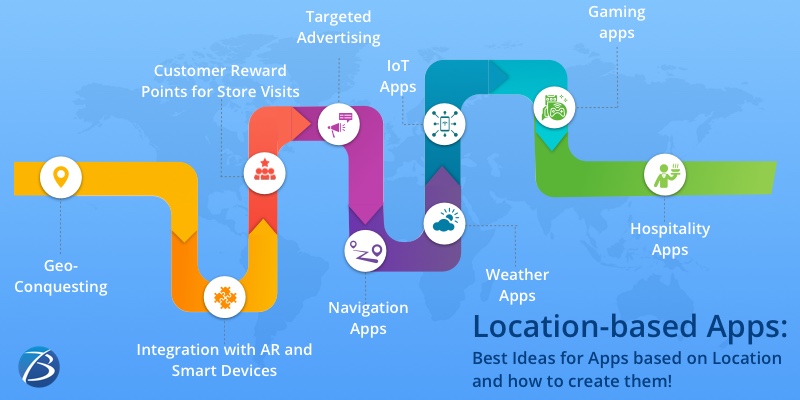
Geo-Conquesting
This is a novel technique that assists businesses in diverting the attention of competitors’ clients and has been implemented successfully by Dunkin Donuts. Take a look at this instance. Starbucks like most others, helps users to locate the nearest coffee shop and even enables advance ordering such that the order is ready before the users enter the store, thereby saving their time. Dunkin Donuts offers an additional feature. It sends a notification to the users who are about to enter Starbucks/or any other eatery – an ad message with a discount coupon. Isn’t it an intelligent idea to convert your competitors’ customers?
Integration with AR and Smart Devices
Location-based apps when integrated with AR can offer guided tours to travelers across the globe, with all required information flashing on the smartphone screens while moving around.
These apps when paired with smart home devices can automate tasks like automatically switch on lights when someone enters by configuring it programmatically.
Hospitality Apps
Hotel apps implementing geolocation can provide extra features – food menus; on-site navigation; self-check-in/check-out, arrival, or departure; electronic keys, etc.
Targeted Advertising
This ingenious idea is ideal for eCommerce apps and helps businesses in carrying out effective advertising campaigns. But how? Ditch the ongoing practice of conducting surveys and inviting consumers for collecting their requirements. Instead, implement geolocation to find out the customers’ daily schedule and the places frequented by them. Use this information to create a customized ad campaign for customers as per their preferences. For example, the customers who are frequent gym visitors receive ads related to products like weights, tracksuits, gym equipment, etc. whereas the ones who travel quite often receive ads concerning the purchase of travel-related stuff such as travel sacks/pillows and so on.
Customer Reward Points for Store Visits
Restaurants/food joints/cafes may utilize geolocation to identify customer visits to your space even if they miss out on opening your app during their visit and then automatically load reward points to consumers’ accounts for each visit. This move will work wonders to improve customer loyalty.

Location-based App Development Steps

Want to develop a High-end Location-based app for your business? Well, check out these basic steps on how to go ahead with the development:
  • Conduct extensive research to identify the market demand for location-based service apps, explore opportunities, and analyze competitors’ strategies.
  • Pick the right approach and features – The app should have a robust backend, an interactive UI, and specific functionalities like map integration (Apple/Google/Bind), GPS-co-ordination, location detection (automatically acquiring users’ present location as well as providing nearby options), and advanced route search including personalized driving directions.
  • Choose the apt location tracking technology – GPS, Beacons, cellular networks, Wi-Fi, etc.
  • Ensure the safety of self-portrait location data and keep your location-based app highly encrypted.
  • Hire professional and experienced developers for executing your project.
  • Build a location-based prototype sphere, choose a suitable app design, develop, thoroughly test the app through various stages, and then deploy.

Concluding Words:

So, isn’t it a brilliant idea to establish your digital footprints by architecting a unique location-based application? In case of any queries or technical assistance concerning app ideation as well as creation, reach out to Biz4Solutions, a highly experienced Offshore mobile app Development Company in India, catering to global clients across myriad industrial domains.