How On-Demand Apps Are Taking the World by Storm?

How On-Demand Apps Are Taking the World by Storm?
On demand App development Service
The magic that mobile apps like Uber and Zomato created in a few years was just the beginning of the humongous on-demand economy. This concept of serving the customers instantly on-demand, at the location they desire, has made both- consumers and the business world go crazy. The on-demand economy is the talk of the town and there is a lot to say about it.
So, what exactly is the on-demand economy? What are the advantages of on-demand apps? How to go about on-demand app development? Are there any challenges too? All such questions will be answered here. So, keep reading ahead.

What is On-demand Economy and an On-demand App?

As the name suggests, the on-demand economy is the trend or the working model, in which the designed apps or services cater to the requirements of the target consumers, either instantly or as soon as possible, at their doorsteps or any other desired location. The goal of this trend is to offer instant products/services to the end-users.
The apps designed for this purpose have the necessary features like location tracking, profile creation, sending notifications, wish-listing the items, seamless search options, flexible payment options, etc., and they are referred to as on-demand applications.
Today, there are a plethora of on-demand apps available in the market which serve a diverse variety of end-users. To name a few popular on-demand applications- Netflix app in the entertainment industry, Airbnb in the hotel booking domain, TaskRabbit when it comes to carrying out household chores, Phlex65 for caregivers to provide day-to-day care services to older people, BloomThat to gift your loved ones with flowers, etc. Hundreds of such apps have been fabricated already, belonging to sectors like food and restaurant, grocery, travel and transportation, health and fitness, salon and beauty, home care services, and much more.

Why On-demand Apps are so Popular?

“I have to complete this critical work today and so, won’t be able to cook. Can we order the dinner?”
“I need to reach there ASAP and public transport will take a lot of time for sure. Let me immediately book a cab.”
“There is no grocery at home and I have a tight work schedule this week. I will better order the grocery online.”
“Today is my nephew’s birthday and it completely went out of my mind to buy a gift for him. I will order a cake and a pizza for him in the evening.”
We all may have gone through such instances owing to our fast-moving busy lives. Thanks to the on-demand apps that we can rely on them for our daily needs and don’t need to spend several hours on them. This trend is commonly observed in the urban areas, however, they are gradually spreading to the rural areas too.
So what are the top reasons behind the popularity of on-demand services?
On demand App development Company
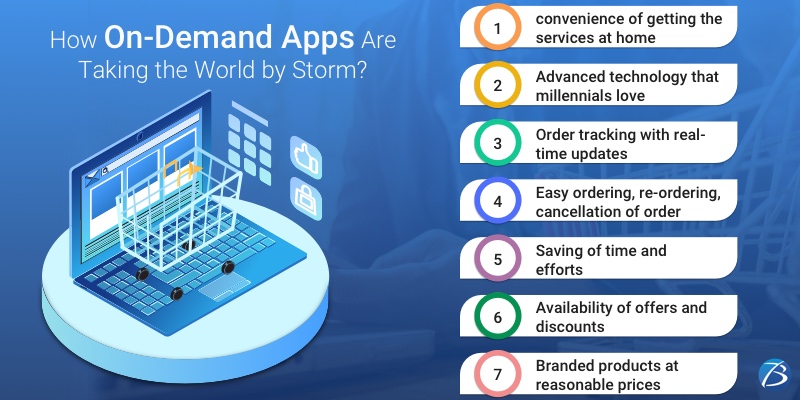
  • Convenience of getting the services at home
  • On-the-go services
  • Advanced technology that millennials love
  • Order tracking with real-time updates
  • Easy ordering, re-ordering, cancellation of orders
  • Saving of time and efforts
  • Branded products at reasonable prices
  • Ease of accessing the apps
  • Availability of offers and discounts
  • Wide range of products and services as compared to live stores
  • No need to carry cash or stand in long queues

Why Businesses Prefer Services of On-demand App Development?

We now know why the consumers are so much into leveraging the on-demand app services. But why business entities are picking this on-demand business model? First, let’s look at some statistics.
  • Well, as per a survey report by Burson-Marsteller, 51% of on-demand service providers said that after entering into this business trend, their financial condition has comparatively strengthened.
  • Another estimation by Burson-Marsteller forecasts that almost 64% of the companies providing on-demand services say that they are expecting their financial profitability to improve sooner or later.
Besides, here are the key reasons why a large number of start-ups, small and large business entities, and even giants are choosing to build top-notch on-demand mobile applications.
  • Countless business opportunities
  • Suitable for diverse industry verticals
  • One-time investment for a long-term solution
  • Competitive benefit
  • Cost-effective solution
  • Improved online presence and brand awareness
There are a few other reasons why so many firms prefer this business model and why there is a rise in the number of on-demand companies worldwide. Please click here and read the post for a deeper insight into this.

How to go About On-demand App Development?

There isn’t any hidden formula to architect an out-of-the-box on-demand service app, however, you need to keep some vital tips in mind; they are given below:
  • Your app idea or concept must be unique and different from those already existing in the market.
  • You must ensure that you take the right guidance from expert professionals for making your project a success.
  • Your team or your on-demand app development partner must possess appropriate in-depth industry knowledge and experience.
  • You must design a practical and smart marketing strategy for improving the overall outcome.
Besides these tips, here is an extensive write-up on “How to Develop a Next-gen On-demand App?” for you. Do have a look.

Notable Challenges Affecting the On-demand Business Sector

The on-demand business model has a huge potential. But there are certain challenges that this industry is already facing and may face in the future.
Firstly, the overall revenue generation has been impacted owing to high consumer demand and related operational costs, especially during the Covid-19 pandemic.
Besides, a high rate of delivery agent turnover is one of the prime factors affecting this domain. The pay of the delivery agents is much higher.
Also, some other challenges that impact the on-demand business sector are product incompetence, high competition, inefficient resources, under/over-valuing of supply and demand, etc.
However, with an exceptional concept for your app, robust technological strategies and enhancements, a proper development plan, and apt guidance, these challenges can be overcome to a great extent.

Final Thoughts

If you are a startup and want to begin your app development journey with an on-demand app, then without any doubt, you must go with this idea. This is so because the on-demand economy is booming at a fast pace and there is a huge scope for on-demand app-based services altogether. Such apps and services have a large user-base and they can be designed at a budget-friendly price. So, it is high time to leverage this opportunity and see how your innovative on-demand app will take the world by storm.
Looking for a reliable on-demand mobile app development company to commence with your project? Reach out to us and our team will provide you all the detailed information and estimates for your project.

Closed-Loop Mobile Payments: All You Need to Know!

Closed-Loop Mobile Payments: All You Need to Know!
Closed loop payment system
Executing payments via digital wallets/ Mobile payments solutions have become the order of the day owing to the emerging digital technologies and an increasing dependency on smartphones.
According to a research report published by the online portal, Mordor Intelligence, “The market value of mobile payment systems was 1449.56 Billion USD in the year 2020. The mobile wallet market is expected to grow at a CAGR of 24.5% during the next few years and the market value is predicted to reach 5399.6 Billion USD by the year 2026”.
Digital wallets have transformed the manner of making payments altogether. The two major categories under this type of payment methodology are open loop and closed loop mobile payments. The open-loop payment system involves using a single digital wallet via smartphones for making payments at several locations. Closed-loop mobile payments, on the other hand, requires prepaying a certain amount of money to one specific merchant or business brand just like using loyalty/gift cards at an apparel store or an eatery.
Out of these two mobile payment categories, the closed-loop approach is more preferable by merchants as well as consumers. In fact, the closed-loop payment model has revolutionized mobile payment one step further and elevated it to the next level! Let’s gather some quick insights on closed-loop mobile payments and the business benefits of adopting this approach.

What is Closed-Loop Mobile Payment?

A closed-loop payment refers to the payment transaction wherein a customer uploads money into a spending account linked to a payment device, just like the functioning of a gift card. This kind of payment happens between a spending account and a particular business brand. The mobile equivalent of this payment system is termed closed loop mobile payment. A closed-loop payment system uses mobile apps for managing gift cards and accounts via smartphone devices. Closed-loop mobile payment solutions allow users to check their balance within the system, make purchases using a mobile app instead of a physical card, and top up their account balance effortlessly. Customers can make payments using mobile devices/tablets to a specific retailer against an established account balance. Some of these solutions even provide the option of automatic balance top-up.
Any branded mobile payment or loyalty solution falls under this category. The TimmyMe app by Tim Hortons and the Starbucks smartphone app are popular examples of the closed-loop mobile payment model.
What is meant by a Closed-Loop Card?
A closed-loop card, also known as a single-purpose card, is an electronic payment card which the cardholder can use for executing purchases from a specific brand. Such cards usually bear the logo of the company where it can be used instead of bearing the logo of a primary payment processor such as American Express, MasterCard, Visa, etc.

Benefits of Closed-Loop Mobile Payments

Closed-loop mobile payments
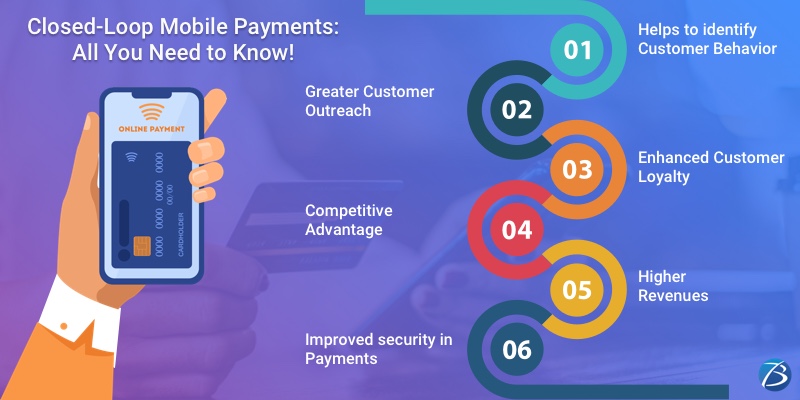
Identifying Customer Behavior for Creating Effective Marketing Campaigns
This mobile payment processing model helps entrepreneurs to capture big data based on millions of customer transactions and then, analyze this data for gaining deeper insights into the buying habits of consumers. Once, the businesses get a thorough understanding of their target market and identify the purchasing habits of their customers, they can create customized promotions/offers and deliver the same to customers’ mobile devices.
Greater Customer Outreach
Mobile technology simplifies sending out purchase reminders to customers via notifications. Moreover, businesses can even set up geo-targeted notifications which get triggered whenever potential consumers are close to their store.
Enhanced Customer Loyalty
The ability to send customized promotional offers and loyalty incentives to customers via smartphone devices not only helps in retaining consumers but also enhances their loyalty quotient.
Competitive Advantage
Using the closed-loop mobile payment model, customers enjoy several benefits like smartphone friendliness, automatic balance top-up, the option of pre-ordering for avoiding line-ups, being able to consolidate several gift cards, and many more. This makes your brand the obvious choice for customers.
The exclusive nature of a closed-loop mobile payment system enables business brands to monopolize customers’ smartphone devices concerning services and products within their niche.
The aforementioned advantages help businesses gain a competitive edge over peers.
Higher Profits
When users add money to fund their mobile wallet apps or e-gift cards, it implies that they have technically spent money within your store. Furthermore, if customers fail to use up their remaining balance, you gain extra profit.

Why should Business Brands Adopt the Closed-Loop Mobile Payment Approach?

It’s high time businesses should adopt the closed-loop mobile payment strategy. Take a look at the reasons!
  • Billions of individuals across the globe own smartphones. As such, your targeted audience is more likely to possess a smartphone device than your firm’s gift/loyalty card. Besides, modern tech-savvy consumers are on the lookout for ways and means that will allow them to link their payment wallets with mobile devices. And, the closed-loop approach perfectly befits this requirement.
  • Consumers express interest in this system due to the bar code scanning abilities of modern mobile devices.
  • Such systems promise improved security. This is because they are not tied into carrier networks, users’ credit cards, or bank accounts, thereby adding an extra security layer between the merchant and the bank account.
  • Closed-loop mobile payments are less complicated and easy to execute.
  • This approach proves profitable for vendors as it involves lower purchase fees in comparison to direct credit card transactions.

Concluding Thoughts:

A closed-loop mobile payment system proves profitable for the merchant as well as their consumers. Therefore, if you possess the necessary resources, commence the mobile app development process by partnering with reliable developers and a merchant service provider for architecting an impeccable closed-loop payment system.
Are you on the lookout for a dependable software firm for building a closed-loop mobile payment system for your business? Contact Biz4Solutions, a renowned Offshore Software Development Company in India, with 10+ years of experience in serving global clientele!