Guidance on building a Productive Medical Mobile Application!

The demand curve for medical mobile apps continues to soar as smartphone apps are the most preferred tools for obtaining any product or service. The healthcare app users enjoy the following advantages:
- Scheduling/postponing/canceling appointments, selecting the doctor/specialist of their choice, and receiving emergency help instantly
- Receiving reminders/updates related to prescription refills and appointments via notifications
- Accessing electronic therapeutic records and lab test outcomes
- Tracking health parameters such as blood glucose levels, cholesterol, height, weight, etc.
- Downloading as well as transferring medical reports like X-ray/ultrasound scans, MRI reports, etc.
Every medical service provider would like to offer the afore-mentioned facilities to their patients for expanding their customer base and retaining the existing ones. As a result, Healthcare providers are hiring Healthcare app development services to build On-demand medical mobile apps. Therefore, I have penned down certain crucial aspects that providers need to comprehend before jump-starting the app development process. A quick read will prove helpful to healthcare app owners in deciding the right roadmap.
Medical mobile app development: Best Practices
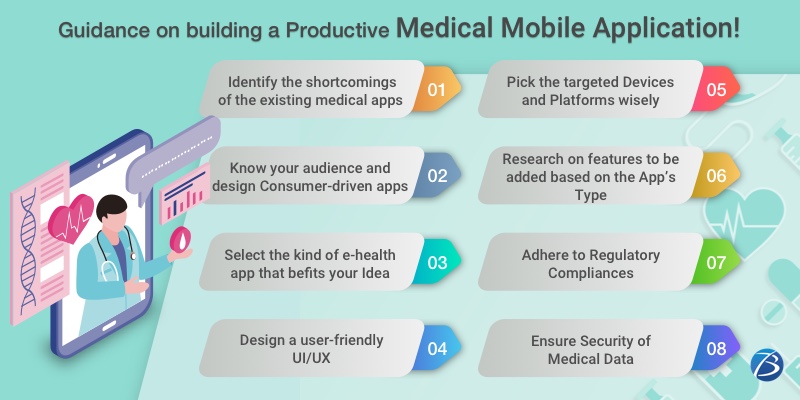
Identify the shortcomings of the existing medical apps
Despite the growing demand for healthcare apps, several apps fail to satisfy customer expectations. So, before you go ahead to architect one, identify the areas where other applications have failed. Some of the commonest shortcomings of current medical apps are as follows:
- A structure that fails to address any specific problem
- Confusing UI, below-average UX, and poor usability
- The lack of clinical output
- The inability to adhere to regulatory compliances and practices to ensure privacy and security of data.
Once you sum up the drawbacks in existing apps; build solutions that are meaningful, dependable, and helpful. Your app must also comply with the privacy and security mandates; as this is one of the most crucial aspects considered by patients and providers before adopting a healthcare app.
Know your audience and design Consumer-driven apps
Conduct surveys to learn about the preferences of your target audience to effectively engage consumers across different demographic groups. Some general observations are:
- Elderly users prefer larger icons/letters and simpler directions and navigation methods
- Youngsters are more attracted to medical apps with colorful displays, gaming technology, social media integration, etc.
- Some demographic groups prefer in-app quizzes and contests relating to wellness and healthcare.
Designing your app as per the preferences of your targeted consumers will accelerate the adoption rate.
Select the kind of e-health app that befits your Idea
There are myriad lucrative functions to include in your medical app such as diagnosis chatbots, phone-to-text abilities, mobile medication alert functionality, geo-location/geofencing, etc. So, it’s important to understand where your app idea fits into the electronic health space and then decide on the type of healthcare app accordingly. Your target app should be fulfilling the needs of one niche in the e-health domain. Here are the major types of healthcare apps to choose from.
Clinical assistance apps help doctors to provide electronic in-hospital diagnoses like symptoms checkers, digital images, laboratory results, etc. And, if this functionality is broadened and patients’ medical data is systemized, EMR and EHR apps come into the picture. The EMR (Electronic Medical Records) software, stores the treatment history of patients; while the EHR (Electronic Health Records) software, allows healthcare providers to securely exchange medical information.
Scheduling and reminder apps assist administrators and practitioners in scheduling future appointments promptly and also send timely reminders to patients concerning scheduled appointments as well as prescription pick-ups whenever required.
Telehealth/Remote Monitoring apps enable the remote transmission of patient-related information to a healthcare provider based in a different location. Doctors can even relay information pertaining to ECG viewing, patient lifescan data, and remote oxygen-level checks in between connected devices.
Healthcare Resource and Training Apps are meant for healthcare practitioners, nurses, and learning physicians. Such apps offer valuable assistance on diseases, drugs, and treatment methodologies; in the form of study guides, clinical references, drug-related information, educational courses/ games, etc.
Fitness and Lifestyle apps are for personal use and are meant for individuals looking for app solutions to track and maintain their personal health and fitness. Apps concerning diet guidance, fitness tracking, meditation, motivation, etc. are some of the commonest examples of this category.
Medical Emergency apps aim at saving lives during emergencies. When the help button is pressed, a direct call to the hospital is activated and the patients’ location is identified.
Design a user-friendly UI/UX
A flawlessly designed UI and UX are essential prerequisites in medical apps. This is because modern-day devices have relatively smaller screens and so it becomes challenging for medical app developers to conveniently present digital content for users. Check out some of the best prevalent practices.
- Let the user commence the app experience with crucial information like profile viewing, advanced search, appointment scheduling, etc.
- Provide important information in the early stages of the users’ journey through your app.
- Keep the graphic design clean, simple, and uncomplicated.
- Create rational and consistent user stories/pathways.
- Choose user interactions with care so that the number of interactions is minimal and the consumers’ objective is achieved as well.
- Try to deliver an overall seamless in-app experience so that your app turns out to be convenient as well as time-saving for users.
Pick the targeted Devices and Platforms wisely
One question that arises in the minds of every app owner is; “Which platforms, devices, and OS should my e-health app support?” Well, e-health apps needs to be supported on the right devices and platforms. Check out some crucial facts.
Devices
- Using mobile devices like Smartphones, smartwatches, and tablets; users can access your app instantly and speedily.
- Desktop devices, like PCs and desktops, will prove beneficial for elderly users and those conducting in-depth or time-intensive research.
Platforms
- Developing apps in both Android and iOS will allow you to reach the maximum audience.
- A single OS can be targeted, if you have already scrutinized the existing analytics and figured out which platform is preferred by your target audience.
Research on what Functionalities to add based on the App’s Type
It’s important to research what kind of feature your app needs based on the type of healthcare app niche you have chosen. The reason is all medical apps do not have the same kind of requirement. For example, a dashboard is not an essential feature in medical resource apps, but clinical assistance and lifestyle apps necessarily need one. Some of the key features of medical apps are listed below.
Dashboard
Dashboards enable healthcare service providers to effortlessly consolidate all patient-related information in one place, thereby improving administration and clinical efficiency.
Patient/User Portal
This is a patient-facing functionality that enables patients to receive messages, reminders, alerts, etc. from the concerned doctor/s or mentor in a single place.
Reporting and Charting
The feature of accruing analytics information for monitoring activity and reviewing progress helps in minimizing reporting/charting mistakes to a great extent and improving the level of care.
Doctor Profiles integrated with Geolocation capabilities
This feature allows patients to easily find the practitioners within close vicinity, review their credentials, and then utilize GPS to reach the healthcare facility where they can find the desired doctor.
Real-time chats/video conferencing
This feature allows patients to instantly connect with on-site practitioners in times of emergency, for diagnoses, or for discussing treatment options.
Payment integration
This feature is used by remote patients for executing payment transactions, and by lifestyle app consumers for buying products or paying for subscriptions.
Adhere to Regulatory Compliances
A medical mobile app must adhere to the privacy and security standards mandated by government bodies; or else the app owners may encounter financial liability issues resulting in hefty fines amounting to millions of dollars.
The regulatory compliances followed by various regions are given below:
The U.S.A.
Any healthcare mobile app meant for the U.S. market that stores or transmits patients’ PHI (Protected Health Information), must comply with HIPAA (Health Insurance Portability and Accountability Act). HIPAA regulates the way how medical data is transmitted between servers and limits unauthorized access to this data. The entities covered by this act are hospitals, medical service providers, health plans, etc.
Canada
The Canadian Government has enforced PIPEDA (Personal Information Protection and Electronic Documents)
for securing medical information. According to this act, individuals have the right to privacy concerning their medical information.
The European Union
Any healthcare entity in the European Union that gathers, stores, or uses citizens’ medical data must follow GDPR (General Data Protection Regulation), irrespective of the business’ location.
The U.K.
The U.K. mandates complying with DPA (Data Protection Act) that limits storing and using personal information.
Ensure Security of Medical Data through all Stages
Maintaining the privacy and security of sensitive medical data should be prioritized. Take a look at some of the standard practices.
- Weighing the upsides and downsides concerning security between Android and iOS devices
- Creating a privacy policy that is informative as well as accessible
- Adding different forms of user authentication methods including user passwords
- Installing and activating data encryption techniques in mobile devices
- Maintaining updates for ruling out the chances of network infections that compromise your PHI
Some Effective Medical Mobile Apps developed by Biz4Solutions
- Healthcare Management System: This is an elaborate web and mobile app solution that helps hospital bodies in managing daily practice management activities and accelerating patient engagement. The solution includes EMR and EHR amongst several other outstanding features.
- Phlex65: It’s a HIPAA compliant app connecting elderly individuals with their caregivers residing in nearby areas and that too in real-time.
- Patient-doctor Communication App: It simplifies the interaction between patients and their practitioners.
Are You Interested in Building a Top-Class Website or Mobile App?
Final Thoughts:
Medical mobile apps provide loads of opportunities to healthcare service providers for engaging with patients effectively and at the same time enhance the UX and quality of care delivered to patients.
Are you looking for a reliable Healthcare app development Company? Contact Biz4Solutions, a leading firm providing unparalleled Healthcare App Development Services to global clients for the last 10 years!