
Does your Mobile App require HIPAA Compliance?
Healthcare data has always been vulnerable to threats like data leaks, security breaches, unauthorized access, etc. The emergence of healthcare mobile apps and the current trend of digital healthcare record maintenance and data transfer; have worsened this possibility. Despite offering advantages like convenience, speed, and accuracy; digital healthcare data is prone to cyber-attacks.
Hence, the governing authorities across the globe have established rigorous standards for all medical entities that collect, process, and store patient data. The Health Insurance Portability and Accountability Act, commonly known as HIPAA, is one such compliance regulation mandated for US-based healthcare bodies that utilize healthcare software solutions.
Developing a HIPAA compliant app involves additional costs as extra security layers need to be integrated within the app. And, data breaches due to HIPAA violations may result in hefty fines or even criminal charges depending upon the severity of the breach. Hence, medical bodies and app development services must be well versed with the specific guidelines that determine whether a particular healthcare mobile app or software needs to comply with HIPAA regulations. This post has consolidated all relevant HIPAA-related information to guide you through HIPAA standards and also mentions which entities are covered under the HIPAA rule. Read along to know whether your healthcare mobile app falls under the category of applications that require HIPAA compliance.
HIPAA: Inception and Governance
The HIPAA act was rolled out on 21st August 1996 and had been updated several times since then. The most noteworthy update was the one declared on 14th April 2003.
The Department of Health and Human Services (HHS) regulates the HIPAA rule and the Office for Civil Rights (OCR) enforces this rule. OCRs provides routine guidance on new issues cropping up in the healthcare industry and investigates the common instances of HIPAA violations.
Why is HIPAA Compliance Important?
HIPAA (Health Insurance Portability and Accountability Act) is a set of interlocking regulatory standards that establish how businesses should use, store, and disclose patients’ data while maintaining the privacy and security of that data.
The prime objective of HIPAA is to prevent the unauthorized and unlawful exposure of sensitive patient information. As such, HIPAA confers patients certain rights regarding their healthcare data. It also offers federal protection to this data by defining rules concerning administrative setups of medical facilities and the technical safeguards to be used by them. The reason is that if confidential patient data is leaked, there would be absolute chaos resulting in the failure of the entire healthcare system. Therefore, all medical organizations handling PHI (protected health information) must adhere to HIPAA guidelines for protecting the privacy & integrity of patient data and ensuring data security.
How does HIPAA Function and what are its Offerings?
HIPAA defines and controls how a patient’s PHI is collected, stored, and managed by doctors, healthcare facilities, and other stakeholders of the healthcare sector. This PHI can be physical records or electronic records maintained by a healthcare application. HIPAA regulates physical and electronic standards for protecting the privacy of an individual’s data.
Coming to offerings, HIPAA focuses on the confidentiality and privacy of healthcare data. The most notable offerings are providing insurance portability to citizens, setting standards for handling medical data, maintaining the efficiency of healthcare data-related operations, and ensuring data security.
HIPAA Regulations: Categories
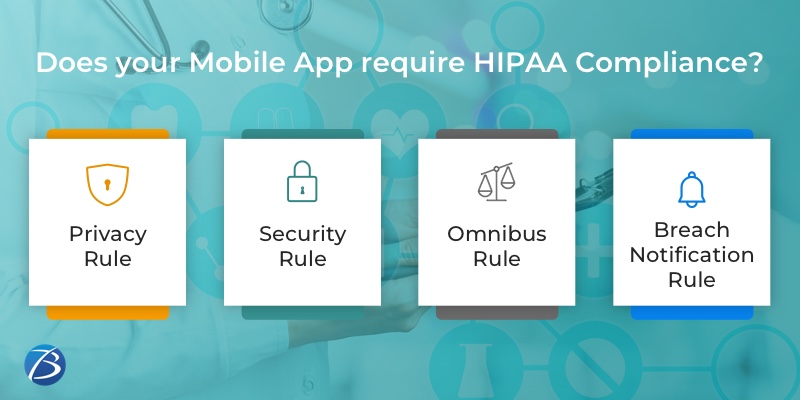
HIPAA Privacy Rule
The HIPAA privacy rule determines which data is considered PHI and which entities will ensure whether the PHI is disclosed lawfully or not.
HIPAA Security Rule
The HIPAA security rule deals with electronic information and establishes guidelines to be followed for maintaining the privacy and security of the PHI. This rule categorizes the data protection methodologies into three different segments – physical, administrative, and technical. Physical security standards cater to actual devices, administrative standards deal with training & access control, while the technical category revolves around data.
HIPAA Omnibus Rule
The HIPAA Omnibus rule was added to apply HIPAA compliance for business associates of covered entities. The rule also mandates the rules pertaining to BAAs. BAAs or Business Associate Agreements are contractual agreements that must be signed and agreed upon before sharing or transferring any data containing PHI or ePHI. Such an agreement is executed either between any covered entity and a business associate or between two business associates.
HIPAA Breach Notification Rule
This rule defines standards to be followed by covered entities and business associates in an event of a data breach involving the ePHI or PHI. The rule states various requirements related to breach reporting. Data breach incidents must be promptly reported to HHS OCR. The breach reporting protocols are defined as per the magnitude and the type of the data breach.
Which Elements of the Healthcare Industry are covered under HIPAA Compliance?
PHI (Personal Health Information)
As defined by the US law authorities, all personal or health-related information of a patient that was created, disclosed, or used during the course of diagnoses or treatment; falls under PHI. PHI includes the data used/stored by a healthcare facility, covered entity, or a business associate of a covered entity for identifying a patient’s identity, and determining their present medical condition, payment transaction data, or provisions of medical care. PHI contains a patient’s demographic details like name, address, contact number, date of birth, geographical location, facial pictures, social security number, insurance information, financial details, and healthcare records like medical bills/e-mails, lab test/scan results, pharmaceutical prescriptions, etc.
In a nutshell, PHI is personally identifiable information that is present in a patient’s healthcare records and the treatment-related data interactions happening between doctors and healthcare professionals. The fact that a patient has received services from a covered entity and the date on which the medical service was availed is also considered PHI.
Covered Entities
According to the Department for Health & Human Services (HHS), covered entities include healthcare clearinghouses, health plans, and the healthcare service providers that electronically transmit any kind of transaction-related medical information.
Business Associates
Any establishment/individual that collects, maintains, stores, or transmits PHI on behalf of a covered entity falls under the category of business associates even if they do not directly deal with healthcare. A business associate that works along with a covered entity also needs HIPAA compliance. Determining whether your mobile app is a business associate or not; may become tricky at times. So, it is advisable for you to consult a legal expert if you have the slightest confusion.
Does your Healthcare Mobile App require HIPAA Compliance?
Now comes the million-dollar question; “Does my healthcare mobile app need to be HIPAA compliant?” Let’s explore!
Identifiable and non-identifiable data
The process of determining whether or not your mobile app needs to comply with HIPAA rules is quite tricky. This is because data like a person’s DOB or zip code may seem least likely to be misused, but such data can be utilized by resourceful hackers for causing harm to individuals because these are identifiable data. As such, app owners must be able to distinguish between identifiable data and non-identifiable data.
For instance, popular fitness applications like Fitbit, Wahoo Fitness, Runkeeper, MyFitnessPal, etc. do not need HIPAA compliance because they track & handle non-identifiable data like heart rate, calories burnt, diet consumed, blood glucose levels, distance covered, steps climbed, BMI, and weight changes. Such data, if stolen cannot be used for carrying out malicious practices. So, this type of data is categorized under consumer health information, and not PHI. Furthermore, the aforesaid apps do not share the stored data with any third-party provider like doctors, medical professionals, or insurance agencies. And, since this data is not being transmitted, app owners do not require encrypting data by adding layers like cipher suites or TLS (Transport Layer Security).
mHealth and telemedicine apps have to be HIPAA compliant as they collect and transmit identifiable patient data. These apps connect patients with doctors for consultation, diagnoses, and treatment. For instance, mHealth/telemedicine app users are asked a plethora of questions concerning their health for narrowing down the symptoms, and then this information is used for finding the most suitable doctor who can begin their treatment. Moreover, patients receive treatment through remote monitoring via video conference calls, text messages, virtual doctor visits, and discussion forums. Therefore, such apps need to store and transmit data like e-prescription, personal identification data, treatment history, appointment information, etc.
Healthcare e-mails and Push Notifications
Generally, e-mails are non-compliant as they are usually unable to encrypt the contents. However, e-mailing information that contains PHI is a HIPAA violation. Hence, if PHI-related information has to be sent through e-mails, you must choose a HIPAA-compliant e-mail service provider for such communications.
Push notifications sent to users via mobile apps may violate HIPAA regulations. This is because, the content sent may be visible publicly on the screen, even when the smartphone device is locked. So, it’s advisable to avoid including any PHI-related data in the push notification content.
API and Database Calls
If your app depends on the data from the covered entity like a practitioner’s office and isn’t HIPAA compliant, then these covered entities will not be allowed to grant access to your app to execute API or database calls. Also it will not be able to read any information contained in the database. This will limit the app’s functionality considerably.
Are You Interested in Building a Top-Class Website or Mobile App?
Concluding Lines:
If your healthcare mobile app needs to be HIPAA compliant, every element of the app including external tools or sensors has to comply with HIPAA rules. HIPPA compliance adds multiple security layers to your mobile app like administrative safeguards, technical safeguards, physical safety measures, documentation safety measures, and breach notification regulations. This increases the complexity of mobile app development and chances of misses are likely.
So, it would be a great idea to seek technical assistance and partner with experienced healthcare app development services. These companies can help you build the most robust HIPAA-compliant apps that function without any operational glitches.


