What do the Modern-day Patients Expect from a Healthcare Application?

What do the Modern-day Patients Expect from a Healthcare Application?
healthcare app development company
The trend of delivering healthcare solutions via a Mobile Healthcare App is garnering popularity and recognition at a fast pace! Medical facilities, as well as providers, are heavily investing in healthcare app solutions to enhance the service quality and encourage the approach of patients’ self-management. These solutions usher in immense benefits like timely medical aid regardless of the patients’ location, reduced errors concerning diagnoses and treatment, improved doctor-patient communication, lesser medical expenses, and many more.
Yet, it has been observed that the adoption rate of healthcare apps is lower than expected despite the availability of endless options. The reason is simple. Most apps fail to satisfy the expectations of the end-users. So, before you proceed to hire a Healthcare App Development Company for crafting that perfect app for you, you must be aware of what features your target customers are looking for. Now, the million-dollar question is, “What do patients expect from a healthcare app?” Well, my write-up answers it all.
This blog throws light on the consumer expectations from a healthcare app and also provides guidance on the essential features to include in a patient-centric healthcare app.

What do Patients expect from a Mobile App?

Patients using a healthcare application generally prefer the following features:
  • Effortless scheduling/canceling/postponing of a doctor appointment
  • The facility of obtaining ePrescriptions including the dose recommendation and being able to access health records easily
  • The availability of the directory containing all health records at a single place
  • Online screening of minor symptoms that do not require a physical visit to the doctor
  • Regular aid concerning healing and early rehabilitation of patients

Key Features to include in a Patient-centric App
healthcare app development services
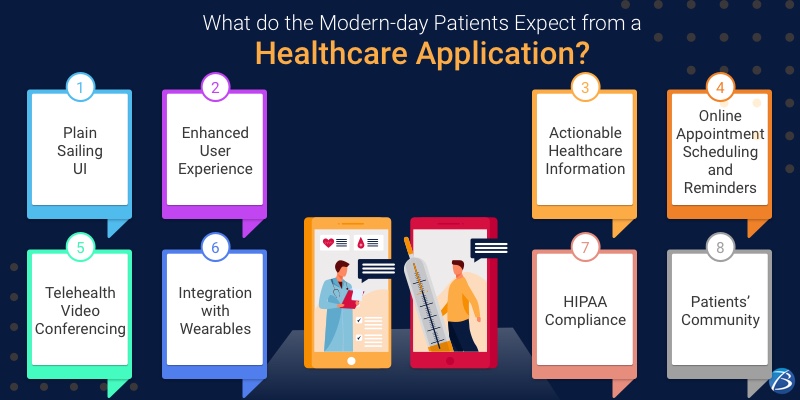
Plain Sailing UI
Patients using healthcare applications belong to various demographics and so we cannot expect every one of them to be tech-savvy. For this reason, your app must involve an easy login procedure, preferably through a single ID card or a Google account. Its functioning should be such that the users receive the maximum output of healthcare information by providing minimum or precise inputs. An audio-based patient compliant portal will be a perfect example in this case.
If the first page of your app asks for too many details, the users are reluctant to survey further. Therefore, it is important to devise progressive reduction methodologies for integrating information and sections so that the patients’ contribution gets reduced.
Moreover, your app must stimulate self-explanatory navigation for switching between various interfaces. Hence, it is a good idea to implement virtual assistants or audio-based instructions in multiple languages, for guiding users as they sail through your app.
Furthermore, all aspects of your app should be visually likable and instantly available. Remember that the patients’ grasp on your app is dependant on factors like fonts, colors, theme, loading speed, and response time of the application.
Simple but Amazing User Experience
Most apps fail to impress end-users owing to below-average user experience. As such, it is important to deliver an amazing digital experience by providing a user-friendly UI and eye-catching data visualization based on the target audience. For instance, if your target audience happens to be elderly individuals, it is advisable to opt for larger-sized app icons and texts.
Actionable Healthcare Information
Patients are going to stick to your app, only if it offers detailed, valuable, and actionable medical information. This is because patients prefer obtaining detailed information about their medical condition, and its causes; so that they can take necessary action based on the opportunities available. Hence, your healthcare app solution should provide all-inclusive and actionable details on a particular medical condition.
Online Appointment Scheduling and Reminders
The online appointment scheduling facility comes with the following advantages for patients.
  • The convenience of booking appointments online and the flexibility to alter the appointment schedule or cancel the same
  • Round-the-clock availability, ease of booking appointments, and also a great time saver.
  • Better error handling by hospital staff and efficient management of appointments
Besides appointment scheduling; modern-day customers, specifically those with chronic conditions, prefer receiving reminders concerning appointments, medicine timing, prescription renewals, follow-up schedule, and checking of vitals like blood pressure, heart rate, etc. Such reminders are provided via text message notifications and even phone calls. This strategy works wonders in retaining customers as well as attracting new ones.
Telehealth Video Conferencing
Telehealth Video Conferencing has elevated doctor-patient communication to a new level altogether. It provides an effective platform where the patients can connect to their practitioners and avail of online consultations instead of physically paying a visit to the medical facility. Check out its distinct benefits for patients.
  • saves patients’ time as well as expenses
  • allows patients to easily co-ordinate with specialists
  • ensures the continuity of care
  • provides remote care for patients residing in remote places
  • enables medical providers to stay informed about the patients’ condition and remotely monitor their medical data
Integration with Wearables
Wearable devices like smartwatches, fitness bands, and health trackers are quite popular amongst the masses. So, if your healthcare app has the ability to integrate with wearables, it would be widely adopted. Wearable devices collect crucial medical data like blood sugar levels, heart rate, tremors, sleep patterns, posture control, workouts, etc. enabling patients to know more about their fitness regime and manage their medical conditions in a better way.
HIPAA Compliance
Most patients these days look for HIPAA compliant healthcare apps to make sure that their healthcare data is protected and the personal information shared by them is not compromised. Patients are critical about the medical data shared as this data is used for insurance coverage as well. HIPAA (The Health Insurance Portability and Accountability Act) mandates that any app accessing PHI (Personal Healthcare Information) must adhere to HIPAA regulations and security standards. A HIPAA compliant app ensures that sensitive personal information and patients’ data are protected.
Patients’ Community
Adding the feature of a patients’ community will add value to your healthcare application as patients wish to connect and interact with each other. For example, a patient who has been diagnosed with a specific health condition or disease would want to contact individuals suffering from a similar condition. This strategy allows patients to garner the much-needed comfort level and peer support, and is an excellent way to engage end-users.

Roadmap: Generation of Actionable Insights from your Target Audience

It is advisable for app providers to build an MVP first instead of a full-fledged application as this is the best budget-friendly way to know what your target audience expects from the healthcare app. An MVP is the most basic and generic version of the envisioned app, with all the primary features and functionalities. In the case of a mHealth app, an MVP plays a vital role in generating actionable insights from the beta testers and early adopters. Once, you identify the areas of improvement through user feedback, promptly resolve the shortcomings and implement the necessary add-ons by launching updated versions. This will make your healthcare mobile app all the more convenient and accessible.

Final Verdict:

There is a high market demand for a highly functional and scalable healthcare app. However, in today’s dynamic and competitive market your app will fail to succeed if the right strategy is not adopted. Hence, all Medical & Healthcare Application Development Companies must possess clear visibility of the expectations of their target audience and plan accordingly. Be smart enough to read the patients’ minds and include patient-centric functionalities for building a game-changing app.
Contact us for further queries and assistance in hiring healthcare app development services!

An Overview: Architecting a Feature-rich On-demand Delivery App!

An Overview: Architecting a Feature-rich On-demand Delivery App!
on-demand app development Services
The on-demand market has emerged to be a fiercely competitive market in recent years. Almost all existing industrial domains, whether food, grocery, health, and medicines, education, entertainment industry, home service, transportation, or even freelancing jobs, have been captured by the on-demand economy in a very short period of time.
You would be amazed to know that the on-demand economy in the year 2016-17accounted for 14 billion USD for just the transportation sector in the US alone. This report by a renowned portal- Statista,aptly proves the potential of the on-demand sector.
Also, as stated by a PWC report, by the year 2025, the on-demand apps and websites market will cross the revenue of $335 billion.
These numbers depict how massive the future scope of this industry is. So, it is essential for budding entrepreneurs and start-up companies, and even the big players in the corporate world to have knowledge of this economy. And this article is a brief guide on this topic- on-demand app development. Here we will be covering details like on-demand app benefits, their types, features, working, etc. Please read ahead to know more.

Top-notch Benefits of the On-demand Apps

  • Unlimited business opportunities in diverse domains
  • Scalability and security
  • Cashless payment facility
  • Ease of ordering the products or services for customers
  • Real-time tracking
  • One-click cancellation of orders
  • Enhancement of customer service
  • Reports and analytics of users’ activities
  • Measurable online presence

Step-wise Workflow of the On-demand Apps

All varieties of on-demand delivery applications have similar work principles. Here are the fundamental steps that explain the working of such apps.
  1. Registration– Firstly, the consumers, as well as the service providers, need to sign up using either their mobile number or social media accounts, or other available options.
  2. Inquiry or Order Placement– Next, a consumer searches for the required products or services and then, places his/her inquiry or order on the app.
  3. Acceptance/Denial of Request– Then the service provider accepts or denies the order. Usually, denial happens in rare cases when there occur some internal or technical issues. Once the order is accepted, the service provider can approve it for further processing.
  4. Payment– Payment delivery depends completely on the consumer’s wish. Some consumers may make online payments in advance and in some cases, they may opt for cash-on-delivery after the order is completed.
  5. Order Tracking– Next, the consumers, as well as the service providers, can track the order in real-time using the on-demand app. During this stage, the consumers can connect with the service providers if required. They may even cancel the order if they want.
  6. Final Delivery– Finally, when the product gets delivered to the consumers, the process is complete. After this, the consumers may drop reviews on the app, but this is optional.

Basic Types of On-Demand Service Apps

Consumer to Consumer (C2C): This kind of on-demand mobile app is an interface between the local service providers and end-users or consumers. Examples of these types of apps include Airbnb, Tinder, and even some ride-sharing apps.
Business to Consumer (B2C): This type of business model connects the consumersdirectly with the businesses. These apps are usually created by individual businesses, for instance, a restaurant creating a food delivery app for its consumers, or a pharmacy creating a drug-delivery app for itscustomers.
Business to Business (B2B): In this type of application, one business enterprise sells its products or services to other businesses or enterprises. Walmart is an apt example of this category. It has its own on-demand app for tracking and managing its products while dealing with other businesses.

Tech-stack used for creating Futuristic On-demand Applications

For creating an impactful app, it is vital to use an advanced tech stack. The on-demand app developersand the concerned team should be equipped with some of thecore technologies like the below:
Frameworks: Angular, React Native, React, jQuery, Bootstrap, Node.js, Ionic
Programming Languages: Java, Swift, Laravel, PHP, Kotlin, JavaScript, Flutter, HTML5, CSS3
Database: MySQL, MongoDB, PostgreSQL
Hosting Platform: AWS
Web Server:Apache HTTP Server
Utilities: Microsoft Azure, Cloudflare
Analytics: Google Analytics
Payment Gateway: Stripe, PayPal
Push Notifications and SMS Integration: Twilio

Must-have Features of the On-Demand Mobile Applications

For Consumer App
  • User profile for the customers to register and sign in
  • Searching products/services and booking orders
  • Push notifications and alerts of their orders, latest offers, discounts, etc.
  • GPS for live tracking of orders
  • Secure and flexible payment models like credit cards, debit cards, wallets, cash, etc.
  • Order history to check previous orders, refund data, etc.
  • Reviews, ratings, and feedback
  • Customer support
For Service Provider App
  • Profile creation for the service providers to easily register and sign in
  • Accepting and declining requests within a stipulated time
  • Alert messages and push notifications
  • Choosing online or offline status for showing their availability for any service
  • Payment module for having a record of their earnings
  • Chatting feature to communicate with customers
  • Special panel for vendors or service providers for managing their riders, staff, services, end-users, billing, etc.
  • Informative dashboard for viewing service histories, performance, earnings, losses, and related statistics
For Admin App
  • Interactive admin dashboard
  • Panel for customer management- customer information management, order cancellation,payment management, discounts, etc.
  • Panel for management of service providers- managing the listing of earnings, penalties, coupon codes, discount offers, etc.
  • Information of pricing and commissions
  • Real-time service tracking
  • Trackinganalytics and reports for business decision-making

Procedure to Fabricate a Full-fledged On-Demand Delivery App

on-demand app development Company
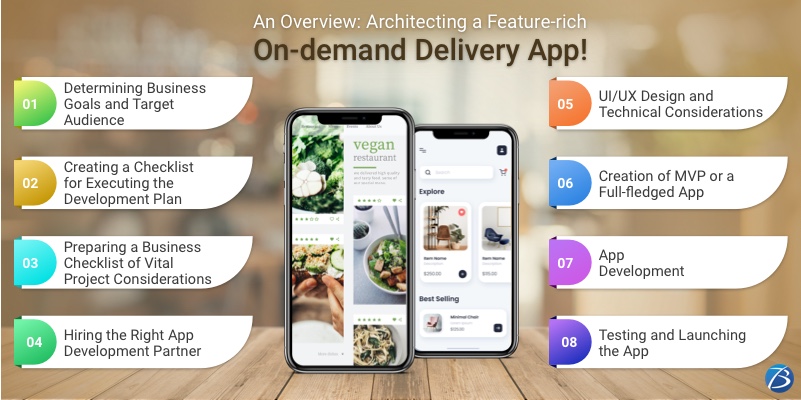
Determining Business Goals and Target Audience
Before starting with the technical part of the app development process, it is necessary to decide on the purpose of the project, the end goals, and the details of your target audience. For this, research about your competitors, get data from online surveys, and get ideas from similar apps in the market.
Creating a Checklist for Executing the Development Plan
The next step is to prepare a checklist for your development team to ease out the execution of the project. This checklist should include the following:
  • Products or services to add to the app, their availability, details of catalog,etc.
  • Feature list as required
  • Confirmation of order requirement from the customer point of view
  • Details of integration
  • Third-party suppliers
  • Costs of products/services
  • Deadline of project completion
Preparing a Business Checklist of Vital Project Considerations
What type of application software do you want to develop? A flower delivery app? A travel on-demand app? Or what else? Also, what features do you want to integrate into the app? Are there any other considerations? Ask these questions to yourself and create a checklist accordingly; the checklist may include:
  • Customer support service
  • Logistics and suppliers
  • Merchant data
  • Flexible hours
  • Delivery charges
  • Discounts and offers
  • Any legal authorities and standards to abide by
  • Security considerations
Hiring the Right App Development Partner
Now you are set to begin with the technical responsibilities. So, it is time to hire your technical partner i.e. the apt app development firm, if you do not have an in-house team. This partner musthave the proven experience, skills, and expertise to develop a modern-day on-demand application. So, perform thorough research and hire a dedicated team.
UI/UX Design and Technical Considerations
Discuss your concept with your designers and developers for them to create a wire-frame of the project. Also discuss with them all the technical aspects of the project like programming languages to be used, app platforms, etc. before beginning with the project development.
Creation of MVP or a Full-fledged App
It is always a better idea to develop an MVP i.e. a Minimum Viable Product because it helps to test your app idea in the market and gain early customers on low budgets. Creating an MVP is comparatively a low-risk idea. But, if you have the flexibility of time and money, you may opt for a full-fledged app as well.
App Development
Once you have decided on whether to develop an MVP app or a feature-rich on-demand app, it is time to begin with the development process. Make sure that your team follows agile development techniques for an organized approach and optimum output.
Testing and Launching the App
Test the app at every stage of development and also after the development process is completed. The quality analysts should get all the bugs and errors fixed to ensure successful project delivery and also make sure that the app offers the best possible user experience.Finally, launch the app on the respective platforms.

Concluding Words:

On-demand apps are flourishing more than ever and they are surely going to be the next big thing in the mobility world. Moreover, the pandemic situation due to the outbreak of coronavirus has given rise to numerous on-demand platformsin almost every business sector. So, undoubtedly, there is tremendous scope for new on-demand ideas and apps.
With this, I would like to wind up this article.
Do comment below to share your take on this topic.
Also, do share with us your experiences about the on-demand apps you developed or are willing to develop.