Onshore, Nearshore, and Offshore Software Development: A Comparative Study of the Advantages and Downsides!

Onshore, Nearshore, and Offshore Software Development: A Comparative Study of the Advantages and Downsides!
Onshore, Nearshore, and Offshore Software Development
Today, a major chunk of IT firms prefer outsourcing their software projects to skilled professionals or a dedicated development team. Outsourcing refers to the process of hiring a vendor agency for executing the process of product development. Herein, the vendor provides the client firm with the necessary resources including proficient developers, a project plan as well as the necessary technological tools.
Business enterprises choose to outsource owing to the following reasons.
  • The lack of adequate financial resources, scalability, and flexibility
  • A dearth of in-house expertise and the requirement for specific skills
  • The increasing demand for uninterrupted services and the urgency to enhance productivity
Outsourcing undoubtedly helps a company to reduce their operational costs, enhance product quality, access a huge pool of talent, and enable a firm to concentrate on core competencies. However, to reap the benefits of this strategy, one must pick the right one amongst several lucrative outsourcing models available.
This post compares the pros and cons of the most popular outsourcing models and will help you to select the best-suited outsourcing model based on your project/business requirements.

Prominent Outsourcing Models: An Overview

The three most prominent outsourcing models are – offshore software development, onshore software development, and nearshore software development. Check them out!
Onshore Outsourcing: Under this model, companies outsource product development tasks to service providers based in the same country.
Nearshore Outsourcing: This model involves outsourcing projects to countries that lie in close proximity with similar or minimal time zone differences. For instance, a nearshore location for a US-based firm looking to outsource would be either Mexico or any of the South American nations.
Offshore Outsourcing: This model indicates outsourcing projects to countries that are located far away with substantial time zone differences. To cite an example, an offshore software development agency in India or other South Asian countries would be the ideal offshore location for a U.S. firm seeking outsourcing services.

Comparing the Advantages and Downsides of Various Outsourcing Models

Onshore Outsourcing
Advantages
Since the client and their technology partners are located in the same country, there are no chances of encountering barriers concerning language, culture, or time zone differences; resulting in an easy, speedy, and comfortable communication process. Moreover, this approach enables the client firm to closely monitor the product creation process in real-time, makes it easy to touch base with the development team, and allows them to apply new changes quickly.
Downsides
The onshore model incurs huge expenses and turns out to be way more expensive as compared to offshore and nearshore models. Furthermore, the range of services offered by an onshore development agency is narrower because of the lesser talent pool available, leaving the client firm with much lesser choices.
Nearshore Outsourcing
Advantages
Nearshoring promises geographical proximity and minimal time-zone differences between the client and the vendor agency. Therefore, it allows better communication with the vendor and more convenience and flexibility in controlling the development process; in comparison to the offshoring approach. Besides, despite the presence of some cultural differences, these are not significant enough to affect the project’s functioning.
In comparison to the onshore model, nearshoring involves lesser labor costs and greater access to development expertise.
Downsides
Nearshore development may involve risks concerning Patent and Copyright violations on account of different copyright rules followed by the country in which your vendor is located. Furthermore, clients nearshoring a project have to incur more expenses than the clients who choose to offshore their project.
Offshore Outsourcing
Hiring an offshore software developer for IT projects is the most preferred and trending practice as client enterprises can reap the benefits of premium quality software development services at budget-friendly rates. Given below are the benefits and drawbacks of this approach.
Advantages
  • Cost reduction: The most popular outsourcing pools are concentrated in locations with lower hourly rates for developers. This allows you to reduce project costs to a great extent and hence provides significant savings for long-term as well as short-term collaborations.
  • Access to better skillsets: Clients can access a humongous talent pool, harness the potential of a wider range of skillsets, and also hire experienced, specialized, and trained developers who are capable of architecting top-quality software products from scratch.
  • Effortless scalability: Software development happens to be quite tricky as it’s difficult to predict the exact resource requirement prior to the commencement of the project. Offshoring resolves this issue by allowing the clients to easily scale their development team up or down as per the need. Remember that it’s way more convenient to add extra developers to your offshore development team instead of appointing new employees for your in-house team.
  • Reduced time-to-market: The client company saves time as hassle-prone responsibilities like hiring and training employees passes on to the vendor agency.
  • Adherence to deadlines: The right Offshore vendor firm will ensure the creation of a top-notch product and maintaining strict product delivery deadlines at the same time.
  • Gain innovative opinion: Companies working with offshore development teams will benefit from the innovative opinions of offshore professionals for obtaining another vision to enhance the final product.
Downsides
  • Communication woes: Communication woes are likely to crop up due to differences in time zones and language barriers. Moreover, it may not be always feasible to visit the offshore production site. However, this issue can be resolved by streamlining the communication procedure using advanced technologies.
  • Cultural differences: The work culture of an offshore team may be different and in such cases, adjustments are needed from both sides.

Advice on Choosing the Most Befitting Option

The most befitting outsourcing model entirely depends upon your priorities and the specific needs of the project. So, you need to ponder; “Which of the following are you looking for – The best price, highly proficient developers, more security, the least amount of hassles, or a uniform blend of all of these aspects?”
Onshoring allows you convenience but involves high expenses. Contrarily, offshoring allows you to leverage skilled development services at lower costs, but the time-zone differences may create roadblocks at times. Nearshoring, on the other hand, perfectly balances the advantages of offshoring and onshoring. However, the offshore model happens to be the most popular outsourcing option.

Final Verdict

Outsourcing, particularly the offshore model, has turned out to be immensely profitable for several start-ups as well as the big market players. Thanks to innovative technologies for digitally connecting the entire world regardless of cultural and time differences, the strategy of hiring an Offshore Software Development services Company for executing software development projects, has ushered in unprecedented gains and provided a competitive edge to client firms.
In case you require assistance in picking the right outsourcing agency, contact Biz4Solutions, a prominent Offshore Software Development firm and reliable technology partner!

Medical APIs and their Significance in Revolutionizing the Healthcare Sector!

Medical APIs and their Significance in Revolutionizing the Healthcare Sector!
healthcare app development
Did you know that before EHRs i.e. electronic health record systems came into the picture, interoperability of the medical information was carried out using fax machines and phone calls? But today, there are various EHRs used by healthcare facilities to cope up with this challenge. For instance, one EHR is in the office, another in the hospital, another in some other branch, or Sr. specialist in the hospital may be using another one. The principal drawback of the old method is that the crucial patient data is mostly fragmented and spread across several chambers. However, to deliver the best possible patient experience, it is of immense importance to have all the records in one place so that the complete picture of the patient’s health conditions and past treatment is easily available.
In regards to this issue, the experts in the healthcare industry realized that there is a need for more robust interoperability standards and medical APIs can be an apt solution for this. These APIs can facilitate data exchange and its processing between numerous systems in medical firms.
So, this article will take you through what are APIs in healthcare, how they are used in healthcare software applications, and how they benefit healthcare app development firms. Let’s commence.

What are Medical or Healthcare APIs and their Potential Benefits?

APIs i.e. Application Programming Interfaces are a set of protocols and definitions that helps a software system to communicate with other services and products without knowing how it is implemented. Likewise, medical APIs can be integrated within a medical software for elevating the effectiveness and the overall efficiency of that product. It helps the data systems like EHRs communicate seamlessly and transfer the medical information between each other and thus, improve interoperability.
What else does a Medical API do?
  • It helps to provide collective medical information required for creating reports.
  • It ensures that a software system receives or sends the medical data and automatically updates the patient information in the system.
  • It enables accessing and storage of medical information in a secure manner.
  • It allows the healthcare app developers to integrate the medical applications with specific devices and even the entire ecosystem. The developers can utilize predesigned API integration features and tools during the app development.
  • APIs help the doctors easily find the complete patient history in one place for providing the most appropriate treatment; thus facilitating medical decision-making.
  • Patients too can benefit from these APIs. They can access and provide their medical records to a new organization for diagnosis and treatment, without making any unnecessary calls to receptionists or so. Thus, they can have better control over their health information.
  • These APIs enhance international collaboration of the medical data for facilitating research. This helps the scientists and researchers study different cases and discover advanced therapies for chronic or genetic health conditions.
  • Furthermore, a medical API can be employed by a host of service providers for managing staff requirements, reducing paperwork, eliminating errors, and thus, elevating the overall efficiency of the healthcare sector.
These were the key benefits of medical APIs. These APIs prove beneficial to numerous parties like individual clinics, large healthcare bodies, medical app development companies, health clubs, other medical service providers, drug developers, patients i.e. end-consumers, pharmacies, health payers, transaction services, and even the concerned government agencies.
Now, let me take you through several types of medical APIs being used in the industry.

Types of Medical or Healthcare APIs

API in healthcare
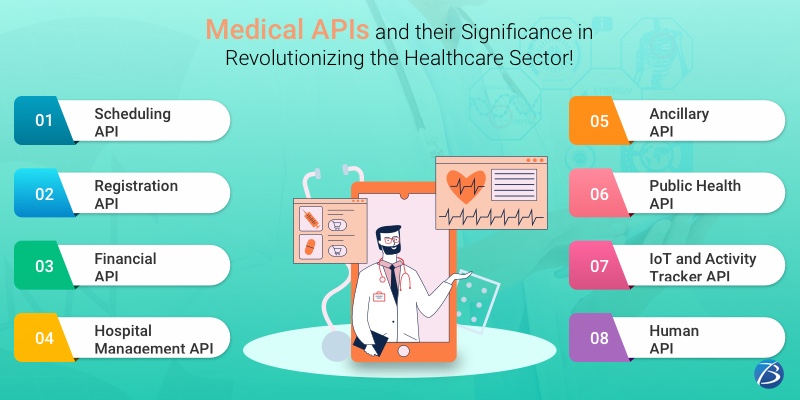
Scheduling API
The appointment scheduling feature is one of the most liked, rather mandatory features of the new-age medical apps. Scheduling API comes with features meant for incorporating the appointment booking feature, cancelling or rescheduling appointments, sending reminders, synchronizing the available slots with the calendar, etc. in the medical apps or software systems.
Registration API
These APIs are utilized for handling the functions related to registration processes involved with various EMR/EHR systems. These APIs can be embedded with EMRs for exchanging patient-specific data. Both patients and physicians will be able to easily register using the Registration API.
Financial API
As the name suggests, this API is used for managing money transactions between patients, medical institutions, pharmacies, or insurance agencies. It helps to generate invoices and bills, send prescriptions, and also manage claims related to insurance. It can further be narrowed down as claims API or billing API, depending on the functions it is used for. However, the healthcare app development firms must make sure that they choose the financial API that has robust security features.
Hospital Management API
This API is purposed to managing clinical data exchanges and other related operations within a medical facility. This API helps in sending and receiving medical information from various units as and when required. This information covers patient records, immunizations, treatment plans, family medical history, etc. Clinical API is another API used for performing similar kinds of tasks.
Ancillary API
There are several processes in a medical facility that lie outside of the organization; for instance, pharmacies, laboratories, radiology units, etc. Using the Ancillary API, the concerned healthcare professional can communicate with these external units, refill the requests with them, and also gather the required data from them. A good example of this is when a hospital wants to exchange some medical information like prescriptions with external pharmacies and refill requests. Ancillary API can be helpful in this scenario.
Public Health API
Such APIs are utilized for exchanging reportable clinical data records with the professional, public, or federal registries, and also with research institutions. Public Health APIs can also be employed for gathering public health records in the scenario of a rampant widespread threat like the ongoing Coronavirus Pandemic. Due to their ability to easily exchange data, these APIs can also be utilized for public health surveillance from data systems like EHRs.
IoT and Activity Tracker API
Wearable Health apps use these APIs for data collection from several IoT-enabled devices like activity trackers, wearable devices, etc. Such data streams help in the monitoring and management of personal health, especially for fitness enthusiasts.
Human API
This API is usually employed by doctors and physicians for viewing test results, prescriptions, patient profiles, and similar other important records. This helps the doctors to access the medical data easily, save time and money, and refrain the patients from longer wait times during appointments.

Some API Challenges

Though APIs have resolved the interoperability issues to a great extent, there are still a few technological gaps.
Since there is a lack of data standards in the healthcare sector, it is essential to create customized APIs that aptly caters to the needs of the concerned service.
In case a system incorporates myriad APIs, then data transformation into a readable format could take several months or even years.
Furthermore, when there are multiple APIs in a system, it can become tedious to manage those APIs, especially when the systems need to be replaced or upgraded.
Testing of these APIs could pose another challenge because healthcare systems usually deal with complex data; which at times, may not be replicated in the testing environments.
There could also be challenges in the privacy and security of the medical data and so, the APIs must be developed to provide safe data storage and exchange, using technologies like Blockchain, encrypted protocols usage, advanced authentication, etc.
Experts have also predicted that there could be some financial concerns, lack of proper documentation, lack of tools for designing, testing, etc.

The Future Scope of Medical APIs and Interoperability

Though there are several challenges coming up, medical APIs are going to be the key when it comes to interoperability and data security. Needless to say, medical APIs have a bright future. Besides, the data exchange laws of the 21st Century Cures Act, are supportive of these APIs. They encourage the proliferation and standardization of these APIs. So, it is expected that healthcare APIs will expand and develop to deliver the best possible services to patients as well as service providers.

Final Words:

It’s evident that medical APIs can boost the communication, overall performance, and efficiency of healthcare organizations. It is expected that these APIs in healthcare will expand to enhance the patient experience, connect healthcare providers to complete data, enable the patients to easily and safely access their medical records, etc. and thus, be advantageous to every medical & healthcare application development company competing to deliver the best services. So, medical APIs are the future of this sector..
With this, I would like to wrap up my article. Do share your views and experiences about the medical APIs in the comments below.