An Overview of On-demand Apps: Types, Features, Development Steps and Costing!

An Overview of On-demand Apps: Types, Features, Development Steps and Costing!

On-demand app development Services
The first on-demand app model was designed for Uber- the world-famous taxi booking app. Who knew that this concept of delivering services on-demand to the customer would make the business world go crazy?
Many ask whether this is just a bubble. Whether is this just a short-term trend? Will this trend slow down soon?
But today, these fast, reliable, and user-friendly on-demand apps are present everywhere. The on-demand economy has disrupted almost every business sector whether grocery, healthcare, home renovation, and many more, and there is no sign of stopping.
So, if you want to gain detailed insights about it or want to know how to approach the creation of a futuristic on-demand app, this article is for you. Here, I have discussed the on-demand app types, working, features, pricing, the development process, and much more. Let’s dive deeper into the topic.

How does an On-demand Application Work?

  • Consumers place a request for the products/services they want
  • The app then connects the consumers with the concerned service provider
  • The service provider looks over the consumer request and accepts it
  • Consumer confirms the address, contact details, cost of the service, etc.
  • Payment is authorized.
  • The service provider delivers the product/service.
  • The consumer does the payment if the ‘Cash-on-delivery’ option was selected

Types of On-demand Apps in the Market with Examples

Taxi and Travel-related Apps:

This domain has benefitted the most from the on-demand economy. Giant players like Uber, Lyft, Curb, Free Now, Airbnb, Booking.com, etc., are helping the users to avail the taxi services using their smartphones.

Food Delivery or Restaurant Apps:

Using these apps, the users can order meals from their favorite eateries nearby. These apps help restaurants to expand their customer base online. UberEats, GrubHub, Doordash, Zomato, etc. the well-known examples of these apps.

Healthcare Services On-demand Apps:

Healthcare apps like Doctor on-demand, IsDocin, Medicast, Phlex65, etc. are some of the on-demand healthcare apps that help patients to hire doctors, physicians, caregivers, or even order medicines online.

Home Services Apps:

Applications like TaskRabbit, Thumbtack, UrbanClap i.e. Urban Company, Merry Maids, etc. are being widely used for hiring services or individuals for carrying out tasks like household chores, dog walking, repairs, plumbing services, etc.

Grocery Apps:

Now people can easily purchase groceries using the apps like Instacart, Amazon Fresh, Walmart, Dumpling, Shipt, etc., and get them delivered to their homes. The usage of these apps has sky-rocketed, especially during the pandemic.

Other On-demand Apps:

Other examples include Treatwell- for salon services nearby, SweatFlix- for exercising and fitness classes, BloomThat- flower delivery services, Starz- an app for downloading movies, shows, etc.

Key Features of an MVP Model for the On-demand Apps

Before hiring an on-demand app development partner, it is always better to decide the potential features to be included in the app. Here I have mentioned are the MVP features required for creating a basic but impactful version of the app. Since there are three versions for any on-demand app, viz. customer app, service provider app, and Admin app, I have accordingly jotted the features.

Customer Version

  • Simple Registration and Profile Creation
  • Push Notifications
  • GPS Tracking
  • Flexible Online Payments
  • Feedback and Rating System
  • Support and Customer Care Services

Service Provider’s Version

  • Simple Registration and Profile Management
  • Buttons for Accepting/Rejecting Orders
  • Push Notifications
  • Button for Online/Offline Status
  • Dedicated Page for Earnings

Admin’s App Version

  • Admin Dashboard
  • Accessibility to Customer’s and Service Provider’s Data
  • Authority to Change Rates and Fees
  • Analytics and Reports

Significant Steps for Architecting a Top-class On-demand Application

Do Your Research

Before getting into the development straight-a-way, it is of paramount importance to do your research well. Research helps you know your target audience better, their preferences, behavioral patterns, etc. Also, research about the ongoing trends, competitors, etc.

Pick the Desired Features and the Relevant Technology Stack

Decide the features you want in your app; you can refer to the above-mentioned list of features for this. But, it is essential to include at least the basic features like registration, GPS, payment, notifications, etc. in the app.
Also, pick the right technology stack for frontend development, backend development, database, web or native (iOS/Android platforms), or cross-platform development, etc. as per your budget.

Hire the Right Development Firm

Finally, it is time to either hire an in-house development team if you are looking for a long-term project or you may even look for an offshore app development company for the project.

Estimated On-demand App development Cost and Pricing

Predicting the exact price for an on-demand app is a tedious job because every project has different specifications and requirements. Besides, the price is affected by various factors like design complexity, features to be embedded, technology stack, platform/s selected, the development team working on the project, etc. So, here I have roughly bifurcated the cost of an on-demand application, take a look.
  • An on-demand app with the fundamental features can range from $20,000 to $40,000.
  • An app with a few moderate features can cost anywhere from $40,000 to $70,000.
  • A full-fledged on-demand app with several advanced and robust features could approximately cost from $70,000 to $150,000 or so.

Final Words:

Needless to say, on-demand delivery apps are the future. They have offered unimaginable flexibility to the consumers for availing a wide range of services, from the very comfort of their homes and this flexibility has made them addicted to these apps. Besides, this economy has empowered diverse businesses and helped them expand their horizon.
So, when are you leveraging the on-demand economy?
Do comment here and let me know your thoughts on this.
Also, share your experiences in case you have already developed on-demand app projects.


Offshore Software Development Process: All You Need to Know!

Offshore Software Development Process: All You Need to Know!
Offshore Software Development Process
The concept of ‘offshoring’ software development projects has been widely adopted ever since its inception. This approach is indeed a lucrative strategy to the path of success. But why?
Well, today most software providers are based in the U.S.A. and Western Europe. However, the development infrastructure expenses and labor costs in these countries are humongous. Consequently, it becomes increasingly challenging for businesses to cope with the dynamic and competitive market. As such, Offshore Outsourcing becomes the most viable option.
The concept of offshore outsourcing is quite complex to comprehend and often baffles entrepreneurs, particularly start-ups. So, I have penned down an all-inclusive write-up on the myriad aspects of offshoring software development projects.
Let’s commence!

Offshore Software Development: In a Nutshell

Offshore software development refers to opening up a new software development center in other countries and hiring dedicated technical professionals for this offshore development center. Employees in this company hold permanent employment just like the local employees and the only difference is that these employees are located in other countries.
Companies adopt this strategy to reap the benefits of cheaper operating costs, a huge talent pool, and the opportunity to scale speedily so that they can optimize their output and enhance their technical proficiency without having to encounter hassles or incur huge expenses.
As per research by Statista published in July 2021, it has been observed that India turns out to be the most preferred location for hiring offshore business services.
This is because an offshore software development company in India promises lower wages and easy availability of skilled professionals in comparison to Western Europe and Asia.
To cite an example, software tycoons like Google, Apple, and Microsoft have set up their R&D centers in Bangalore, India, termed the Silicon Valley of Asia.

Offshore Software Development Outsourcing Models

Fixed-price
Under this model, the client firm and the development team/company decide a fixed price as well as the timeline for project execution, and any new client requirement is usually re-evaluated concerning costs and timeframe. This approach works best when both sides are clear about the specific project needs and there are hardly any chances of deviation regarding requirements.
Dedicated Team and Resources
This model involves the outsourcing agency assigning a skilled development team for the client company and this team is treated as the client’s employees who are working remotely. This approach is suitable for long-term projects wherein the client intends to hire software developers in a flexible manner; usually for creating software with scalability scope, or for maintenance after product development.
Time and Material
As per this outsourcing model, the client makes the payment based on the resource utilization – hours of work and materials used. This approach is implemented when the client is unable to define the project needs clearly, or when a trial is being developed before crafting a full-fledged app.

When should you opt for Offshore software Development over In-house Hiring?

Hiring an outsourcing team is the best option under the following circumstances.
  • Your budget is limited and you are looking for cost-cutting.
  • Your region faces a dearth of the required expertise needed by your software development project.
  • Your in-house professional team is too busy working on other important projects.
  • You desire faster product delivery and strict adherence to timelines.
  • You wish to leverage the most recent technology stack for your project and you have to hire experts for the same.

Picking the Right Software Outsourcing Agency: Factors to consider

Hiring the wrong team will create roadblocks in your path to success. So, choose wisely. Check out the major aspects to consider while you outsource your project to an offshore team or partner with a software solutions provider.
  • Obtain the assistance of an experienced technology expert from your side while hiring an offshore team.
  • Check the firm’s profile by evaluating earlier/ongoing projects, testimonials, blog posts, case studies, etc., and review references on business listing portals like Clutch; to gauge their overall proficiency.
  • In case you have a distinct app idea, ensure that the outsourcing firm signs a non-disclosure agreement (NDA).
  • Mention the technologies you would like to use in the project and clearly define the expected outcome.
  • Select the right offshore development model – development centers, dedicated teams, or project-based contracts – depending on your project requirement.
  • Maintain sound communication with your service provider by being in touch, providing the necessary guidance, and exercising control over the development process.
  • Make sure the partner firm provides support and maintenance services post-development. This way, your software is regularly updated to the recent versions and thus retains its value.

Offshore Software Development Services: Business Benefits

Offshore Software Development
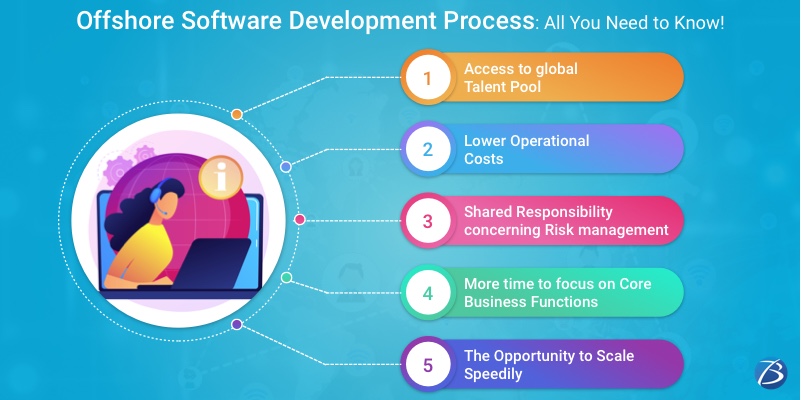
Access to global Talent Pool
Entrepreneurs enjoy access to a huge pool of talented, qualified, and experienced software professionals across the globe. These professionals are not only proficient in the latest technologies, but also keep their skillset updated from time to time as per the technical advancements.
Surprisingly, many developed nations like the U.S. suffers from IT talent scarcity; whereas popular outsourcing destinations like India, China, Vietnam, etc. possess a pool of software engineering expertise.
Lower Operational Costs
Offshoring the product development process comes with the promise of much lower operational costs as compared to hiring an in-house team; owing to lower wages of employees. Moreover, you don’t need to spend on additional expenses like office space, software licenses, equipment, utilities, and recruitment processes.
Shared Responsibility concerning Risk management
Managing risks effectively while executing software development projects is a crucial factor in determining success, and should not be undermined. And the good news is that risk management becomes a shared responsibility when a project is offshored. Besides, the risks involved in the developmental process can be handled in a better way by the offshore company as it happens to be a part of its core business.
More time to focus on Core Business Functions
Unlike in-house hiring, you need not be accountable for every minute detail of the product development process as the vendor manages all important functions right from recruitment to product delivery. As such, you find more time to focus on core business activities like establishing a robust client base or interacting with business partners.
The Opportunity to Scale Speedily
It’s quite challenging to hire in-house professionals as it involves time, effort, as well as significant financial risks; resulting in work overloading, compromised product quality, and losing clients to competitors.
Outsourcing averts such crises situations as payrolls are lower and the firm is able to shoulder down periods effortlessly. Additionally, it helps in scaling up the team and the project speedily without much ado. This leads to readiness for tackling more projects and hence opens up new opportunities for your business.

Profitable Outsourcing Locations

India
India is the most lucrative location for offshoring software projects amongst all other destinations. The reason is it offers a pool of skilled developers and highly trained experts with fluent English language skills, and a comparatively lower cost of project development.
Eastern Europe
For businesses based in Western Europe, nearshoring software services to Eastern European countries is a viable option. It is useful for businesses that need continual real-time collaboration with their in-house workforce.
Latin America
Outsourcing projects to Latin America works well for companies based in North America. This is because their time zones are almost similar which enables client firms to manage projects in real-time and to establish effective communication with their offshore team.

Final Thoughts:

I hope this post has provided you comprehensive guidance on all aspects of the offshore software development process. This profitable approach is sure to empower your upcoming project with a proficient development team, high-quality codes and ensure a quick developmental cycle. So, think wisely and act smart!
Are you having further queries or looking for assistance? Contact us!