How to Migrate Chat Applications from Layer to Firebase?

How to Migrate Chat Applications from Layer to Firebase?
Chat applications
This blog post talks about how we migrated from Layer to Firebase in our existing chat application and what were the challenges we faced during this migration process. It will be quite helpful to mobile app developers while migrating the chat mobile apps or any existing apps with chat functionality. So, let’s look into the detailed process.
We had used Layer Android SDK for integrating chat functionality in one of our new-age messaging apps. This app has features like real-time 1 – 1 and group chatting, audio messages, recalling messages, Facebook messenger integration, payment gateway and military-grade security. The app is about 3-4 years old and is live on play store with a large number of paid users.
Layer provides SDK’s and API’s to implement real-time chat functionality in mobile applications. It helps to implement real-time 1 – 1 chat and group-chat functionalities. Since, Layer had shut down on October 30th, 2019, we had to migrate our chat functionality on this messaging app to Firebase platform by migrating all old users’ data from Layer to Firebase.

Why we Migrated to Firebase?

The major reason behind migrating from Layer to Firebase is the shutdown of Layer Platform. To keep all the mobile apps with chat feature and chat apps that we developed running properly without any hassle, it was essential to migrate from Layer to another platform. So we chose one of the best platforms- Firebase.
Firebase provides two cloud-based database solutions that are client-accessible and support data syncing in real-time:
  1. Cloud Firestore
  2. Real-time Database
Cloud Firestore provides better scalability, and performance for web, mobile, and server development from the Firebase framework. It is a cloud-hosted NoSQL database. It can be directly accessed via native SDKs for iOS, Android, and web apps. It is also available in native Node.js, Python, Java, and Go SDKs, along with RPC-based and REST-based APIs.
Cloud Firestore can keep all your data in sync for different client apps with the use of real-time listeners. It can provide offline support for web and mobile for developing responsive apps that can work efficiently despite issues like internet connectivity or network latency.

Migration Steps we Followed

1) Design Firestore Structure Model:
Cloud Firestore is a NoSQL database and it is document-oriented where the data can be stored in documents that are organized into collections. Each document contains a set of key-value pairs. We designed the Firestore database structure as per our old data structure present on Layer.
2) Migrate Existing Data from Layer to Firebase:
To migrate chat data from Layer to Firebase, we created a script which helped to fetch data from Layer using Layer APIs and uploaded it to Firestore as per our data structure. Layer provided data in JSON format and we converted that JSON format data to Collection and Document format.
3) Firebase SDK Integration and Development:
We integrated the Firebase Android SDK to work with Firestore. Then we implemented chat functionality for existing users and for new users as well.

List of Chat Functionalities we Implemented:

1) Basic Chatting Functionalities:
  • Text
  • Image
  • Video
  • Audio
  • Image with Text
  • Video with Text
  • Audio with Text chatting
2) Offline Chat Support:
3) Message Features:
  • Search
  • Filter and Sorting
  • Clear All
  • Mark/Unmark
  • Delete
4) Message Settings:
  • Do not view messages older than a certain number of days
  • Automatically download photos and videos (Wifi only/Wifi and Mobile)
  • Automatically save received photos and videos to photo gallery
  • Set maximum video upload size

Challenges we Faced while Migrating from Layer to Firebase:

1) Designing a Proper Data Structure:
Designing a proper data structure in Firestore was a big challenge as we had to consider the smooth working of functionalities like search, sort, filter, unread message count and also ensure that data is stored in Collections and Documents.
2) Migrating Data from Layer to Firebase:
Converting JSON data retrieved from Layer to Firestore in Document and Collection format was one of the challenges we faced. Also, the size of Layer data was quite big which consisted of text, audios, images, and videos. We did this step-by-step by first migrating data of most active users and subsequently all other users.
3) Syncing data from Firestore to Android App Local Database:
Another challenge we faced was about syncing the migrated data from Firestore to the local Android app for both online and offline support, especially when the user opens the app for the first time after migration. Here in some cases where the size of users’ conversation was large, it took quite a bit of time to sync the data. Hence to overcome this issue, we synced first just the conversation list and after opening actual conversation, synced messages within that conversation.
Hence to overcome this issue, we synced first just the conversation list and after opening actual conversation, synced messages within that conversation.

The Bottom Line:

Due to Layer shutdown, many applications had faced issues with their chat functionality and hence it was necessary to migrate their implementation from Layer to any other platform. As a prominent mobile app development company, Biz4Solutions has good experience not only in chat application development, but also in migrating the chat functionality of existing apps from Layer to a robust platform like Firebase.
So, do you also want to migrate any of your applications from Layer to Firebase? Reach out to us today! We have a team of highly skilled mobile app developers and technical experts trained for solving various critical software solutions.

The rising Popularity of Location-based Apps and their Business Benefits!

The rising Popularity of Location-based Apps and their Business Benefits!
Conceptual-  location based app

Imagine a scenario when individuals are on a road trip to some remote place, and they encounter sudden adversities like an accident or a blown tire. Next, they call for assistance; but have a hard time communicating their present location and providing route directions as the place is unknown to them; resulting in delayed help. In such situations, location-based applications come to the rescue as these track down the exact location of the smartphone user, without the need for giving directions, enabling the help services to reach quickly.
How about a situation when one visits a foreign city and faces difficulty in finding a grocery store or a food joint? Well, location-based intelligence helps in speedily locating the desired store!
This distinct capability of location-based services (LBS) – finding out the location of the user and provide services accordingly – helps consumers to overcome myriad roadblocks encountered in their daily lives. As these apps continue to rise in popularity, businesses across diverse sectors are focussing on Location-based App development. As per a report published by “RESEARCH AND MARKET”, the LBS market was valued at 44.47 Billion USD in 2020, and is predicted to reach 155.13 Billion USD by 2026; as it’s expected to expand at a CAGR of 23.4% between 2021 and 2026.”
Let’s dig into some crucial insights on the rise of location tracking apps and peek through the reasons to incorporate a location-based app for your business.

Functioning of Location-based Services

Location-based Services utilize the smartphone’s GPS technology for tracking its users’ location if that particular user has allowed the GPS service on his phone. Once smartphone users opt for this service; LBS will identify their location, even the street address they are in, without users having to enter any data manually. LBS establishes two-way communication between the service provider and app users. After receiving the necessary data concerning the users’ location, their requirements, and preferences; customized information is provided to them.
Location-based apps like Instagram (Social Networking), Uber (Transportation), Pokemon Go (Gaming), etc. have radically transformed their respective sectors. Take a look!

Top Industrial Domains Leveraging Location-based Services

Retail
LBS-driven retail apps help consumers to find a nearby store or select a favourable pick-up location. Physical retail stores employ this technology to enhance the in-store experience of customers by:
  • Providing the indoor navigation feature in the apps employing Beacons
  • Sending personalized notifications to would-be customers the moment they enter the vicinity of the store.
Biggies like Target and Walmart have successfully implemented this approach.
Automobile
Geo-location apps have simplified things for customers as well as the owners of logistics, public transportation, cab services, and travel firms in the following ways.
  • Effortless fleet management
  • Updates to passengers about the real-time status and delays in vehicles.
  • Tracking the real-time location of customers using gps services available in cab service application.
On-demand delivery
On-demand delivery apps owe their whopping success to LBS as orders and couriers can be tracked in real-time. Moreover, users can effortlessly find the providers for the services they are looking for. On-demand Salon app, On-demand home services app, etc. are some examples.
Gaming
Gaming apps like Scavify and Pokemon Go have successfully integrated smart technologies like VR and AR with LBS to offer a realistic experience to gamers.
Travel and Tourism
The tourism apps leverage LBS to notify tourists with real-time updates, and also help them to find hotels near specific sights or landmarks. Airbnb, hotel chain apps like Marriott, etc. are noteworthy examples.

Business Benefits of Location-based Apps

Location-based App for your Business
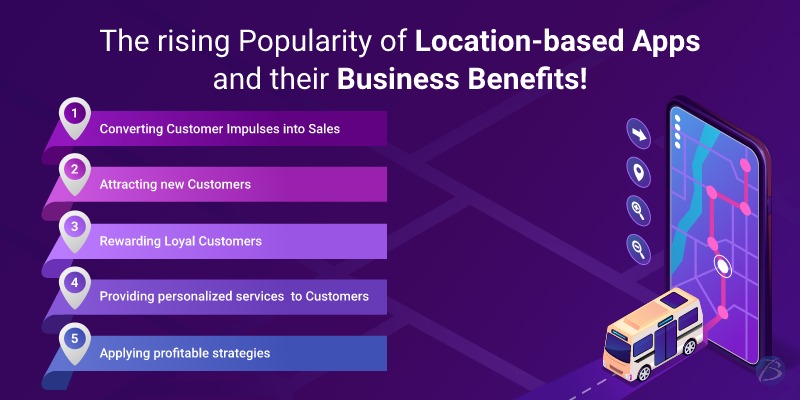
Converting Customer Impulses into Sales
The location-based technology helps businesses to approach the consumers at a time when they are most likely in the vicinity of the store or buying a product online from a specific location. Therefore, when customers are in proximity to your store, it is possible to convince them to purchase from your store. How? For example, it’s raining outside and a passerby has an impulse to buy an umbrella. At this moment your location-based message of offering umbrellas at discounted rates pops up on his/her smartphone!
Attracting new Customers
LBS strategies can effectively convert online traffic as well as foot traffic; by persuading visitors to try your products/services for the first time. This can be done by offering special offers for first-time check-ins or purchases. Once a customer gets converted, engage them by offering top-quality services.
Rewarding Loyal Customers
LBS enables you to track the check-ins and thus identify loyal customers. Then, you can easily retain them by offering free coupons or attractive offers. For instance, when a customer downloads a taxi app and books a cab, his/her details are registered with the business. This allows the business to send SMS to the customer regarding special offers.
Providing personalized services to Customers
Modern customers prefer personalized deals. So, business brands employ location-based marketing platforms to recognize the personal preferences of customers, through detailed tracking of their movements, shopping activities, etc. The current location and behavioral data of users allow brands to deliver personalized messages to the right set of audiences at the apt time and place. For instance, hotels can elevate customer experiences by sending welcome messages and providing offers in the form of coupons, room up-gradation, spa offers, etc.
Applying profitable strategies
Geo-location-powered apps allow businesses to try unique strategies for boosting sales. For example, a restaurant usually suffers very low sales after lunch hours and the owner wants to offer discounted prices for snacks and light refreshments during that period. The smartest way to implement this strategy is by sending discounted rate notifications to persons passing by that restaurant at that time.
Key Takeaways
Its high time businesses should harness the potential of location-based apps to attract customers and expedite sales.
Looking for Location-based App Development Services? The adept professionals at Biz4Solutions, a prominent Location-based App Development Company, will guide you all through your journey.