Best React Native Developer Tools for designing Exceptional Apps in 2021!

Best React Native Developer Tools for designing Exceptional Apps in 2021!
React Native Developer Tools
Software firms across the globe have the privilege to choose from hundreds of libraries, tools and frameworks; while executing the process of mobile application development. However, despite the availability of innumerable options, React Native by far has become one of the most preferred choices of corporate enterprises and mobile app development companies. The reason behind its popularity is the extensive benefits offered by React Native development! Right from a simple learning curve, code re-usability, cross-platform development, high-speed development, support from a vibrant community, to the creation of native-like applications; this framework has a lot to offer. And, when we talk about its technical offerings, React Native developer tools just can’t be ignored. These tools are some of the most vital elements of React Native App Development Services.
So, this blog is all about the top-notch React Native tools available in the market. These are widely used by almost every React Native app development company out there. So let’s have a glimpse at a few of them.

8 Popular React Native Developer Tools to Know and Use in 2021

React Native Developer
1.Visual Studio Code
Released in 2015 by the software giant Microsoft, Visual Studio Code is lightweight; yet a robust source-code editor. It is open-source, free to use and is written in JavaScript, CSS, and TypeScript. It works well with platforms like Windows, Mac, Linux, etc.
Visual Studio Code comes with in-built support for technologies like Node.js, TypeScript, and JavaScript. Besides, it has a huge ecosystem of extensions to support languages like C#, C++, Python, PHP, Java, Go, etc. It also supports runtimes like Unity and .NET.
2. Android Studio
As the name suggests, this tool enables React Native development for Android. Android Studio 4.1 was the major release. The recent version of Android Studio comes with features like Kotlin DSL support in Android Gradle plugin, newer database inspector, allows running of android emulator inside Android Studio, visual layout editor, faster emulator, APK analyzer, flexible build system, smart code editor, real-time profilers, and much more.
3. Xcode
Xcode is Apple’s integrated development environment (IDE) that contains several software development tools for building apps in iOS, MacOs, etc. This is a perfect pick for creating powerful React Native apps for iOS. It is also a great tool for debugging and installation of iOS packages. Recently, Xcode 12 was released by Apple which comes with all the more fascinating features like customizable font sizes for the navigator, new document tabs, redesigned organizer, improved code completion, enhanced auto-indentation, etc.
4. Redux
Written in JavaScript, Redux was developed by Andrew Clark and Dan Abramov and released in the year 2015. It is an open-source tool commonly used with libraries like React, Angular, etc, for developing user interfaces. It is a very small tool whose file size accounts for hardly 2kB including dependencies. It helps in the creation of apps that run in different environments like native platforms, front-end, back-end, etc, and are quite easy to test. Also, it offers features like a time-traveling debugger and live code editing. As a result, it is highly recommended that React Native development services should use this tool for their projects.
5. React Native Debugger
This tool is like a standalone desktop app that goes well with Windows, macOS, Linux, etc. It is probably the best debugger tool for React Native developers when they are already using Redux. It comes with default React’s Developer Tools and Redux DevTools embedded in it. Also, it is possible to edit the UI and inspect React Native elements using this tool.
6. React Navigation
React Navigation is written in JavaScript and is quite popular amongst the developer community as it enables them to establish the navigation and routes in the native apps with the help of navigators like Drawer, Tab, Stack, etc. It is an easy-to-use tool that is highly customizable and also provides Extensible Platforms. It is used for developing alluring components for both platforms- Android and iOS.
7. React Native CLI
Being the official CLI for the React Native framework, React Native CLI is an MIT licensed tool. This tool provides an original method for bootstrapping for creating a React Native app using the command line. This method is required if the React Native developer needs to access the native layer of the app. It is extensively used for the automation of tasks such as starting the packager, linking, creating the apps, etc. It is used as a debugging tool as well sometimes. It supports custom configurations. For instance, it can be used for the installation of React Native project pre-configured with a particular package such as TypeScript or even complete boilerplates.
8. React Native Tools
It is also a free tool developed by Microsoft but kind of an extension of the Visual Studio Code. This tool provides a supportive environment for developing as well as debugging the React Native projects. It allows debugging styles in React Native and also enables debugging for React components, making it one of the best debugging tools. Besides, it runs the react-native command with the use of a “command palette.”

8 Additional React Native Tools explained in Brief:

1. Nuclide: Nuclide is a free and open-source tool that is highly customizable and helps React Native developers to make improvements in the code. Its top features include – context view, working sets, remote development, a task runner, quick open, health statistics, a debugger, code diagnostics, etc.
2. Bit: his tool is quite useful for the creation of advanced React Native component libraries. It resolves issues related to collaborating and sharing UI components across different repositories.
3. Expo: This is an open-source tool-chain that has its own CLI and offers easy-to-use components and APIs. It also provides several services like accelerometers, real-time updates, fine documentation, powerful community support, etc.
4. React devtools: Though this tool is more concerned with React and Reactjs, it is also useful for debugging the React Native code. Also, its latest version provides support for inspecting React native styles, live editing, etc.
5. Vim Editor:This tool comes with a highly configurable text editor and provides a complete set of features for designing React Native apps. It is easy to work with and helps in effectively changing any kind of text.
6. Sublime Text:This is another amazing text editor that has numerous plugins and functionalities for app development. It also has features like “Goto Anything” for faster navigation to files, lines, symbols, etc. Other goodies that Sublime Text offers are “Command Palette” and support to multiple programming languages and markup languages.
7. Jest: Developed by Facebook, it is actually a testing framework for JavaScript but also works well with React Native, especially for functions like unit testing. Its features like Built-in code coverage, zero-configuration, and snapshot testing make it a rich tool.
8. Reduxsauce: This tool is helpful to the developers when they work on Redux codebases and need to create Reducers and Actions in Redux.
Final Words:
The React Native developer tools that we have mentioned in this blog play a significant role in not only building captivating apps but also in accelerating the development process to a great extent. These are some of the finest tools and React Native Developers need to have the fundamental knowledge of at least the ones noted here.
Along with these tools, the knowledge of React Native component libraries is an add-on. For detailed insights on these, please have a look here .
Has this blog been helpful to you?
Please let us know your thoughts in the comments section.
Also, share with us your experience of using React Native app development tools.

Best Countries to Consider for Offshore Software Development in 2021!


Best Countries to Consider for Offshore Software Development in 2021!
Offshore Software Development Agencies
It was in the year 1989 when outsourcing i.e. offshoring the projects started becoming a popular approach, and today, in 2021, it has become an integral part of global business operations. This trend is growing exponentially. So, let’s have a glance at a few statistics on offshore development.
  • Before the Covid-19 pandemic, the market size for global offshoring services crossed $92.5 billion.
  • In the USA, every year almost 3 lakh jobs get outsourced.
  • During the pandemic too, outsourcing of IT services increased from 12.7% in the year 2019 to 13.6% in the year 2020.
  • IT outsourcing market is estimated to rise to $98 billion, at a CAGR of 5%, from the year 2020 to 2024.
  • About 46% of the firms who outsource the projects say that outsourcing gives them access to talented and skilled professionals who aren’t available in-house.
These estimations by Fortunly.com, a well-known portal for news, reviews, and market analysis, give us a peek into the rising scope of offshore software development services and their demand.
So, this blog gives you a deep insight into the world of offshoring as we have enlisted the top locations across the globe for hiring software offshore development firms. We will also share some tips on how to begin with offshore development. So, if you are an entrepreneur or a start-up company willing to outsource your software project, then this post is for you. Let’s begin.

List of the Best Outsourcing Destinations for Software Development
Software Outsourcing Companies
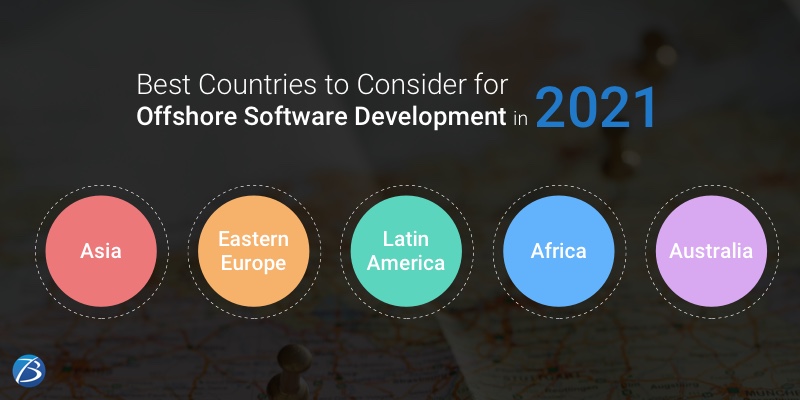
Asia
Asia is like a paradise for global companies to hire world-class offshore software development services. In Asia, there are approximately 7 million developers and the average rate of these offshore software developers ranges from $20 to $40 per hour. Below is the list of popular Asian countries for outsourcing:
  • India
  • China
  • Vietnam
  • Indonesia
  • Philippines
  • Malaysia
  • Nepal
  • Sri Lanka
  • Pakistan
  • Bangladesh
Out of these, India is one of the most popular destinations across the globe for outsourcing, due to its budget-friendly prices, availability of talented developers, advanced infrastructure, favorable government policies, etc. Today, the technology and engineering graduates in India are about 2.6 million. Furthermore, India consists of almost 5 million experienced software developers and their charges are comparatively lower ranging from $20 to $30 per hour. Due to all such reasons, today, approximately half of the fortune 500 firms prefer India.
Eastern Europe
East European countries possess a huge talent for outsourcing software services. There are more than 40 tech universities in Romania alone, producing 5,000+ software professionals per year. In Bulgaria, this number is about 3,500 graduates.
Overall, there are almost 1 million software professionals in Eastern Europe and they possess the broad commercial experience required for delivering world-class services. They are also equipped with the latest programming languages like JavaScript, Java, Python, and more. Their hourly rate is from $25 to $40. Besides, their convenient time zones, huge talent pool, cultural similarities, etc. make East European countries a top choice for outsourcing. A host of East European countries that outsource their services are listed below:
  • Ukraine
  • Czech Republic
  • Russia
  • Hungary
  • Belarus
  • Poland
  • Romania
  • Bulgaria
  • Estonia
  • Slovakia
Latin America
In recent years, Latin America has experienced a growing demand for offshoring its software services. The hourly rates of the developers vary from $30 to $55 per hour, depending on their work experience, and qualification. The countries in Latin America have similar time zones like North America and so, there is very little difference in time zone.
Here is the list of top offshoring countries from Latin America:
  • Brazil
  • Argentina
  • Chile
  • Costa Rica
  • Panama
  • Colombia
  • Peru
  • Mexico
Africa
Amongst all the destinations, African countries are the cheapest to hire offshore software developers as the hourly rates of the developers are lower than $20. There are approximately 20,000 software professionals in Africa. But a few professionals with good experience can even charge around $40 – $50.
Here is the list of African offshore development countries:
  • Egypt
  • Nigeria
  • Morocco
  • Kenya
  • South Africa
Australia
Australia has steadily emerged as a preferred zone for outsourcing software services. As compared to other Asian countries, Australia has a geographical advantage. Also, their native language is English, which is another huge advantage. However, the hourly rate of developers can be very high ranging from $100 per hour to $180 per hour.

Some Tips to Begin with Offshore Software Development

How to Start with Offshore Development?
While choosing the apt offshore destination for you, you first need to finalize your project requirements and then, choose the best-suited destination to hire offshore software developers. Next, you need to research for deciding the offshore company by looking for client reviews, the company’s specialization, their years of experience, company reputation, team size, etc. Also, before starting the project, you should have a rough picture of your project goals, the budget, and the timelines. This will help to avoid any miscommunication with the offshore team and help achieve the results as required.
Criteria for an Offshore Team
Here are some criteria that you should look for while selecting an offshore software development firm:
  • Technical education and expertise of the professionals
  • Ranking of software developers and their firm
  • Time zone and location differences
  • English language expertise
  • Experience in highly complex projects
  • Tech competency diversity

Final Thoughts

The outbreak of the Covid-19 Pandemic has brought a massive shift in the work culture and forced countless entrepreneurs to partner with offshore software development services for their development needs. And why not? Offshoring saves costs while delivering top-quality services and allowing businesses to focus on their core competencies.
So, in this blog, we have shared some of the top-notch locations for offshore development that will help budding entrepreneurs find the right tech partner for their projects.
So was this blog helpful? Do share your feedback with us.
For any assistance on hiring an offshore software development firm, get in touch with us.