Best-in-class IoT App Development Tools and Platforms in 2021!

A report generated in 2019 by Statista, a renowned online marketplace and research portal, estimated that the global expenditure on IoT will account for $1.1 trillion by the year 2023.
These astounding numbers are enough to understand why the scope for IoT app development has risen at a fast pace. Diverse industries like manufacturing, healthcare, transportation and logistics, oil and gas, and water industry, are heavily investing in IoT for architecting data-intensive applications with advanced analytics.
Modern-day applications like smart homes, or fleet management solutions, or traffic monitoring systems, or remote healthcare solutions are all based on IoT. Such cutting-edge IoT solutions require certain tools and platforms to function. These tools and platforms play an important role in bridging the gap between IoT devices and data networks. They also help in displaying real-time data, store huge data sets, manage devices’ boards, integrate back-office systems, and much more.
So, in this blog, we will provide detailed insights on some of the popular tools and platforms used for IoT app development solutions.
Noteworthy Tools and Platforms for IoT App Development!
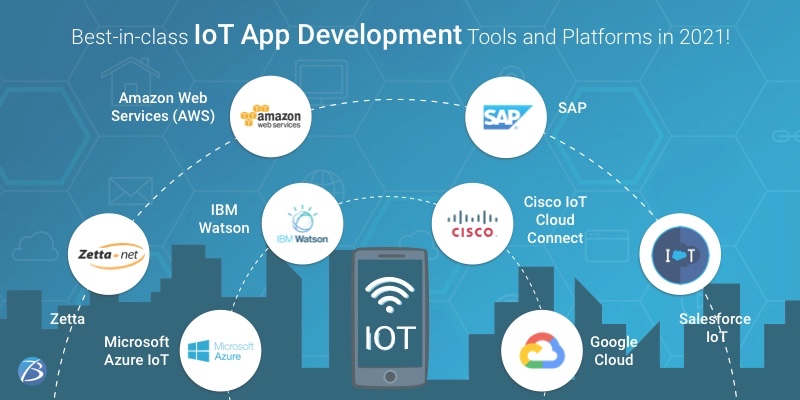
Microsoft Azure IoT
Microsoft’s Azure IoT Suite is a collection of several cloud services like:
- IoT Hub
- Machine Learning
- Power BI
- Stream Analytics
- Notification Hubs
This is a comprehensive platform meant for connecting and managing various IoT assets using various cloud services. It also helps in securing IoT applications. Its features include data tracking, system shadowing, identity registration, and a set of the rules engine. Besides, Azure IoT Suite is a great option for serving all types of business domains.
IBM Watson
This is one of the leading cloud-based platforms that excel in IoT app development. It is a well-designed platform used for secure data transmission, remote device control, cloud capacity for storage of high amounts of data, real-time data analysis, high-security features, risk management, etc. Along with IoT, IBM Watson also supports artificial intelligence and Blockchain services.
Cisco IoT Cloud Connect
Cisco focuses on providing a safe IoT platform to its clients for connecting various devices present at diverse geographical locations. Its IoT app development platform-Cisco IoT Cloud Connect supports functions like the below:
- data analysis
- app enablemen
- network connectivity
- tasks management and automation
- broad customization of IoT apps
- several adaptability openings
- voice and information correspondence
This platform assists power management, smart cities, industrial automation, transportation systems, and more.
Google Cloud
Google Cloud is an appropriately handled and combined provider of IoT services. It supports the handling of several IoT devices connected anywhere around the world and also helps in end-to-end IoT development. It comes with a highly advanced tool for getting real-time data and analytics. Furthermore, Google Cloud comes with functionalities like high security, business process optimization, cloud services, completely managed infrastructure, etc.
Zetta
Zetta is an API-based platform that makes use of Node.js. It is a complete toolkit employed for the creation of HTTP APIs for devices. This platform integrates REST APIs, WebSockets for developing data-intensive applications. The prominent features that Zetta offers are mentioned below:
- Runs on the cloud, on a PC, and also on some limited development boards.
- Runs on the cloud, on a PC, and also on some limited development boards.
- Converts any device to an API
- Allows the IoT app developers to assemble device apps, cloud apps, as well as smartphone apps in one place.
- Helps control sensors, controllers, actuators, etc. by featuring an easy interface and the necessary programming language.
Amazon Web Services (AWS)
Amazon Web Services aka AWS is another renowned IoT development platform available in the market. It is an exclusive framework platform that requires fewer efforts in the cloud. IoT app developers find this platform highly versatile and adaptable. Also, it is a cost-efficient platform, due to which it is one of the favorite choices of a host of global-level business enterprises.
Besides, IoT Device Management of AWS supports easy connection and expansion of the devices. Also, the administration ensures a safe and flexible execution with the results of monitoring, refreshing, investigating, etc. of the usability of the device.
SAP
This IoT development platform helps in remote monitoring and management of all the devices related to your IoT project. These remote devices like sensors, actuators, etc. can be connected either directly or with the use of a cloud application. It comes with a robust analytical ability which helps to sort out, make ready, and pay attention to the data collected from IoT devices such as sensors, meters, controllers, etc. With its latest updates, SAP enables using the IoT data for creating and combining AI applications.
Salesforce IoT
Salesforce IoT is a US-based platform. It is also a highly adaptable IoT app development platform and aims at opening the IoT data for all the users. This platform aids in the development of customizable IoT applications connected to any gadget and in representing its data for additional usage. Also, the “client first” approach of Salesforce is the reason that this platform is popular and stands out from its competitors.
Additional IoT Development Platforms
- Arduino: It is an open-source prototyping platform and is a great option for both- IoT software and hardware development
- HP Enterprise Universal: This is a highly scalable, versatile, and modular IoT platform that offers secure monetization, precise data assessment, cross-vertical operations, etc.
- Oracle IoT: This platform is known in different areas like enterprise software, cloud computing, database management, etc. for IoT solutions
- Kaa: It is a highly expandable and flexible IoT platform with features like data visualization, configuration management, data processing, etc.
- Particle.io: This is a comprehensive platform that offers IoT Rules Engineer, Device Cloud, Device OS, etc.
- ThingsBoard: It helps in device management, data processing, project visualization, etc., and ensures minimum time-to-market for the projects. Innumerable devices can be connected and measured with IoT protocols like MQTT, HTTP, etc.
Are You Interested in Building a Top-Class Website or Mobile App?
Key Takeaways:
Needless to say, IoT technology is here to stay for long. The connected devices and smart data analytics are already transforming the world in ways never thought. So, a plethora of IoT app development companies has emerged globally.
However, without the right set of tools and platforms, it isn’t really possible to design outstanding modern-age IoT solutions. The aforesaid IoT development tools and platforms will prove enormously beneficial to the IoT developers and companies altogether.
Our blog comes to an end here.
Let us know your views on this and also share with us any other tools and platforms that you came across in your projects.